

















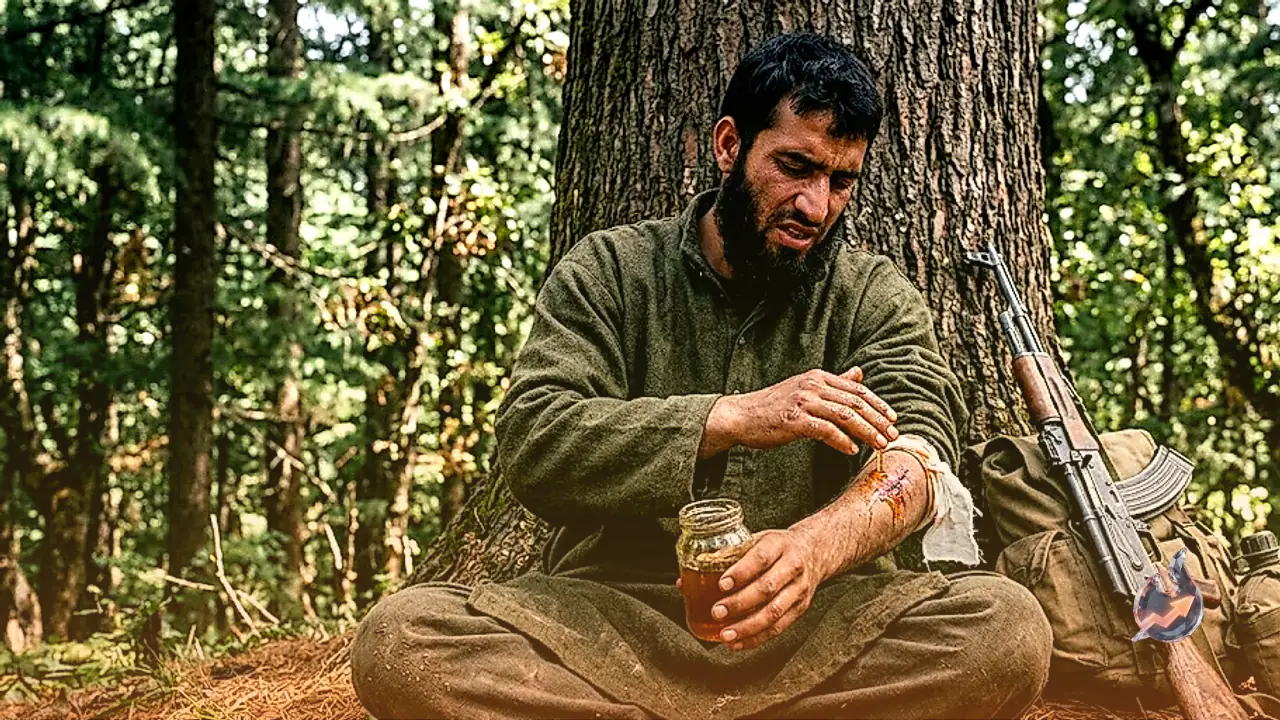

Security officials in Jammu and Kashmir have disclosed extraordinary operational details following the elimination of top Lashkar-e-Taiba operational commander Mohammad Asif, also known as Hashim Musa, during a high-altitude military operation in the Yusmarg area of central Kashmir's Budgam district earlier this week. Severely wounded during an earlier firefight and completely cut off from medical treatment due to an intense, multi-layered security cordon, Musa resorted to treating his bullet wounds with raw honey to prevent fatal infection while evading troops in dense forest hideouts. Officials identified Musa as a former commando of the Pakistan Army's elite Special Services Group (SSG) who went on to steer major operational strikes across the region.
Wounded During Operation Sheruwali in Rajouri
According to operational accounts from security officials, Musa sustained gunshot wounds during an encounter in the Dorimal-Gambhir Mughla belt of Rajouri district in Jammu. That engagement took place under Operation Sheruwali, a relentless tracking and search mission launched to hunt down two heavily armed terrorists that stretched for more than 45 days. Intelligence later confirmed that the two operatives holed up in the rugged terrain were Musa and his close associate Yasir. Despite intense cordon-and-search operations, the duo managed to survive in the dense forest belts of Poonch and Rajouri for an extended period, relying on covert wilderness shelters while evading tracker teams.
Photographs Recovered from Slain Associate Yasir's Phone
The unusual survival tactic came to light after security forces neutralized Musa's associate Yasir in the upper reaches of Yusmarg during the first week of September. A forensic examination of a mobile handset seized from Yasir's possession revealed several photographs documenting Musa's bullet wounds slathered with honey. Investigators found that these images had been transmitted across the border to handlers based in Pakistan to update them on the commander's physical condition and recovery. Cross-border handlers had also sent specific messages stressing that only pure honey be procured and applied to avoid complications and accelerate tissue recovery.
Ayurvedic and Scientific Insights into Honey for Wound Care
Explaining the medical properties behind topical honey application, Dr. RP Parashar, president of the All India Doctors Association of Indian System of Medicine, noted that Ayurveda has documented honey as a healing agent for centuries. Citing the classical surgical treatise 'Sushruta Samhita', he explained that under 'Vrana Chikitsa', honey is categorized as possessing Shodhana (cleansing) and Ropana (healing) actions. Contemporary biomedical research supports several antimicrobial mechanisms inherent to honey. Its high osmotic pressure draws fluid away from bacterial cells, its naturally acidic pH inhibits pathogens, and certain varieties produce hydrogen peroxide enzymatically, forming a hostile environment for bacterial proliferation.
However, Dr. Parashar emphasized that treating high-velocity gunshot injuries is fundamentally different from managing minor superficial cuts. Gunshot trauma typically leaves behind foreign debris, necrotic tissue, or microscopic bullet fragments that create deep anaerobic pockets prone to lethal infections. In formal clinical environments, only certified sterile medical-grade honey is utilized under strict aseptic protocols. Applying unrefined or contaminated market honey directly to an uncleaned bullet cavity in the wilderness carries severe risks of sepsis and cannot be regarded as a substitute for surgical intervention.
Veterinary Specialist on Honey's Osmotic Mechanism
Veterinary specialist Dr. Jehanzeb Sirwal corroborated the physiological mechanics of honey when applied to severe tissue trauma. He explained that honey acts as a potent hyperosmotic agent, drawing excess inflammatory exudate out of wounded tissue, facilitating the debridement of dead cellular matter, and reducing surrounding edema. He observed that people living in forested and remote rural belts have historically relied on honey as a folk remedy for burn injuries and deep lacerations, and the same traditional method is frequently applied to wounded livestock when veterinary drugs are inaccessible.
The End of a Five-Year Manhunt for a Lethal Commander
The elimination of Musa marks the culmination of an intensive five-year manhunt for one of the most elusive operational leaders in Jammu and Kashmir. Security records indicate his direct involvement in orchestrating more than a dozen lethal strikes targeting armed forces personnel as well as civilian infrastructure. Key attacks linked to his operational command include
- Bhatta Dhurian Ambush: In April 2023, an army vehicle was ambushed in the Bhatta Dhurian area of Poonch, resulting in the death of five soldiers.
- Kandi Forest Blast: In May 2023, an improvised explosive device blast during search operations in the Kandi forests of Rajouri claimed the lives of five elite commandos.
- Dera Ki Gali Ambush: In December 2023, military transport vehicles were ambushed in the Dera Ki Gali sector of Poonch, killing four soldiers.
- Air Force Convoy Attack: In May 2024, terrorists ambushed an Indian Air Force convoy near Sanasitar, leading to the death of one airman.
Shifting Focus to Civilian and Infrastructure Targets
In the latter half of 2024, Musa's network expanded its targets to include civilian infrastructure and construction projects across Kashmir. On October 20, 2024, armed terrorists assaulted a workers' camp associated with the strategic Gagangir tunnel construction project in Ganderbal district. The indiscriminate shooting resulted in the death of seven individuals, including a local physician and several project employees. Just four days later, another coordinated attack targeted an army vehicle in Butapathri, claiming the lives of two soldiers and two civilian defense porters who were assisting military logistics.
Mastermind Behind the 2025 Pahalgam Massacre
Security agencies further confirmed that Musa was one of the prime conspirators behind the catastrophic terror attack in Pahalgam in 2025. That assault unfolded across the scenic Baisaran meadow, where terrorists targeted unarmed visitors, resulting in the massacre of 26 people, predominantly vacationers. The Yusmarg encounter in Budgam has finally closed the chapter on the SSG-trained operative responsible for extensive violence across the Kashmir valley and Jammu frontier.