





















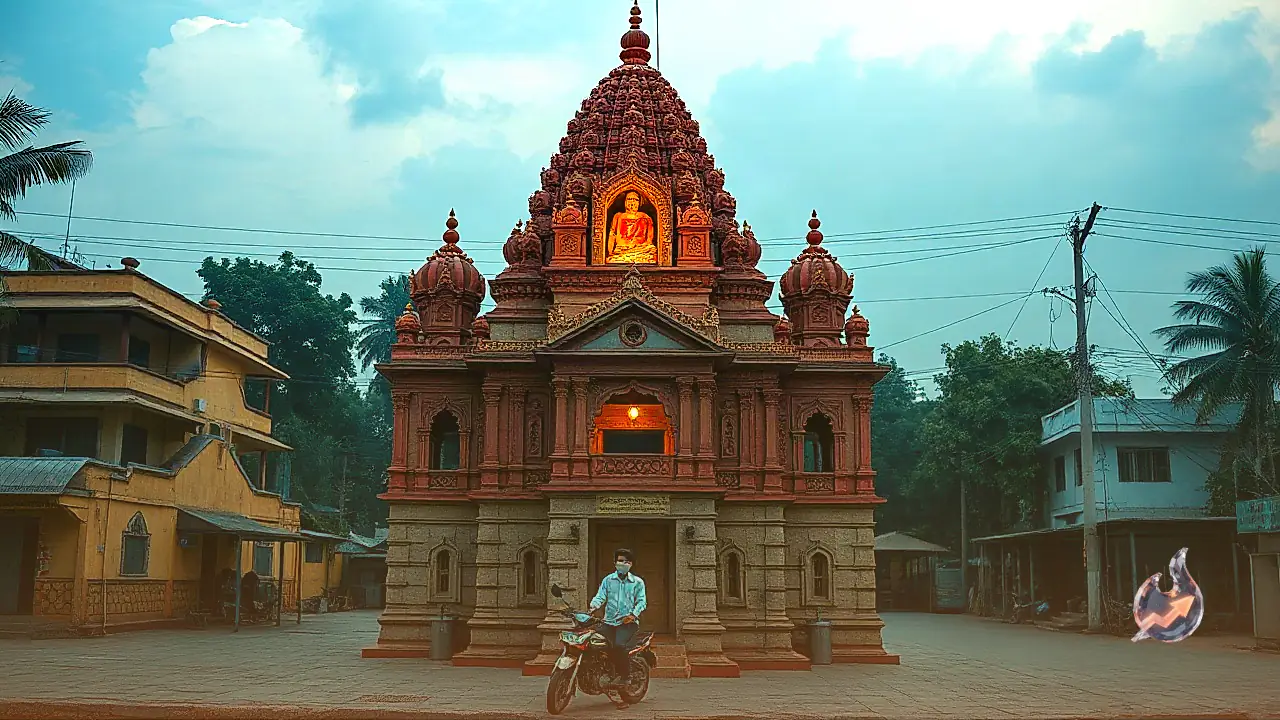

Located directly in the middle of Tatanagar Station Road in the industrial hub of Jamshedpur, Jharkhand, the Maa Bhagwati Temple has endured as a central landmark of spiritual faith for over a century. Spanning approximately 125 years of history, this shrine holds deep religious significance for local residents as well as thousands of commuters and long distance travelers passing through Tatanagar Railway Station. Positioned in the exact center of one of the city's busiest traffic arteries, the temple continues to stand firmly at its original location. Local residents and devotees view this persistence not as an urban anomaly, but as a reflection of divine power and blessings. Over the decades, the shrine has evolved beyond a simple place of worship into an enduring symbol of spiritual devotion, traditional belief, and documented community faith. Daily, visitors gather from early morning until night to seek blessings and offer prayers.
Swayambhu Origin and the Sacred Peepal Tree Narrative
According to traditional lore and local accounts, the deity of Maa Bhagwati inside the shrine was never crafted or formally installed by human hands. The core narrative surrounding the temple is that the deity is Swayambhu, or self-manifested. Historical accounts pass down the belief that the manifestation originally occurred from the trunk of a sacred Peepal tree present at the location. When early passersby and local residents began kneeling in prayer at the site to seek relief from personal hardship, they reportedly experienced swift resolutions to their problems. As prayers were answered over time, public faith expanded rapidly. What originally began as a modest worship spot beneath a Peepal tree gradually transformed into a major religious hub for the city.
Observations of the Priest and Devotee Convictions
Serving priest Pandit Ram Poojan Das notes that a defining characteristic of the shrine is the emotional and mental relief experienced by visitors arriving in distress. Devotees maintain an unshakeable belief that Maa Bhagwati alleviates the suffering of anyone who visits her altar with a pure heart and sincere intentions. This shared conviction has passed through generations, maintaining a strong bond between local families, regional pilgrims, and the sacred space. Visitors regularly describe feeling a profound sense of tranquility upon offering their prayers.
Persistence Amid Road Expansion and Infrastructure Growth
A notable aspect of the temple's modern history involves urban infrastructure initiatives and road-widening projects launched along Tatanagar Station Road over the years. Because the structure sits directly in the center of the road, administrative and engineering efforts were made on several occasions to relocate or shift the shrine to improve traffic movement. However, despite these recurring attempts, the temple has remained untouched at its original spot. Devotees interpret this outcome as clear evidence of divine authority, asserting that a location chosen by a self-manifested deity cannot be easily relocated by human infrastructure projects.
Community-Driven Renovations and Selfless Offerings
The contemporary appearance of the Maa Bhagwati Temple is not the work of a single wealthy patron or corporate initiative, but rather the result of incremental community efforts. Over decades, visiting worshippers have voluntarily contributed according to their personal means toward the maintenance, structural enhancement, and beautification of the shrine. From ceremonial supplies and flowers to structural upkeep, offerings are brought forward strictly on a voluntary basis. No mandatory donations or demands are ever imposed on visitors, preserving the shrine as a pure space of uncoerced devotion and collective care.