




















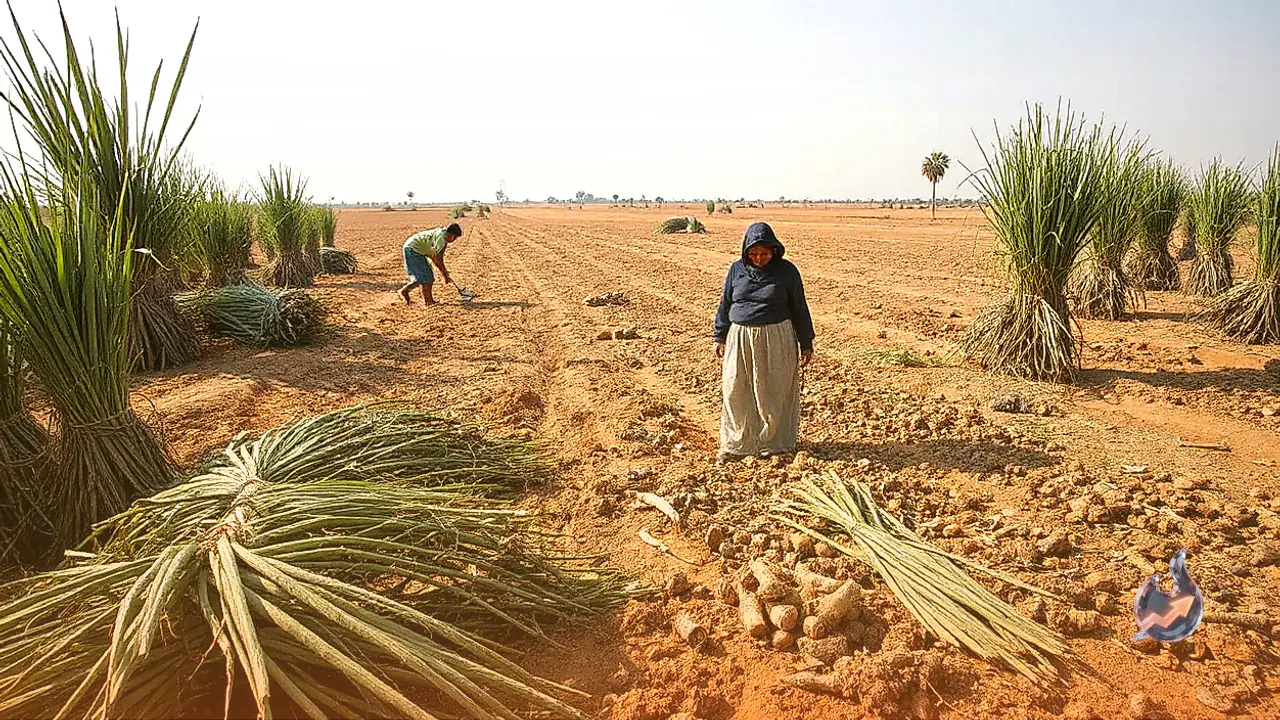

Cultivating vetiver, commonly known as khas, involves a precise balance of traditional agricultural timing and industrial processing to yield high-value essential oil. When a standing crop reaches harvest readiness, the operational sequence begins not below the ground, but directly on the surface. Field laborers clear the land by slicing off the entire aerial vegetation, which comprises the upper stalks and leafy greens. Once this surface mass is removed, the field rests for approximately 10 to 15 days before the subterranean phase commences. Digging out the root systems requires individual attention to prevent physical damage to the oil-bearing fibers. Workers carefully unearth the base of each separate plant, immediately detaching the fibrous root bundles from whatever remains of the crown so the material can enter cleaning without delay.
Root Cleaning, Water Soaking, and Mechanical Chopping
Subterranean harvesting naturally leaves the root clusters coated in heavy dirt, making intense sanitation the primary post-harvest priority. Farmer and entrepreneur Sunil Kumar explained that the freshly excavated roots undergo meticulous, deep-cleaning wash cycles to ensure that every residual particle of field soil is eliminated. Once free of coarse dirt, the clean bundles are submerged in large water vats to soak for a duration lasting between 24 and 48 hours. This prolonged soaking softens the tough woody tissues and loosens any micro-particulates trapped between root hairs. After the immersion period wraps up, workers execute a second comprehensive wash before draining the roots. To allow this bulky biomass to pack efficiently inside the compact drums or distillation boxes of the processing facility, specialized small machines shred the long strands into uniform, manageable pieces.
The 100-Hour Distillation Cycle and Gravity Separation
The chopped root fragments are loaded directly into the distillation plant to initiate thermal extraction. Distillation relies on fundamental vaporization physics, where steam generated through sustained heating extracts the volatile aromatic compounds from the root fibers and channels the vapor mixture into a condenser. Cold water is pumped continuously through the condenser unit, forcing the rising aromatic vapors to cool, liquefy, and drain into a collection receiver located at the bottom of the system. Completing just one single extraction run from a batch of roots demands roughly 100 hours of continuous distillation operation. When this exhaustive cycle finally ends, the collected liquid mixture is left undisturbed for 12 to 13 hours. Technicians then apply the settling technique to draw off the separated layer of pure essential oil from the condensed water base.
Aroma Refreshing and Propagating New Seed Slips
Once separated from the condensed moisture, the raw vetiver extract undergoes an aroma-refreshing phase to prepare it for high-grade commercial distribution. The refined essential oil is then packaged and dispatched to premium fragrance and consumer markets. Simultaneously, the production lifecycle comes full circle by utilizing the surface foliage that was sheared off at the very beginning of harvest. Instead of being discarded as organic waste, these top stems are trimmed into specialized vegetative planting slips. Farmers separate the individual slips and replant them straight into prepared field beds for the following growing season. This dual-purpose farming method allows growers to monetize the distilled oil while perpetually maintaining their own planting stock without buying external seeds.