






















In the heart of Central India, a remarkable medical facility is quietly reversing the horrific damage inflicted by humans on the region’s most misunderstood creatures. The School of Wildlife Forensic and Health Center, located in Jabalpur, stands as a solitary beacon of hope for wild animals pushed to the brink of death. Far from a conventional veterinary clinic, this specialized hospital undertakes the daunting task of treating severely traumatized wildlife, offering them a miraculous second chance at life before returning them to their natural habitats.
The Gruesome Reality of Festive Cruelty
Reptiles, particularly snakes, often bear the brunt of deep-rooted superstitions and commercial exploitation. Around festive occasions like Nag Panchami, traditional snake charmers capture these animals to display them for profit, subjecting them to unimaginable torture. Shobha Jaware, the director of the School of Wildlife Forensic and Health, highlighted the staggering volume of such cases. Over the past year alone, the facility received 65 snakes that required urgent medical intervention, a count that included 15 highly venomous cobras.
The methods used by these captors driven by financial greed are profoundly cruel. To render the snakes harmless for public display, charmers routinely extract or break their venomous fangs. However, the abuse rarely stops there. In many cases, the captors brutally sew the mouths of the reptiles completely shut. Even more horrifying is the use of industrial-grade synthetic adhesives like Fevikwik to glue the jaws of the animals together. Unable to open their mouths to eat or drink, these captive creatures are left to slowly die in agonizing pain, starving on the brink of death while being paraded in front of unsuspecting crowds.
A Complex Surgical Miracle
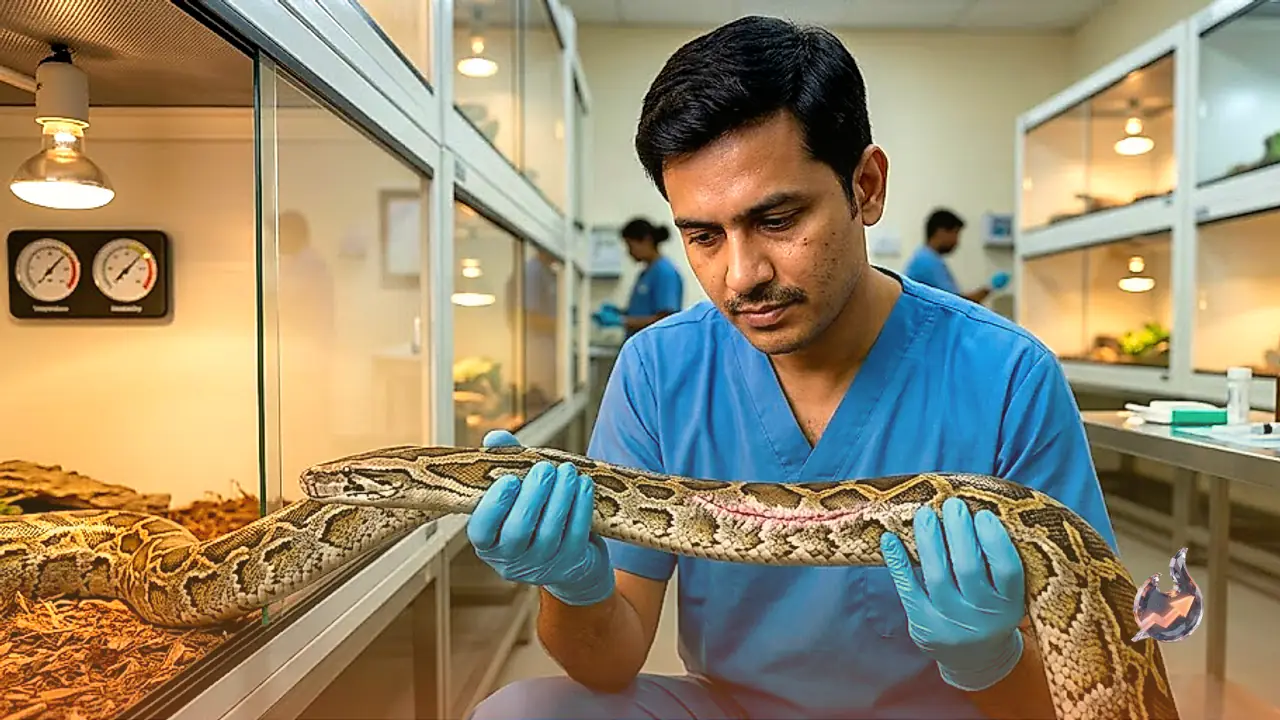
The veterinary specialists at the Jabalpur center consistently demonstrate extraordinary skill when faced with catastrophic injuries that would overwhelm an ordinary clinic. Director Shobha Jaware recounted a recent, blood-curdling case that tested the limits of veterinary medicine. The local forest department had rushed in a severely mangled snake that had been ruthlessly beaten with heavy sticks by a mob of humans. The blunt-force trauma was so extreme that the animal's internal organs, including its intestines, had ruptured and spilled completely out of its body.
While such a gruesome sight might cause even seasoned professionals to hesitate, the dedicated team of expert doctors immediately sprang into action. They placed the critically wounded reptile on the operating table and performed an incredibly intricate, high-stakes surgery. With meticulous precision, the medical team managed to safely reposition the exposed intestines back into the abdominal cavity and successfully close the severe wounds. Thanks to their timely and capable intervention, the snake survived. Like all patients at the facility, once the animal has fully recovered and regained its strength, it will be safely released back into its natural forest environment.
The Frontline Defenders and Rescuers
The success of the hospital relies heavily on a coordinated network of field operatives who intercept these abused animals. The anti-poaching and rescue team of the Jabalpur forest department serves as an essential protective shield for the region's wildlife. Working tirelessly on the ground, wildlife expert and specialized snake catcher Avi Varshai leads efforts to track down and save these vulnerable creatures. Throughout the course of a single year, Varshai personally rescues hundreds of snakes from perilous situations across the region.
These rescue operations frequently involve highly dangerous and rare reptile species that require delicate handling. The moment these injured or traumatized animals are secured from their captors or hostile human environments, they are immediately transported to the hospital for emergency admission. This seamless pipeline from active rescue in the field to specialized surgical care ensures that even the most battered animals have a fighting chance at survival.
Preserving the Ecological Balance
Beyond the immediate act of saving individual animals, the underlying mission of the Jabalpur center is deeply rooted in environmental conservation. While many wild species, particularly venomous reptiles, are inherently feared and deemed dangerous by the general public, they play an absolutely critical role in maintaining the health of the broader ecosystem. As apex predators and pest controllers, their presence is vital for natural balance.
The philosophy driving the School of Wildlife Forensic and Health is that every living creature possesses an equal right to exist and thrive in its natural environment, just as humans do. By dedicating their resources and expertise to treating the voiceless, the institution sends a powerful message. It actively proves that true humanity and medical compassion should not be reserved exclusively for people, but must extend outward to protect and heal the entire natural world.