


















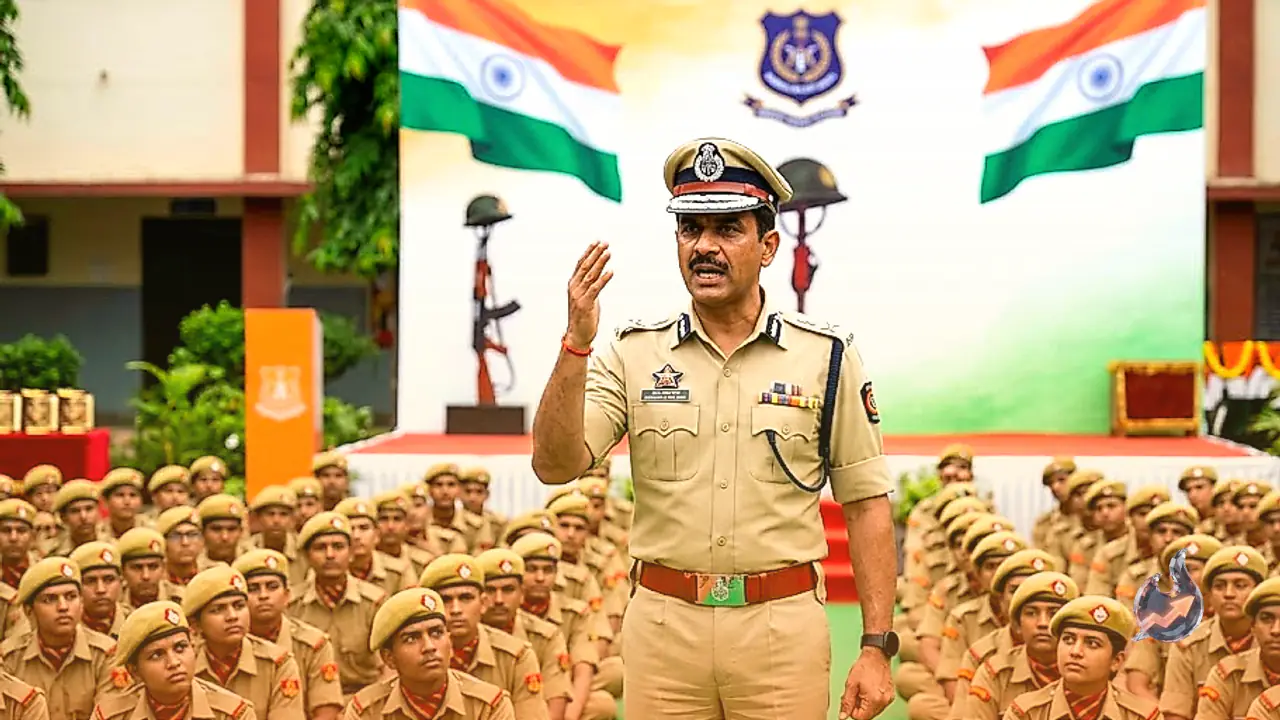

During a solemn Kargil Vijay Diwas commemoration hosted at Bhonsala Military School in Nagpur, Nagpur Police Commissioner Vishwas Nangre Patil delivered an inspiring address directed primarily at Gen-Z. Emphasizing the transformative power of youth, the senior officer highlighted that if the younger generation channels its energy constructively, young individuals can not only elevate their personal capabilities but also play a monumental role in shaping the nation's future. The focal point of his speech centered on the rising addiction to mobile phones and its detrimental impact on mental health and cognitive development.
Digital Distractions and Shrinking Focus: The Screen Time Dilemma
Expressing deep concern over the excessive reliance on digital devices in daily life, the Police Commissioner noted that establishing meaningful communication with youth has become increasingly challenging. A large number of young individuals now log between 6 to 7 hours of daily screen time, spending endless hours scrolling through social media platforms. He explained that the brain functions under a fundamental principle: focused attention enables learning, learning leads to progress, and progress ultimately yields true happiness. However, continuous screen switching causes the human mind to jump from one thought to another every 5 to 7 seconds. This rapid distraction makes it nearly impossible to comprehend the complex chemical shifts taking place within the brain.
Ancient Wisdom from Hitopadesha and the Significance of Age 16
In addition to addressing modern digital pitfalls, Vishwas Nangre Patil drew upon ancient Indian philosophy to guide the young audience. He recited a famous verse from the text 'Hitopadesha', composed by Acharya Narayan, before the students of Bhonsala Military School
"Youvanam Dhanasampattih Prabhutvamavivekita | Ekaikamapyanarthaya Kimu Yatra Chatushtayam ||"
Elaborating on the verse, he explained that youth, material wealth, authority or power, and recklessness are four factors where even a single element is capable of ruining a person's life. If all four converge simultaneously, the potential for destruction becomes unimaginable. He specifically pinpointed the age bracket of 16 to 18 years as the most critical developmental phase, as it coincides with the crucial growth of the human brain's prefrontal cortex. Citing historical precedent, he pointed out that Chhatrapati Shivaji Maharaj laid the foundation of Swarajya at the young age of 16. Therefore, youth must refrain from squandering this golden period on superficial screen scrolling and instead dedicate themselves to ambitious lifetime goals.
Beyond IQ and EQ: Why Adversity Quotient (AQ) Matters Most
Discussing the benchmarks of personal success, the Police Commissioner clarified that a high Intelligence Quotient (IQ) alone does not define a person's complete potential. While Emotional Quotient (EQ) and Social Quotient (SQ) are equally vital, the most indispensable attribute in life is the Adversity Quotient (AQ). A person's true character and capability are tested by how strongly and resiliently they fight back during tough, unfavorable circumstances.
To illustrate this concept, he recalled the extraordinary bravery of India's military heroes. Remembering Captain Vikram Batra, the hero of the 1999 Kargil War, he noted how capturing a formidable peak did not diminish his spirit, leading him to proclaim 'Yeh Dil Maange More' as he set his sights on conquering the next summit. He also paid tribute to the supreme sacrifice of Param Vir Chakra recipient Lieutenant Manoj Kumar Pandey and other brave soldiers, citing the iconic poetic lines
"Fairs will be held every year on the pyres of martyrs; this will remain the final mark of those who die for the motherland."
He stressed that national commemorations like Vijay Diwas exist precisely to keep the ideals of these martyrs alive in the hearts of future generations.
From Pen to Rifle: The Transformation into a Defender of the Nation
Pivoting to the realities of security personnel, Vishwas Nangre Patil painted a vivid picture of the challenging life led by police officers and soldiers. He acknowledged that those tasked with upholding law and order or guarding national borders frequently experience moments of extreme helplessness and pressure. Describing the emotional and disciplined journey of a civilian becoming a soldier, he observed that a defender is forged when a student's pen turns into a rifle, their shirt becomes a uniform, their shoes turn into heavy boots, their teacher becomes a strict instructor, their principal becomes a commandant, and their school prayer ground converts into a parade ground.
He further added that when a young person begins viewing their mother not merely as an individual parent but as 'Bharat Mata', patriotism ceases to be a mere sentiment and becomes embedded in their blood and skin. Speaking with deep conviction, he shared that for him, the police uniform is not just a piece of cloth, but an integral extension of his own skin.
Responding to Public Criticism with the Duty of 'Main Khaki Hoon'
Highlighting the trials of public service, the Police Commissioner shared that policing often feels like a thankless profession. Despite standing guard day and night for public safety, police personnel frequently endure public hostility and verbal abuse. He revealed that over the past 7 to 8 days, he and his department faced intense criticism and harsh words. Nevertheless, the sacred duty of a true police officer is to remain steadfast in serving the nation and society without being deterred by adversity.
To articulate this unwavering commitment, he recited his deeply emotional self-composed poem 'Main Khaki Hoon'
"Whether it is day, night, or dusk, I am the burning wick, I am Khaki.
In storms, in tempests, during Holi, during Ramzan,
In honor of the nation, I am the unwavering path of duty, I am Khaki.
Ever ready to smile through scorching sun and pouring rain,
To celebrate every festival amid crowds.
To endure stones at times and insults at others,
I am molded from a different clay, I am Khaki.
Adorned and resilient even after enduring severe hurdles,
I find glory in the uniform, I am Khaki.
I am light in the darkness, hope in difficult times.
Call upon me and I come running, I am Khaki.
I am a weeping chest wrapped in the tricolor..."
His passionate verses left a profound impact on the students gathered at Bhonsala Military School, inspiring them toward national service, discipline, and duty.