





















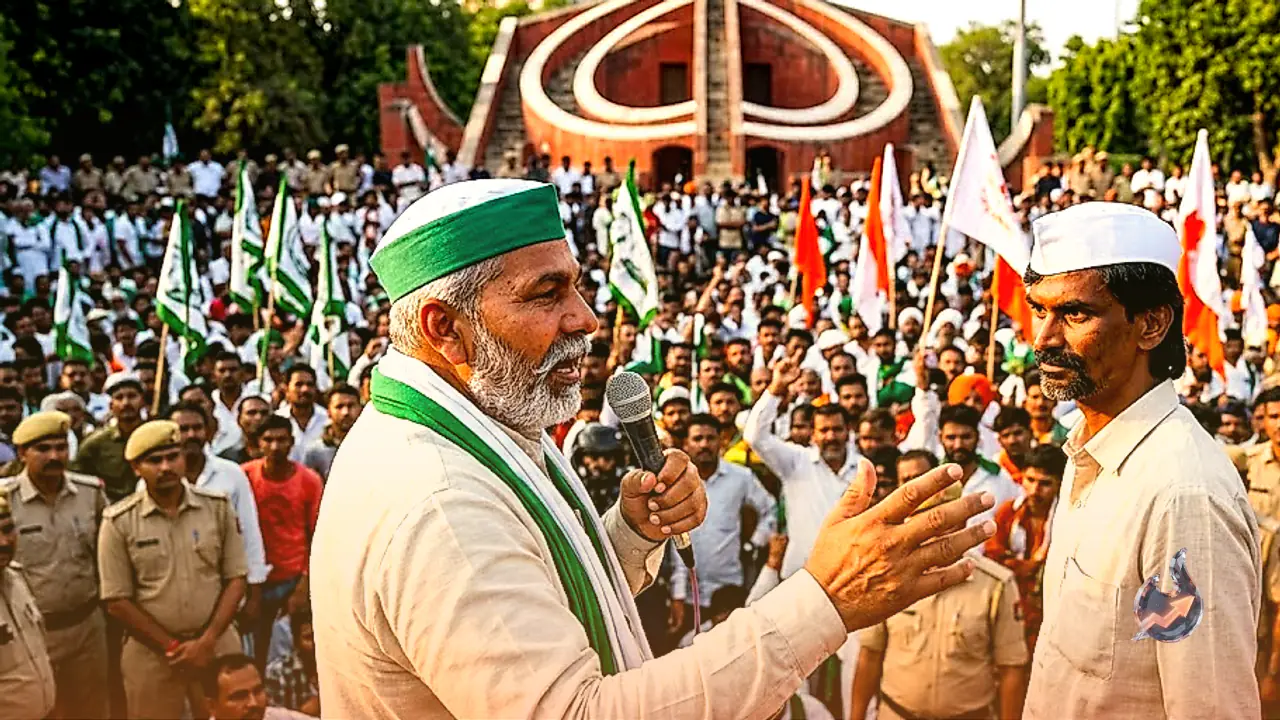

The ongoing agitation over the alleged irregularities in the NEET examination has taken a massive turn in the national capital, transforming a student grievance into a formidable challenge for the administration. What began as a focused demonstration initiated by the Cockroach Janta Party at Jantar Mantar is rapidly evolving into a much larger socio-political mobilization. Students and youth delegates from various corners of the country have been flocking to the iconic protest site in Delhi to demand accountability and transparency in the education sector. The atmosphere at the venue had been tense for days, but the dynamics shifted drastically following a forceful police baton charge on the demonstrators on July 20. This controversial use of force did not quell the dissent; instead, it has intensified the anger among the youth and drawn the attention of prominent political figures who have since visited the site to express their solidarity.
Veteran Agitators Step In
The protest has now received a significant strategic boost with the unexpected entry of two heavyweights known for leading massive, uncompromising anti-government demonstrations. Bharatiya Kisan Union national spokesperson Rakesh Tikait and prominent Maratha reservation activist Manoj Jarange Patil have officially thrown their weight behind the aggrieved students. The arrival of these two figures is particularly notable because both leaders have a proven track record of sustaining long-term campaigns against the current ruling establishment. Tikait was a central, defining figure in the prolonged 2020-21 agrarian demonstrations that successfully pressured the central government. Similarly, Patil launched an intense, high-stakes campaign for Maratha quotas against the Eknath Shinde-led Maharashtra administration in September 2023. Their active involvement at Jantar Mantar signals a potential scaling up of the current student-led movement, threatening to merge rural agrarian networks and regional caste agitations with urban youth discontent.
Farmers Ready With Tractor Trolleys
Arriving at Jantar Mantar on Wednesday accompanied by a strong contingent of roughly 500 farmers, Rakesh Tikait made his intentions explicitly clear to the administration. He assured the protesting youth that the nationwide farming community is closely monitoring their situation, adding that their formidable tractor trolleys stand ready to provide necessary logistical backing if the agitation requires it. Tikait framed the ongoing struggle not just as a fight over an exam paper, but as a deeper battle of ideologies, noting that ideological revolutions have historically been the most powerful engines of change.
Do not go on a hunger strike because the king here is a dictator, Tikait remarked to the gathered crowd, advising them to preserve their physical strength.
Instead of resorting to starvation tactics, the veteran farmer leader suggested establishing community kitchens and free food distribution centers at the protest venue to sustain the momentum peacefully over a long period. Addressing the fallout of the July 20 police action, he noted that protesters often face state force under official orders, but the youth who suffered the baton blows will carry the memory of this oppression for the rest of their lives. He predicted that this very struggle will act as a crucible, producing future national leaders and principled administrators who understand grassroots struggles. Tikait envisions these injured students carrying the spark of resistance back to their respective rural villages, thereby exponentially expanding the footprint of the protest. He also confirmed that localized demonstrations supporting the students are already being organized at the district level across various states.
Maratha Leader Demands Minister's Resignation
Adding an entirely different regional pressure point to the Delhi protests, Manoj Jarange Patil traveled all the way from Jalna in Maharashtra to stand shoulder-to-shoulder with the students on Wednesday. His focus was laser-sharp on demanding administrative accountability for the alleged educational compromises, fully endorsing the students' call for the immediate resignation of Union Education Minister Dharmendra Pradhan. Patil expressed his absolute and unconditional support for the Cockroach Janta Party's efforts on the ground, emphasizing that raising voices peacefully is a fundamental democratic right of every citizen that must be protected.
He strongly condemned the recent police action against the protesting youth, describing the baton charge as entirely inhuman and an excessive use of state machinery against unarmed scholars.
It is the first time we are seeing such a cruel government, and one wonders how long this must be tolerated, Patil stated during his visit to the national capital.
The Maratha leader issued a direct, uncompromising appeal to the administration, demanding that they immediately allow the students to exercise their democratic right to protest without facing further punitive or violent action. He did not mince his words, delivering a stern warning that any continued suppression of the youth would yield heavy political consequences for the ruling party. According to Patil, if the administration fails to handle the situation fairly and continues its crackdown, both the central leadership in Delhi and the incumbent BJP government in Maharashtra will have to pay a severe electoral price. The convergence of these distinct protest leaders at Jantar Mantar indicates that the NEET issue is no longer just an education department problem, but a catalyst for broader anti-establishment unity.