




















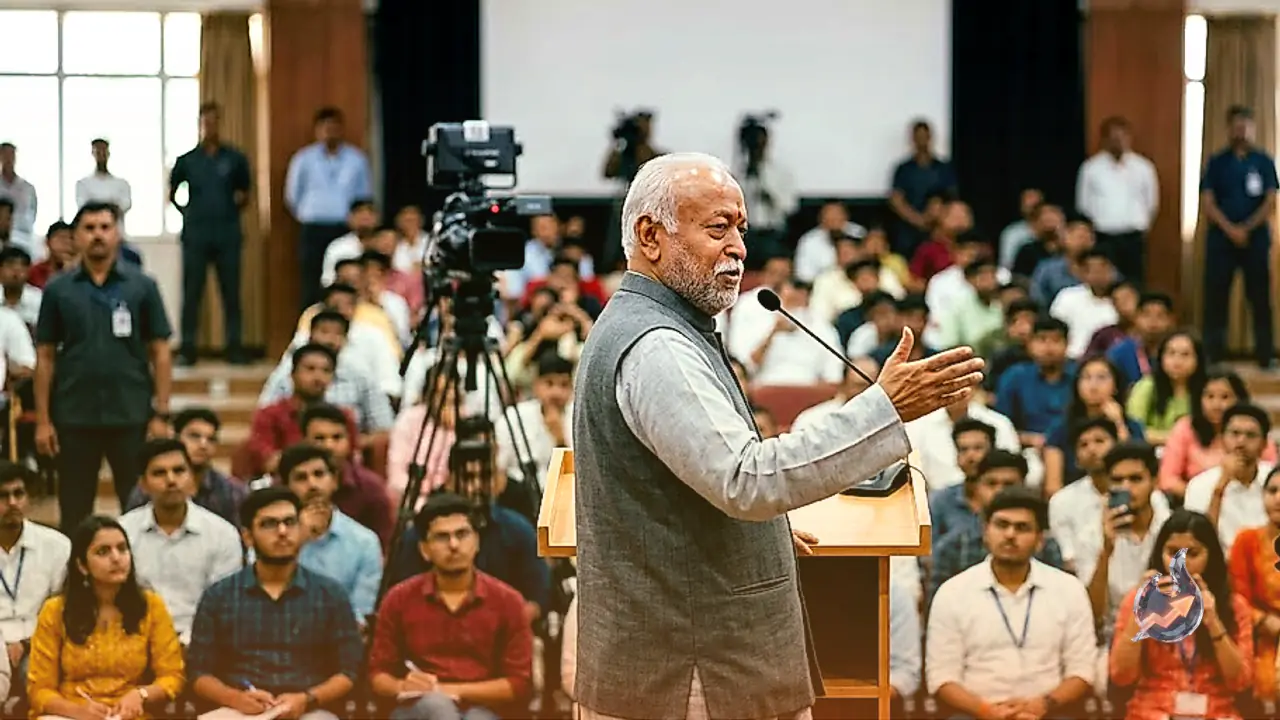

Speaking at an event organized by India's International Movement to Unite Nations (IIMUN) in Mumbai, Rashtriya Swayamsevak Sangh (RSS) Chief Mohan Bhagwat engaged in an interactive session with students and young citizens. During the interaction, he addressed several pressing national, social, and economic issues. His wide-ranging discourse covered topics including recent student movements led by Gen Z, unemployment challenges, social reservation policies, digital media ethics, same-sex marriage frameworks, and India's diplomatic relations with neighboring countries.
Gen Z Agitations and the Need for Educational Reforms
Addressing the recent wave of youth protests, the RSS chief emphasized that public demonstrations are fundamentally a medium of communication. He stated that the grievances raised by Gen Z are valid and highlighted the urgent necessity for structural reforms within the nation's educational framework. Modern youth demand logical and well-reasoned answers, meaning traditional expectations of unquestioning compliance with elders no longer hold.
Dismissing arguments that young people should refrain from protesting, Mohan Bhagwat stressed that administrators and society must listen attentively when the youth speak out. He pointed out that a communication gap was evident during recent demonstrations, which needs to be bridged. Rejecting attempts to brand student protesters as anti-national, he characterized Gen Z and Gen Alpha as highly honest generations that represent the nation's future, requiring an approach rooted in affection, trust, and open dialogue.
Social Media Regulation and Public Responsibility
In response to discussions surrounding social media bans, the RSS chief noted that while regulations and discipline are essential, they can only succeed if there is a fundamental shift in public mindset. Legislation alone cannot transform society unless the public embraces and adheres to those laws in daily life.
He observed that societal role models evolve over time and must act with heightened accountability. Influencers and public figures who command large followings on digital platforms must remain fully aware of the impact their conduct and messages have on the broader community. Furthermore, he advised citizens against blindly accepting unverified information or videos circulating online, emphasizing the importance of fact-checking content through authentic and credible sources before sharing.
Perspective on Same-Sex Relationships and Marriage Structure
Regarding the LGBTQIA+ community, Mohan Bhagwat affirmed that they are an integral part of society and have historically found acceptance within Indian tradition. However, explaining his views on marriage, he noted that Indian culture views marriage not merely as a living arrangement between two individuals, but as the foundational pillar of the family unit, which serves as the core building block of society for raising future generations.
He cautioned against making hasty alterations to established social institutions without preparing society first, noting that laws reflect societal acceptance rather than dictating social norms. He suggested that same-sex partners deserve respectful treatment and that distinct legal frameworks or systems could be explored to govern cohabitation. He called for a broader, inclusive societal dialogue on the matter to ensure collective progress.
Reservation Policy and the Vision of Dr. B.R. Ambedkar
On the topic of affirmative action, the RSS chief stated that understanding reservation requires an honest reading and implementation of Dr. B.R. Ambedkar's principles. The reservation system was instituted to counter deep-rooted social discrimination, and consequently, it remains necessary as long as social inequality persists in society.
At the same time, he remarked that individuals and groups who have successfully achieved social and economic mobility through reservation should voluntarily foster a spirit of making space and passing opportunities to others in need. He clarified that reservation is not meant to be a permanent fixture, but a vital tool designed to achieve social upliftment and equality.
Addressing Unemployment and Promoting Dignity of Labor
Discussing economic challenges, Mohan Bhagwat called for a fundamental mindset change regarding employment. He stated that gainful employment should not be viewed narrowly as traditional job seeking, but must encompass entrepreneurship and skilled technical work. He expressed concern over the social stigma often attached to manual labor, noting that physical work does not receive the societal respect it inherently deserves.
He pointed out that many individuals have attained significant financial success and stability through trades often considered ordinary or minor. Unemployment can be significantly alleviated if society stops evaluating work through hierarchical notions of high or low status. Fostering a culture of entrepreneurship and instilling genuine respect for all forms of labor remain essential steps forward.
Foreign Relations and Shared Cultural History
Reflecting on India's diplomatic stance towards neighboring countries such as China and Pakistan, the RSS chief stated that during times of conflict, the nation must stand united behind official government policy. However, underlying historical and cultural ties cannot be completely erased by temporary conflicts. He noted that Chinese historical accounts recognize the moral and cultural values imparted by India two millennia ago, while Pakistan was an integral part of India less than a century ago.
Mohan Bhagwat emphasized that these historical bonds cannot be severed entirely. While military or political conflicts may temporarily freeze bilateral engagements, they do not destroy long-standing cultural roots. Once conflicts are resolved, diplomatic efforts must resume from where they were paused, as permanent hostility offers no sustainable solution.