























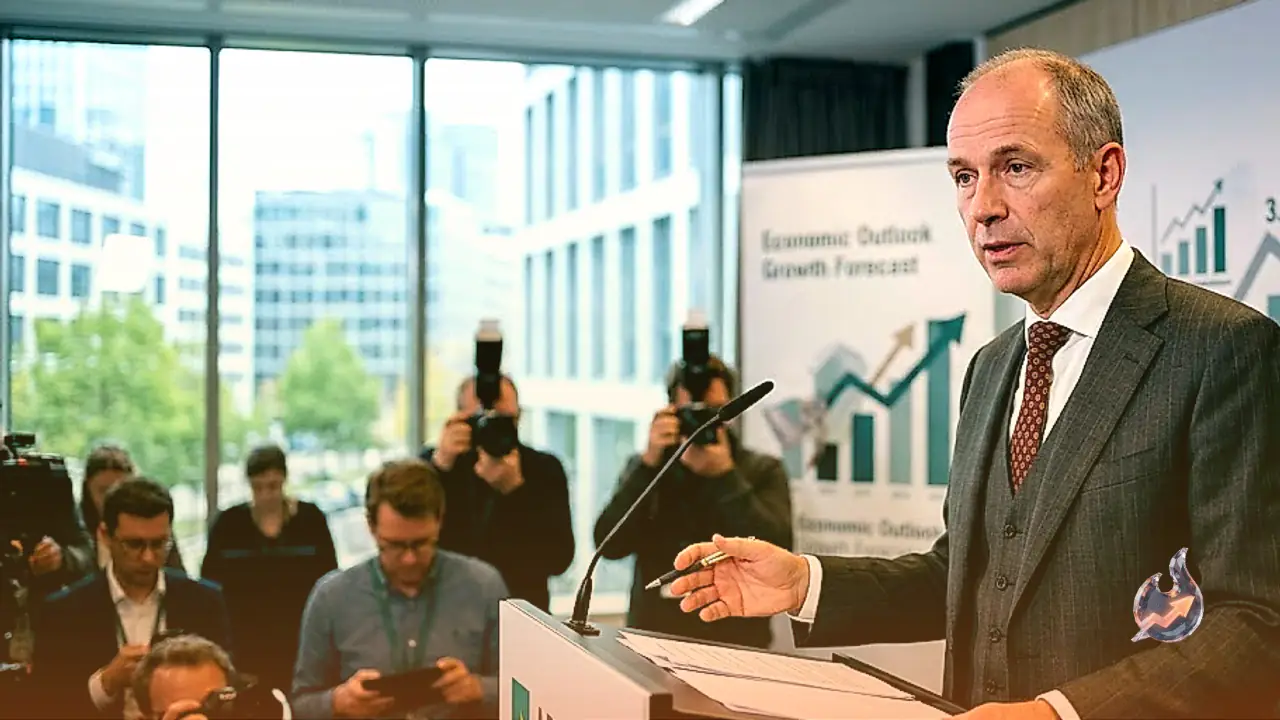

ABN AMRO says the eurozone economy is holding up far better than many had feared, even as a fresh spike in energy prices threatens to push inflation to levels not seen in three years.
Growth Proves Sturdier Than Expected
The Dutch bank expects the region's resilience to broadly continue over the coming quarters, despite the renewed energy shock working its way through the economy. That said, the recovery in household consumption is likely to run into fresh headwinds, since the energy-driven price spike eats into real incomes and leaves consumers with less spending power than they had before. When wages don't rise as fast as prices, households effectively have less money to spend on everything else, which slows the pace at which consumer spending can drive growth.
Germany, the eurozone's biggest economy, is expected to keep the wider region propped up. ABN AMRO expects continued government spending in Germany to support the country's own recovery, and that spending should remain a key pillar holding up growth across the currency bloc as a whole. Public spending on things like infrastructure and defence has been a major theme in Germany over the past year, and ABN AMRO's outlook suggests that support is not fading any time soon.
Strong second-quarter growth data, combined with upward revisions to Germany's own growth numbers, were enough to push ABN AMRO back to its earlier call of 0.8% growth for the eurozone in 2026. In other words, the bank had penciled in a more cautious number at some point, and the strength of the recent data has been enough to undo that caution and restore the higher estimate. The bank's forecast for 2027 has been left unchanged at 1.2% growth.
Inflation Jumps to a Three-Year High
The bigger story, according to ABN AMRO, is playing out on the inflation side, where the renewed energy shock is expected to leave a much deeper mark than it has on growth. Headline inflation in the eurozone has already rebounded sharply, climbing from a June trough of 2.8% to a three-year high of 3.3% in August. That is a jump of half a percentage point in just two months, and it puts inflation at its highest level in three years.
Almost the entire increase came from energy prices, the kind of costs that show up quickly in transport, heating and manufacturing bills and then filter through to the price of almost everything else. But ABN AMRO also flagged a notable pickup in goods inflation, a trend it had already called out in its Monthly report just before the summer began. That matters because it suggests the pressure on prices is not confined to energy alone, and that some of the increase may prove stickier than a pure energy shock would be.
Peak Above 3.5% Expected, With Wages Now in Focus
Looking ahead, ABN AMRO expects inflation to peak above 3.5% in the coming months before easing back, with the full-year average for 2026 now projected at 3.0%. That is 0.5 percentage points higher than the bank's forecast back in June, a meaningful upgrade that reflects how quickly the energy-driven price pressure has built up since the middle of the year.
With inflation running hotter, ABN AMRO says attention will increasingly shift to what economists call second-round effects, essentially whether workers start demanding higher pay to keep up with rising prices, and whether businesses then pass those higher wage costs on to their own customers, creating a self-reinforcing cycle that can keep inflation elevated long after the original shock has faded. Wage inflation is the specific effect ABN AMRO says it is watching most closely.
There are early signs this process may already be under way. Indeed's monthly wage data for July showed the first warning signs of a pickup in wage growth. Separately, the European Central Bank's own forward-looking tracker for negotiated wages has also picked up in recent months. Taken together, ABN AMRO sees these as early signals that the energy shock could feed through into broader, longer-lasting inflation pressure rather than staying a one-off spike that fades on its own.
Central banks such as the European Central Bank watch measures like negotiated wages closely because they offer an early read on whether higher prices are becoming embedded in the economy rather than fading with the energy shock itself. A steady rise in wage settlements can make an inflation problem harder to unwind, since it feeds directly into the cost side of many businesses, from retailers to service providers, who then have to decide whether to absorb the higher wage bill or pass it on to customers.
For now, the bank's overall message is one of a two-speed economy: growth that is proving unexpectedly resilient, anchored by Germany's spending and a steady recovery elsewhere, set against an inflation picture that has deteriorated sharply and is now being watched closely for signs of spreading into wages.