






















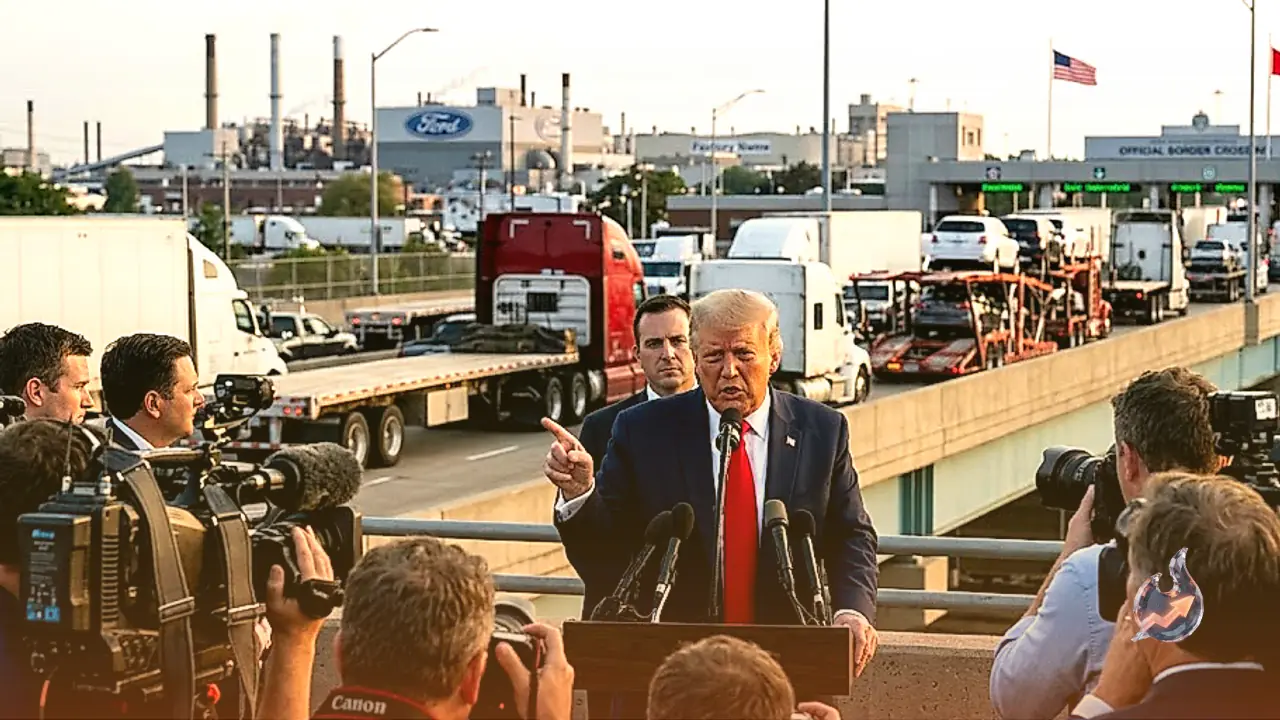

The Trump administration's threatened 50 percent tariff on Canadian vehicles and auto parts has sparked major concerns regarding North American trade stability. Dev Ashish at Societe Generale highlights that this move signals a broader push by Washington to redirect manufacturing investment directly to the US, further undermining the reliability of the USMCA. Canada faces immediate pressure from these developments and is actively planning retaliatory measures, raising fundamental questions about whether the nation remains an equal treaty partner or risks becoming a production satellite dependent entirely on US discretion.
The 50% Tariff Threat on Canadian Vehicles and Parts
While the threat to impose steep 50 percent tariffs on Canadian automotive exports starting January 1, 2027 leaves some room for negotiation, experts note that its underlying objective extends far beyond conventional trade barriers. The shift in the American stance has forced political leadership in Canada to re-evaluate its long-term economic standing. Questions are mounting over whether Canada can maintain its status as an equal partner under the trade pact or if its market access is increasingly subject to the unilateral policy whims of Washington.
Canada Prepares Retaliatory Measures
In response to the mounting pressure from the southern border, Canada is preparing decisive counter-measures. These retaliatory steps are expected to target politically sensitive US exports to make the economic cost felt where it matters. Further details regarding these countermeasures are anticipated shortly, with initial rollouts expected around September 8, setting the stage for potential trade friction.
Currency Markets and Global Developments
Broader financial markets are also reacting to a confluence of geopolitical and economic triggers. The GBP/USD pair extended its consolidation into a second consecutive day, fluctuating tightly above the 1.3600 handle. Meanwhile, the US Dollar found stabilizing support as investors evaluated new US sanctions on Iran. Diplomatic channels have also shown slight renewed activity amid reports that Pakistan is carrying a diplomatic offer to Iran aimed at halting ongoing sieges and lifting sanctions through a Memorandum of Understanding.
Middle East Tensions and Precious Metals
The EUR/USD pair struggled to build recovery momentum, trading below the 1.1700 mark during the latter half of the day. The US Dollar benefited overall from a cautious market mood as traders assessed ongoing developments in the Middle East, though disappointing domestic consumer sentiment data helped the currency pair hold its ground somewhat. In the commodities sector, Gold (XAU/USD) experienced an intraday pullback during American trading hours after touching a fresh three-month peak of $4,697 earlier in the session.
Crypto Rally and Earnings Season Wrap-Up
In digital assets, Bitcoin (BTC) continued its strong upward momentum, trading comfortably above $80,000. This marks the highest trading tier for the leading cryptocurrency since mid-May, highlighting an encouraging shift in investor risk appetite, liquidity conditions, and technical indicators. Concurrently, the Q2 earnings season for S&P 500 members is nearing its conclusion with largely positive reports. However, attention remains squarely fixed on AI favorite NVIDIA (NVDA), whose upcoming earnings release will formally close out the reporting cycle for the Magnificent Seven.
US Treasury Liquidity Operations
In fixed-income markets, the US Treasury announced a notable shift outside its standard calendar. At 12:32 GMT, the department revealed plans to at least double the size of its liquidity support buyback operations across the 10-year to 20-year and 20-year to 30-year sectors. The maximum cap per operation will be raised from $2 billion to at least $4 billion, taking effect on September 9 and running through November 4.