





















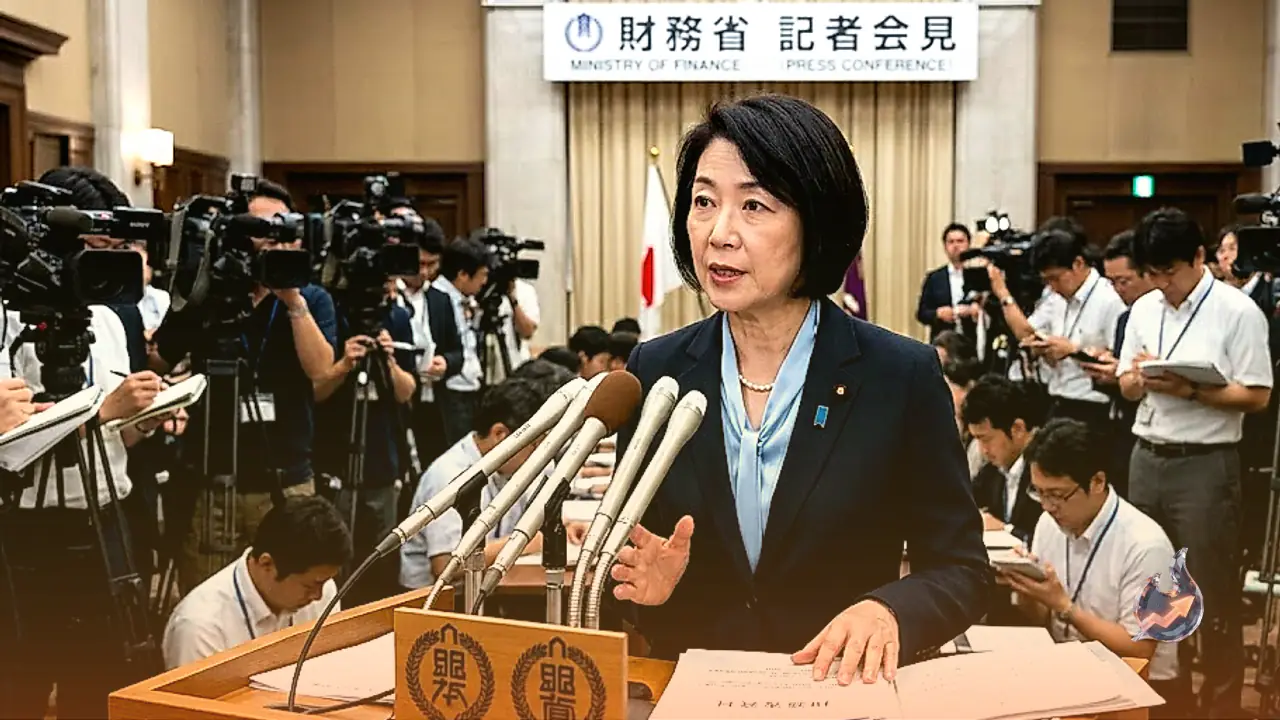

Japan’s policy debate on Thursday brought fiscal credibility and the inflation target into the same frame. Finance Minister Satsuki Katayama said officials would review budget requests and control debt issuance at a level capable of gaining market credibility. She also said the Bank of Japan is expected to coordinate closely with the government, conduct appropriate monetary policy and steer toward stable, sustainable inflation of 2%.
Fiscal plans placed beside market confidence
The fiscal message was not limited to a general call for caution. Katayama said budget requests would be reviewed, placing the proposed plans under official examination. She connected that review with government borrowing and said debt issuance should be controlled at a level that can earn credibility with markets.
No specific budget request was identified, and no debt ceiling or numerical borrowing limit was provided. The absence of those details means the statement set a standard for managing issuance rather than announcing a particular reduction. Market credibility therefore became the benchmark against which the fiscal approach was presented.
Putting budget requests and debt issuance in the same statement also showed why fiscal management matters alongside monetary policy. The government controls the budget and borrowing process, while the central bank controls monetary policy. Katayama’s remarks treated the two as separate responsibilities that still need to support the same objective of stability.
Excessive currency volatility remained part of the message
Katayama also returned to the issue of excessive volatility in currency markets. She said that when Japan-US launched a joint intervention, the determination to address excessive volatility had been made clear. The reference connected the current discussion of stability with the earlier willingness to act against sharp market swings.
No new intervention was announced in these remarks. Katayama separately made no comment on the Bank of Japan’s policy. Her statement therefore expressed an expectation of coordination without providing a fresh monetary-policy decision or a new currency-market operation.
USD/JPY showed a modest daily decline
At the time of writing, USD/JPY was down 0.10% on the day at 156.10. That figure captured the dollar-yen pair at one point while the fiscal and monetary messages were being considered. The decline was modest, and neither the percentage move nor the exchange-rate level was described as a policy target.
The 0.10% change is a daily snapshot rather than a long-term conclusion about the yen. It shows where the pair stood at the recorded moment, not where it must move after Katayama’s comments. This distinction matters because exchange rates can shift while officials discuss separate budget, debt and inflation objectives.
The Bank of Japan’s mandate centers on price stability
The Bank of Japan is Japan’s central bank and the institution that sets monetary policy in the country. Its mandate includes issuing banknotes and carrying out currency and monetary control to ensure price stability. Within that mandate, the inflation target is around 2%, giving the price objective a central role in policy decisions.
Price stability is the bridge between the bank’s operational responsibilities and Katayama’s message. Note issuance and currency control give the BoJ direct responsibility for the monetary framework, while government borrowing decisions shape the fiscal backdrop. The two policy areas remain institutionally separate even when they are discussed together.
Ultra-loose policy began in 2013
The present discussion cannot be separated from the ultra-loose policy adopted in 2013. The BoJ introduced that stance to stimulate the economy and fuel inflation while Japan was operating in a low-inflation environment. The policy was designed to provide stronger monetary support when price growth was weak.
Its framework was Quantitative and Qualitative Easing, abbreviated as QQE. Under QQE, the bank printed notes to buy assets such as government bonds and corporate bonds. Those purchases were used to provide liquidity, making asset acquisition and monetary expansion central parts of the ultra-loose approach.
Negative rates and yield control followed in 2016
In 2016, the bank deepened the strategy rather than moving away from it. It first introduced negative interest rates and then took the additional step of directly controlling the yield on its 10-year government bonds. Both measures loosened policy further.
The sequence is important because it shows how the easing program expanded after 2013. Negative rates were introduced first, followed by direct yield control in the 10-year government bond market. Together, they reinforced the same broad strategy of maintaining abundant monetary support.
March 2024 brought a retreat from the old stance
The BoJ lifted interest rates in March 2024. That move effectively marked a retreat from the ultra-loose monetary-policy stance that had defined the previous phase. It did not erase the earlier history, but it changed the policy backdrop against which future decisions would be assessed.
This shift is central to understanding Katayama’s current expectation. The central bank had already begun moving away from the most aggressive easing framework, so her call for appropriate policy and close government coordination comes after a material change in direction. No new rate path was supplied in her remarks.
Policy divergence weakened the yen in 2022 and 2023
The BoJ’s massive stimulus caused the yen to depreciate against its main currency peers. That depreciation was a direct consequence of the scale of monetary support described in the policy history. The exchange-rate pressure became more severe in 2022 and 2023.
The reason was increasing policy divergence between the BoJ and other major central banks. Those other central banks chose to raise interest rates sharply to fight inflation at decades-high levels, creating a wider policy and rate differential. The widening differential dragged down the value of the yen.
Part of that trend reversed in 2024, when the BoJ decided to abandon its ultra-loose policy stance. The reversal was partial, but it showed that changing the policy gap can alter the currency backdrop. This history explains why the central bank’s path and the government’s fiscal credibility are being watched together.
Inflation moved above the 2% target
A weaker yen and a spike in global energy prices pushed Japanese inflation higher. The combined effect took inflation above the BoJ’s 2% target. Currency weakness and energy costs are identified as contributors rather than treating the increase as the result of one isolated factor.
The prospect of rising salaries in Japan also contributed to the move. Salaries were described as a key element fueling inflation, which placed wage expectations alongside the yen and energy prices in the explanation. No percentage weight was assigned to any of these drivers.
Katayama’s use of stable and sustainable is therefore important. The objective is not presented as a one-off move through 2%, but as inflation that can remain steady and durable. That wording keeps the numerical target unchanged while adding a condition about the quality and persistence of the outcome.
What the remarks establish and leave open
Katayama’s remarks establish a two-part policy message. The government will review budget requests and control debt issuance with market credibility in mind. The BoJ is expected to conduct appropriate monetary policy, coordinate closely with the government and steer policy toward the 2% price target.
They do not establish a new interest-rate path, a debt ceiling or a timetable for fiscal adjustment. Katayama’s separate statement that she had no comment on BoJ policy makes that limitation clear. The remarks should therefore be understood as a framework for coordination, not as an announcement of a specific decision.
The framework links three concerns: confidence in government borrowing, excessive currency volatility and the durability of inflation. It also explains why the fiscal and monetary sides are being discussed together even though different institutions are responsible for them. For readers watching the market, the key distinction is between a stated expectation and an implemented policy action.
The recorded USD/JPY level shows the currency backdrop at one moment, while the longer policy history shows why the yen, inflation and debt credibility remain connected. What remains unspecified is the size of any future borrowing adjustment, the timing of further monetary steps and the exact route by which stable, sustainable 2% inflation will be achieved.