























Military confrontations between the United States and Iran have escalated sharply across Middle Eastern waterways and regional defense installations. Iran’s Islamic Revolutionary Guard Corps (IRGC) announced that its naval unit intercepted and captured a state-of-the-art US unmanned underwater drone near the strategic entrance of the Strait of Hormuz. Simultaneously, Iranian forces claimed responsibility for launching a salvo of 20 ballistic missiles targeting a key military facility housing US troops in Jordan. However, the United States Department of Defense firmly dismissed Tehran's claims of capturing an operational military asset, clarifying that the vessel had suffered a severe technical malfunction more than a day earlier and had simply ceased functioning. This multi-front military friction directly follows a series of heavy precision strikes conducted by American forces against five Iranian oil tankers.
Ballistic Missile Engagement Targeting US Air Base in Jordan
According to statements released by Iran’s state news agency IRNA, the Revolutionary Guard Corps executed what it characterized as a "punitive operation" directed at the al-Azraq air base located in Jordan. Iranian military officials asserted that heavy ballistic missiles were deployed during the strike, framing the attack as a direct retaliation against recent American military operations targeting Iranian economic assets.
Providing a conflicting tactical operational assessment, the Jordanian Armed Forces confirmed that their air defense installations identified and effectively neutralized the aerial threat. Official releases from Jordan's defense ministry indicated that surveillance radars detected a total of 20 incoming ballistic missiles trajectory lines heading toward the facility. Air defense batteries engaged immediately, successfully destroying 18 missiles mid-flight before they could reach their intended target coordinates. The remaining two ballistic missiles impacted within uninhabited, barren terrain well clear of residential areas or populated centers, resulting in no reported casualties or structural damage.
US Forces Destroy Five IRGC-Linked Iranian Oil Tankers
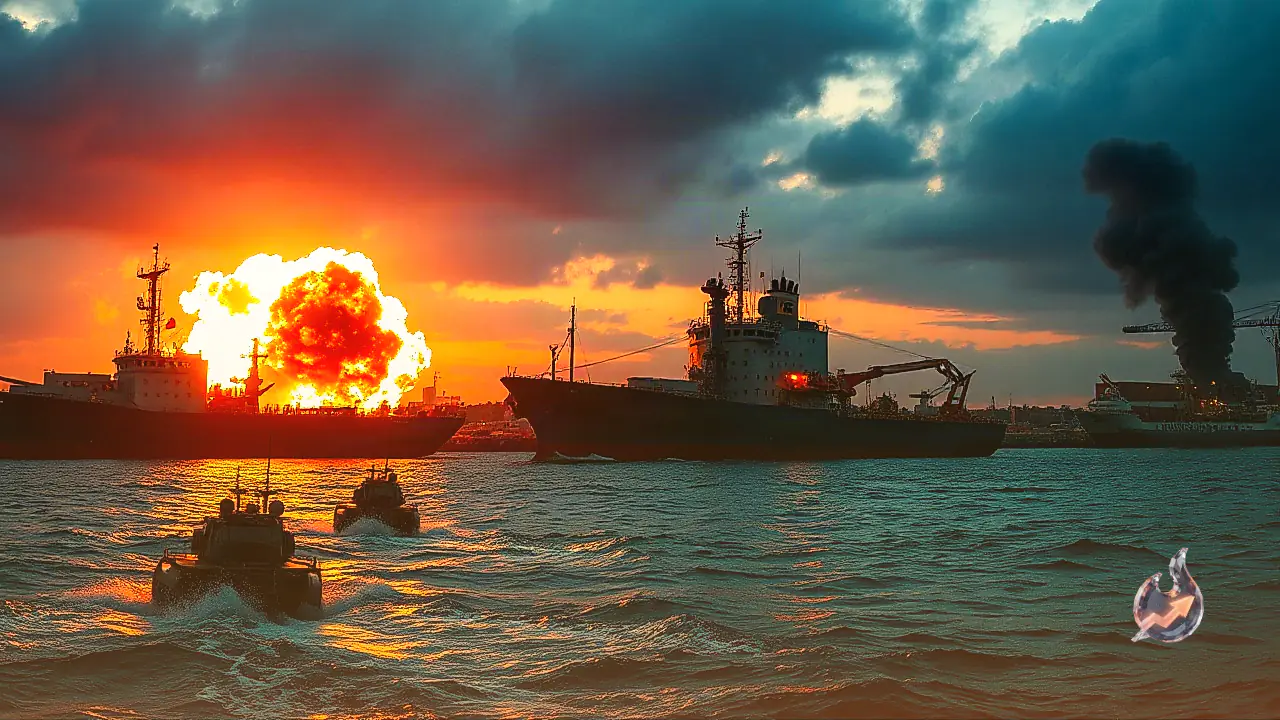
The missile exchange followed an intense naval operation carried out by the United States military on Tuesday, September 8. Statements issued by US Central Command (CENTCOM) confirmed that American air and naval assets targeted and destroyed five commercial oil tankers linked directly to the Islamic Revolutionary Guard Corps.
Military details revealed that four of the targeted vessels were transporting crude oil within the Gulf of Oman when they were struck. The fifth Iranian tanker was targeted and rendered inoperable in the Persian Gulf near Kharg Island. Pentagon officials stated that this aggressive maritime action was executed in direct response to repeated Iranian missile attacks launched against a US Navy warship over the preceding 48-hour window.
US Secretary of State Marco Rubio Issues Warning to Tehran
While conducting an official diplomatic visit to Colombia, US Secretary of State Marco Rubio addressed reporters in the city of Barranquilla, issuing a stern warning regarding Iran's maritime aggression. Rubio emphasized that the United States would maintain a decisive military stance against any actions threatening American naval assets in the region.
Addressing the press, Marco Rubio stated, "Iran continuously attempts to target US Navy vessels. Whenever they do or attempt to do so, America will target their tankers." The Secretary’s firm declaration underscored Washington's policy of proportional military retaliation aimed at crippling Iranian oil transportation capabilities should harassment of US warships persist.
Iranian Claims Over Dive-LD Underwater Drone and Technical Specs
Adding another layer to the maritime standoff, the naval force of the IRGC claimed to have seized a sophisticated unmanned underwater vessel operating at the choke point of the Strait of Hormuz. Iranian state media identified the captured hardware as the Dive-LD, an autonomous underwater vehicle manufactured by Anduril, a defense technology company based in California.
Hailing the operation, IRGC naval commanders stated, "We captured one of the US military's most advanced unmanned submarines at the entrance of Strait of Hormuz." According to official technical specifications provided by Anduril, the approximately 19-foot-long Dive-LD is designed for complex undersea missions. Its operational capabilities include detecting and clearing naval sea mines, surveying and mapping bathymetric seabed structures, gathering maritime intelligence, and inspecting vital undersea infrastructure such as submerged fiber-optic communication cables and energy pipelines.
Pentagon Rebuttal: Technical Failure Disables Older Drone Model
The US Department of Defense countered Iran's narrative, providing a detailed explanation regarding the status of the unmanned craft. A Pentagon spokesperson clarified that the underwater drone was not seized during an active operational mission, but had experienced an internal mechanical failure more than 24 hours prior, causing it to become inert in regional waters.
The spokesperson noted that the craft had been conducting routine maritime domain awareness and supporting active US naval operations across the region before malfunctioning. Furthermore, the Pentagon emphasized that the unit involved was an older model iteration that lacked classified sonar, advanced radar systems, or sensitive intelligence-gathering technology. Consequently, US defense officials disputed Tehran's portrayal of the event as the capture of a cutting-edge military spy submarine.