














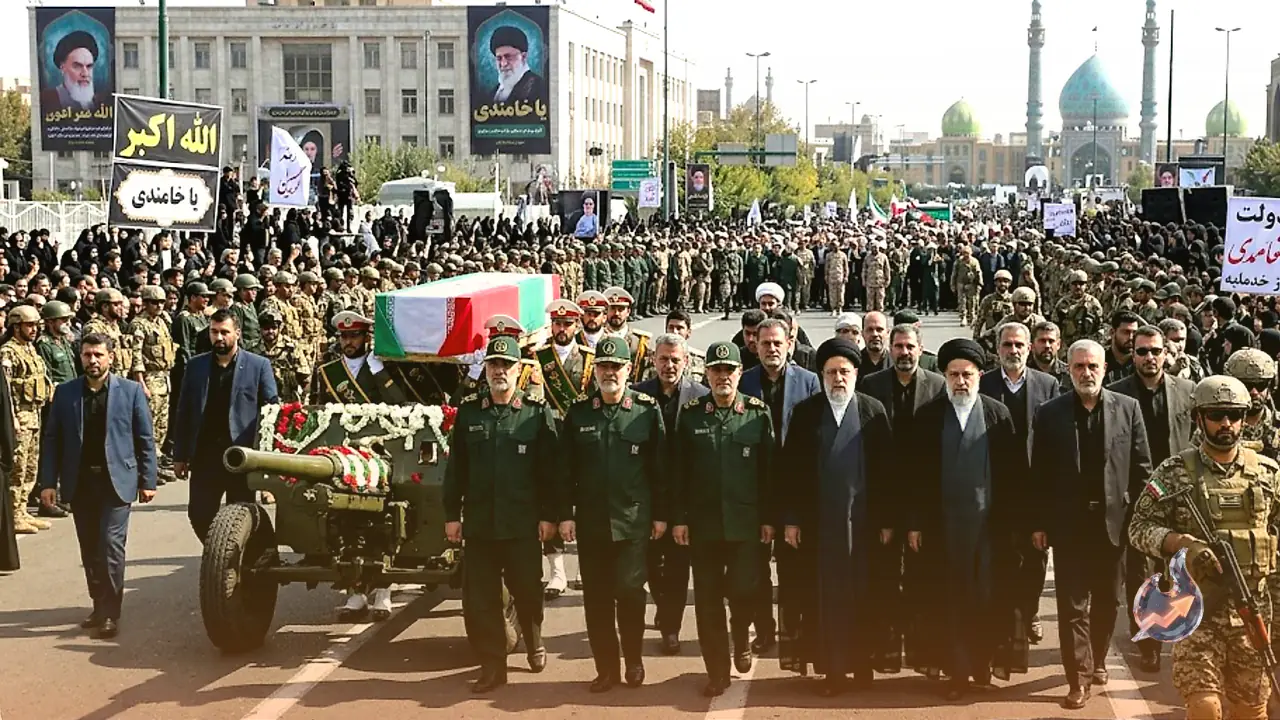

The historic streets of Tehran were flooded with millions of mourners on Sunday for the official funeral services of Iran's late Supreme Leader Ayatollah Ali Khamenei. However, the monumental gathering was instantly overshadowed by a glaring vacancy: Mojtaba Khamenei, the recently designated supreme leader, was nowhere to be seen during the highly publicized events. His absence has reignited feverish global speculation regarding his safety and physical condition, particularly following rumors that he may have been seriously wounded in the coordinated US-Israeli airstrikes that claimed his father's life. Having not appeared in public since taking office in early March, his complete withdrawal from the spotlight has added an air of deep mystery to the ongoing transition of power.
A Conspicuous Absence Amid Rumors of Injury
His three brothers, Masoud, Mostafa, and Meysam, were all prominently visible at the service on Sunday. They stood alongside the Islamic Republic's top echelon, including President Masoud Pezeshkian and the chief of the Revolutionary Guards, Ahmad Vahidi. Mojtaba, who was officially appointed to succeed his father in early March, has not made a single public appearance since taking the helm of the regime. This complete withdrawal from the public eye has intensified rumors that he was physically compromised during the devastating military strikes. Furthermore, inside Tehran, there are deep-seated apprehensions that Israeli intelligence may be actively tracking him for assassination, adding a heavy layer of security paranoia to the state-orchestrated proceedings and explaining his forced isolation.
The Grand Scale of the "Funeral of the Century"
Iranian authorities have termed this massive sequence of events the "funeral of the century," anticipating a staggering attendance of between 12 million and 20 million citizens over the course of the week. Ali Khamenei, who governed the Islamic Republic with an iron fist from 1989 until his death in February, is being bid farewell in a meticulous, state-run operation. Sunday was declared a national public holiday across Iran to facilitate maximum attendance. The late supreme leader's body is currently lying in state within Tehran's vast Grand Mosalla religious complex. The initial funeral prayers were officiated by Jafar Sobhani, a highly revered 97-year-old Shia scholar and senior teacher from the holy seminary city of Qom, reflecting the deep religious roots of the regime.
Extreme Weather and Medical Emergencies in Tehran
The sheer density of the crowd in Tehran, coupled with climbing temperatures, created challenging conditions for the millions in attendance. In an effort to prevent heat exhaustion and dehydration, state security personnel and volunteers sprayed the tightly packed crowds with mist and water. Despite these measures, the physical toll on the public was significant. Official statements from Iran's national news agency, Irna, confirmed that more than 4,000 mourners had to seek urgent medical attention at temporary clinics and medical centers set up in and around the Grand Mosalla complex. Images from the scene captured exhausted attendees, including an elderly woman being carried away on a stretcher by emergency medical teams. However, authorities noted that no deaths had been reported during Sunday's events. Special warnings were issued by state media regarding the critical danger of crowd crushes due to the expected arrival of more than 10 million people in Tehran alone.
A Display of Family Loss and Political Defiance
Beside Ali Khamenei's main casket, the Iranian regime displayed four other coffins belonging to relatives who perished in the same airstrikes in Tehran. Among these was his one-year-old granddaughter, Zahra Mohammadi Golpayegani, a poignant detail that was used to rally emotional solidarity among the public. Throughout his decades of leadership, Ali Khamenei defined his rule through an unyielding, confrontational stance against Western powers, most notably the United States and Israel. Under his guidance, Iran established and financed a robust network of armed proxy groups across the Middle East, including Hamas in the Gaza Strip, Hezbollah in Lebanon, and the Houthi movement in Yemen. This regional strategy of resistance was prominently reflected in the slogans and banners held by the grieving crowds.
Inflammatory Rhetoric and Vows of Vengeance
The atmosphere at the Grand Mosalla was highly charged with anti-Western anger. Mourners carried large banners with explicit messages such as "kill Trump" and "kill Bibi," the latter referring directly to Israel's Prime Minister Benjamin Netanyahu. The crowd repeatedly chanted "death to America" and "death to Israel," expressing their fury over the airstrikes. Before the formal prayers began, a prominent poet named Mohammad Rasouli delivered a highly provocative recitation. Rasouli declared to the massive crowd that "Trump's murder is our responsibility," a statement that drew thunderous applause and synchronized chants from the mourners, who openly vowed to avenge the deaths of their leaders.
Donald Trump's Provocative Statements and the Public's Response
From Washington, US President Donald Trump made a series of highly controversial remarks regarding the funeral proceedings. Trump confirmed that international peace negotiations had been temporarily suspended for a week to allow the funeral events to take place. He noted that with so many top-ranking Iranian officials gathered in a single location, the United States theoretically possessed the capability to eliminate the entire leadership with "one shot." However, Trump added, "But we are not going to do that because then we would have nobody to negotiate with." Trump also expressed surprise at seeing large numbers of Iranians weeping publicly, admitting he had believed the population harbored deep hatred for Khamenei. "Maybe it's fake tears," he remarked.
This claim of artificial grief was met with fierce rejection by ordinary Iranians. Zahra Safaei, a 50-year-old mourner at the complex, responded defiantly, stating that the Iranian people did not launch their revolution 47 years ago, nor did they sacrifice countless martyrs, simply to shed insincere tears today. The emotion in the streets, she insisted, was completely genuine and born out of real devotion.
The Week-Long Funeral Itinerary
The grand funeral procession is scheduled to move through the streets of the capital, Tehran, on Monday, following the removal of Khamenei's casket from the Grand Mosalla. The itinerary spans several days and multiple geographically significant locations. On Tuesday, the coffin will be transported to the holy city of Qom, a major center of Shia scholarship. From there, the procession will cross international borders on Wednesday, traveling to a highly significant Shia religious site in neighboring Iraq. Finally, on Thursday, the late supreme leader will be laid to rest in his northeastern hometown of Mashhad, concluding a highly choreographed state ritual designed to project strength, unity, and defiance to the rest of the world.