























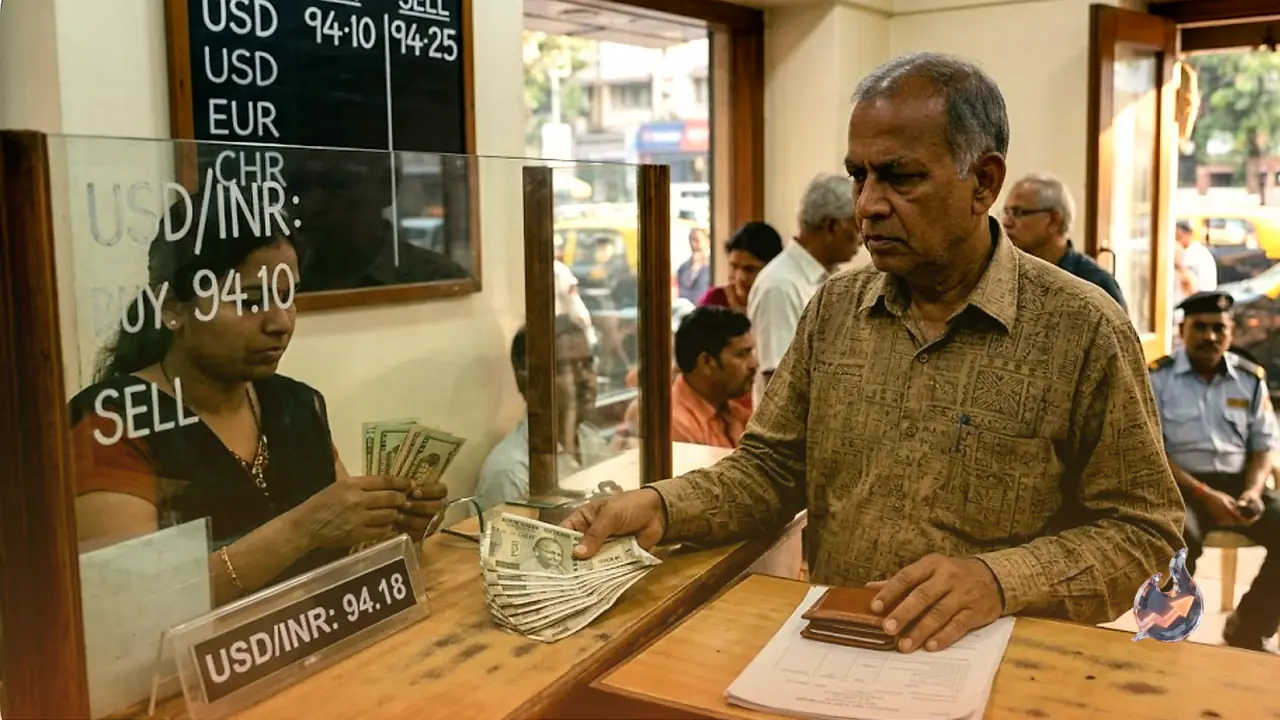

Over the past few months, one headline keeps returning almost daily: the rupee (INR) is weakening against the US dollar (USD), closing at fresh lows week after week and month after month. This is not merely a story about numbers. The move touches everything for India and for Indians, from the cost of imported fuel and electronics to the returns you earn on international investments.
For any investor trying to build a resilient, hedged portfolio, or for anyone thinking of moving money abroad, understanding the data and the market forces beneath the surface has become essential.
How the rupee moved through early 2026
The numbers from the opening months of 2026 tell a clear story of the rupee sliding against the dollar. At the end of February, the USD-INR rate sat at roughly 90.75 to 90.97. Through this stretch the rupee actually held relative strength, even as global markets wrestled with shifting trade policies and changing interest rate environments.
The picture changed as the second quarter began. By April 6, the rate had climbed to 93.06. The pressure carried into mid-April, with the rupee touching 93.39 by April 15 before correcting slightly to 93.34 on April 16.
The sharpest strain came late in the month. On April 24 the currency hit a recent high of 94.30, then settled a touch lower at 94.23 on April 27. In just two months, that added up to a depreciation of about 3.6%.
The forces driving the slide
Several macroeconomic and geopolitical factors converged to push the currency lower. One of the biggest triggers was the escalation of tensions between the US and Iran. Friction of this kind usually sparks a flight to safety, with investors shifting capital into the dollar and strengthening it against other currencies.
At the same time, such tensions tend to lift crude oil prices. Because India is a major importer of oil and other petroleum products, costlier crude raises the demand for dollars to pay for those imports, which naturally drags the rupee down.
A shifting trade map
India's trade relationships have also changed sharply. In the fiscal year 2025-26, China overtook the US to become India's largest trading partner. Crucially, the relationship is heavily lopsided, with India running a trade deficit of roughly $112 billion with China.
On top of that, merchandise exports fell, leaving a narrowed but still large trade deficit of $20.67 billion. A trade deficit that persists demands a steady supply of foreign currency, and over time that can weaken the local currency.
The wider global trade backdrop remains unsettled too. After the US Supreme Court declared certain global tariffs illegal, alternative 15% global tariffs were announced under different trade laws. These moves delayed India-US trade talks and injected fresh uncertainty into currency markets.
India, on its side, has been working to soften these pressures. One such step was the Free Trade Agreement signed with New Zealand, aimed at doubling bilateral trade between the two countries.
Building a portfolio that can take the strain
In this environment, the priority for any resilient portfolio must shift toward defensive strategies that protect real global purchasing power. The central pillar of that defence is a strong international diversification strategy, backed by tactical domestic allocations.
The most obvious route is international exposure and global diversification. Increasingly, investing outside India is no longer an option or a luxury. It works as a natural currency hedge: as the rupee weakens, the value of US-denominated assets automatically rises in rupee terms.
Global investing also lets Indian investors tap growth in markets that run on economic cycles different from India's. By holding USD-denominated assets that stretch from US Treasury bonds to global equity ETFs, investors gain direct exposure to the world's primary reserve currency, which has historically appreciated during spells of global volatility. International markets further open the door to sectors that are underrepresented in India, such as advanced biotechnology, global e-commerce giants and leading-edge semiconductor firms.
Gold, silver and the IT cushion
A second approach is to use commodities as a store of value. Precious metals like gold and silver often act as a hedge against currency devaluation.
Add to that the fact that certain sectors work as natural hedges because their revenues come mainly in dollars. The Information Technology sector is the clearest example, which makes it a relatively safe sector for investment. That said, it is worth remembering that a sector's performance is never driven by currency alone.
The mutual fund route
There is also the option of investing in mutual funds with global mandates. Many asset-management companies offer such funds, which invest in both Indian and overseas securities. However, overseas investment by Indian mutual funds is subject to industry-wide limits set by the RBI and SEBI. Once those limits are hit, fund houses may temporarily suspend fresh inflows into schemes that carry a mandate to invest in overseas securities.