





















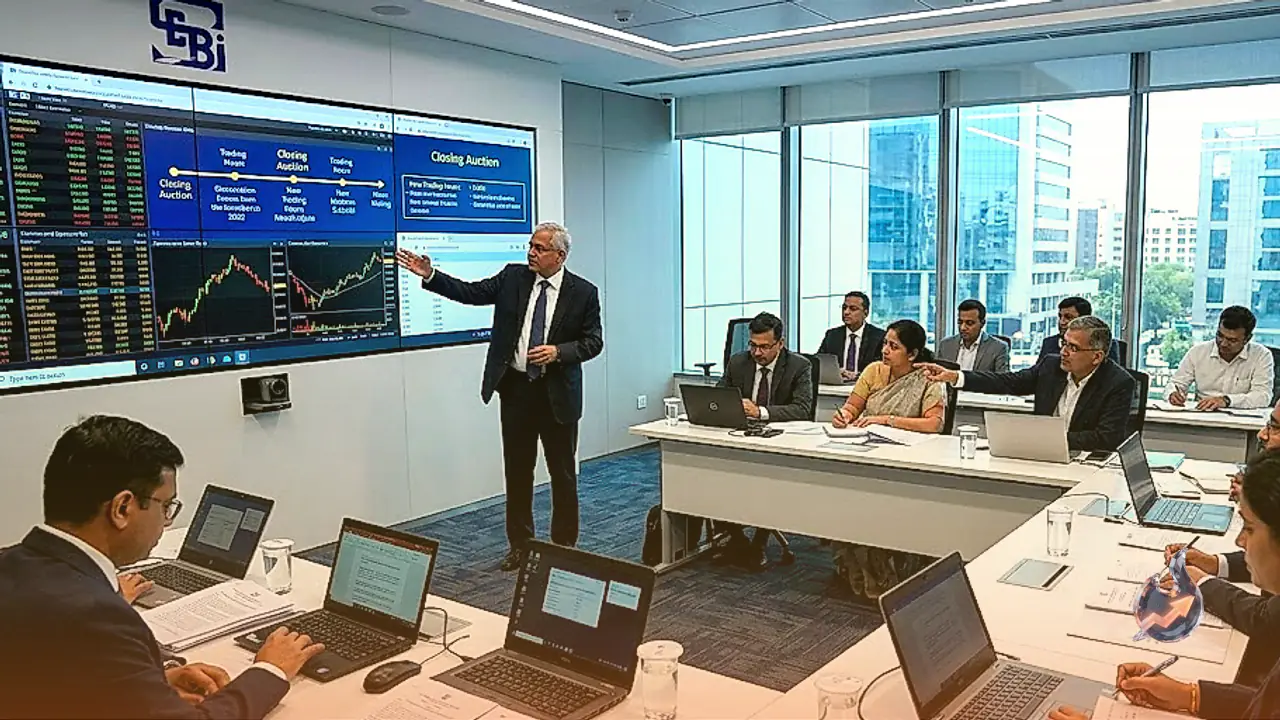

Capital markets regulator Securities and Exchange Board of India has revamped the operational framework governing the closing auction session across equity bourses. The primary objective behind this regulatory intervention is to enhance transparency and mitigate extreme price volatility that frequently occurs during auction trading in stock and index futures and options right after the regular closing bell on BSE and NSE. The comprehensive modifications directly impact overall market timings, contract settlement methodology, and the execution route for iceberg orders.
Unified Order Pooling and Closing Price Determination
Under the freshly structured mechanism, brokerage firms and stock exchanges will aggregate all pending buy and sell orders into a unified pool at the conclusion of standard trading hours. This consolidated pool serves to establish an optimal single average price at which the largest possible volume of shares can be matched and cleared. Under the earlier operational setup, the closing auction session gathered orders during the final 30 minutes preceding the closing bell to determine an average trading price. This collective clearing pattern already serves as standard practice on global venues such as the New York Stock Exchange and the London Stock Exchange.
Hariselvan Radhakrishnan, Founder & CEO of HST Wealth, stated, "SEBI has revised the Closing Auction Session framework. From December 7, CAS will run between 3:30 pm and 3:40 pm, while derivatives trading will continue until 3:45 pm." Radhakrishnan also highlighted that expiry settlement for index and stock derivatives will remain anchored to the final 30-minute volume-weighted average price of underlying constituents, thereby curbing excessive dependence on a solitary auction-determined closing figure. He added that regulations governing the automatic migration of unexecuted limit and iceberg orders into the auction window will come into force starting February 8, 2027.
Adjustments to Session Timings and Execution Windows
Under the revised schedule taking effect from December 7, 2026, the regular cash equities market will operate continuously until 3:30 pm. Immediately following this cutoff, an independent 10-minute auction window will run from 3:30 pm to 3:40 pm to discover the official closing valuations for designated equities. This marks a structural shift from the historical regime where regular market activity wrapped up at 3:15 pm, making way for an auction window between 3:15 pm and 3:35 pm.
The procedural window for market participants has also been compartmentalized. Investors will be allowed to submit both normal orders and price-specific limit orders between 3:31 pm and 3:36 pm. The submission door for standard normal orders closes promptly at 3:36 pm, though traders may continue submitting and modifying price-specific limit orders until 3:40 pm. Additionally, the pre-auction preparation interval has been streamlined from the earlier five-minute lag down to just a single minute between 3:30 pm and 3:31 pm.
Randomized Cutoffs to Discourage End-Moment Distortions
A crucial rule change centers on the conclusion of the session, with the updated auction window designed to terminate at a completely random moment between 3:38 pm and 3:40 pm. This randomness aims to discourage aggressive market participants from waiting until the absolute final second to modify bids and offers, a tactic that historically caused sharp and artificial price spikes. Requiring trades to be submitted earlier gives futures and options participants sufficient operational room to establish a fair and steady equilibrium valuation.
Trading durations for derivatives have also been clearly differentiated between contract categories. On standard trading sessions, index futures and options will stay active for trading until 3:45 pm. However, on their scheduled expiry day, these index contracts will halt 15 minutes earlier at 3:30 pm. This restriction does not apply to single-stock futures and options, which will retain their extended window and continue trading until 3:45 pm even on contract expiry days.
Treatment of Iceberg and Unexecuted Limit Orders
Regarding unfulfilled market interests, the revised framework provides that the vast majority of pending price-specific limit orders will be pushed directly into the closing auction session. In addition to changes phasing in around February 8, 2026 and February 8, 2027, large-volume iceberg orders, which ordinarily disguise order magnitude by displaying only small tranches on the public order book, will automatically transfer into the closing auction as fully visible, transparent positions unless the placing investor explicitly opts out beforehand.
It remains fundamental for market participants to distinguish between the official closing price and the last traded price of a given security. Both BSE and NSE calculate the official closing figure via the Volume Weighted Average Price (VWAP), derived from all trades matched during the final 30 minutes of the session. For instance, if an equity fluctuates between Rs 1,000 and Rs 1,020 through the entire trading day and a tiny retail lot executes at Rs 970 immediately prior to the closing bell, that solitary transaction cannot dictate the stock's recorded close. Relying purely on the last traded price can create misleading benchmarks, whereas VWAP assigns proportionate weight to larger-volume blocks to insulate the final valuation from tiny, erratic trades.
Balancing Mechanisms and Advantages for Index Funds
According to educational materials published by brokerage firm Zerodha, the restructured auction setup sharpens the broader price discovery process. Under this system, the closing mark accurately mirrors the exact price band where buyers and sellers achieve mutual equilibrium. It becomes significantly harder for manipulative participants to sway prices through last-minute bids, large institutional orders find smoother and deeper execution, and tracking error narrows substantially for index mutual funds and exchange-traded funds. It should be noted that this specific auction framework directly governs index and stock futures and options rather than standard cash equities.
The mechanics of how the closing auction operates can be observed through an indicative market scenario. Consider a company share carrying a reference benchmark of Rs 1,000 at 3:15 pm. Inside the dedicated auction window, participants log their requested prices along with share quantities. The exchange engine evaluates executable supply and demand across price tiers to select an equilibrium figure representing the highest volume match. A prospective buyer bidding Rs 1,010 is equally willing to clear at Rs 1,005 or Rs 1,000, since any price at or beneath their cap is acceptable. Similarly, a seller asking Rs 1,000 will readily execute at Rs 1,000 or above. The exchange algorithm calculates cumulative executable depth at every rung, ultimately selecting the single price where the maximum aggregate shares can be matched.
Exchange-Level Metric Availability for Traders
Brokers have clarified the specific visibility criteria governing price metrics across different asset classes. For shares listed on the NSE, an indicative close for non-auction stocks becomes accessible beginning with the first trade recorded after 3:00 pm, though reference prices and order imbalance quantities do not apply to them. Conversely, for stocks included in the closing auction, market participants can track the reference price, indicative close, and imbalance quantity starting from 3:20 pm.
For shares listed exclusively on the BSE, these three metrics are available only for designated auction stocks from 3:20 pm onwards, remaining unavailable for non-auction equities. In the futures segment, participants have access solely to the reference price and the indicative close; imbalance figures are not shown because continuous contract trading proceeds simultaneously across the session. For broader market indices, exchanges broadcast only the indicative closing figure, derived continuously from the valuations of the underlying constituent basket.