






















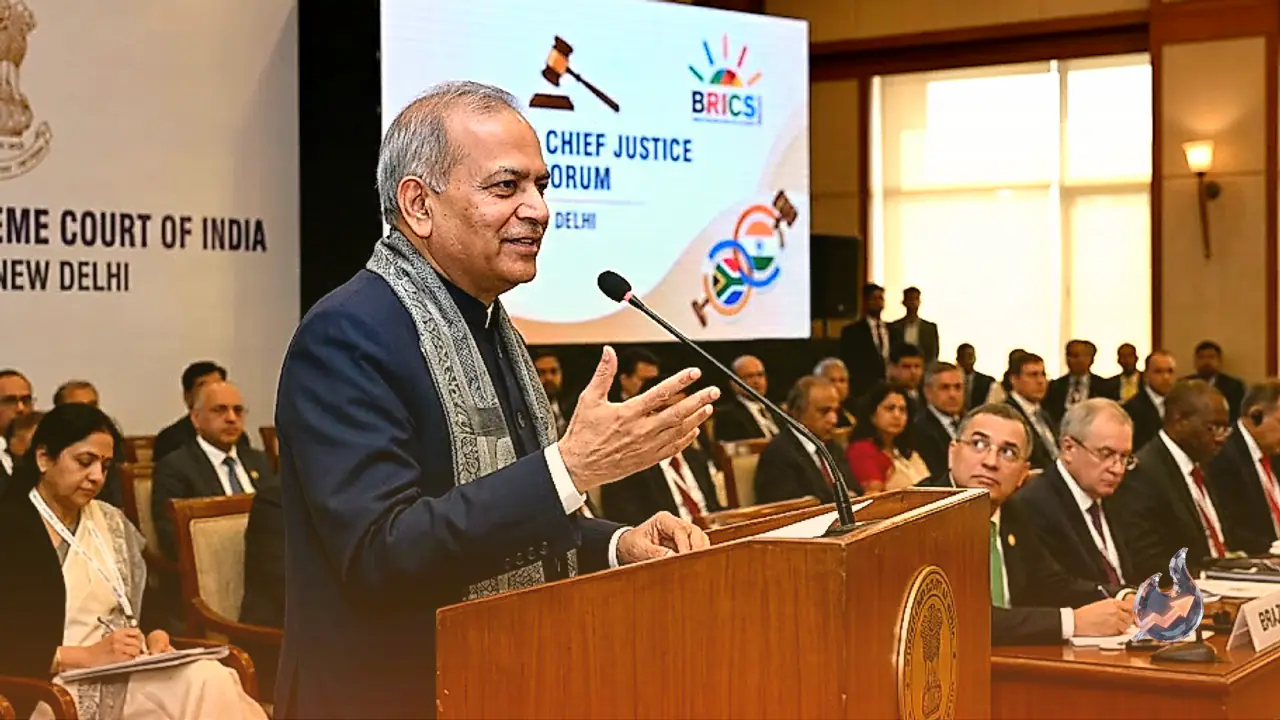

Top judges from major emerging economies and partner nations have gathered in the national capital, but during the second day of the BRICS Chief Justice Forum, Chief Justice of India Surya Kant wove together the themes of justice, development, and humanity in a manner that elevated the platform far beyond ordinary legal discourse. Hosted by the Supreme Court, the BRICS Chief Justice Forum heard the CJI state that the assembled heads of judiciaries are not merely a collection of distinct nations and legal frameworks, but a community of legal minds bound by a shared conviction that contemporary and fast-evolving challenges can be resolved through the enduring values of justice.
He noted that this BRICS platform serves as a modern fabric woven with threads of traditions, where discussions are designed not to remain confined within the pages of statute books, but to search for viable solutions for humanity as a whole. The CJI asserted that the world must envision a future where the rule of law acts as a steady and unyielding stream that channels the river of development into an ocean of shared prosperity.
Nalanda and India Message of Dialogue
In his address, Chief Justice Surya Kant made a specific reference to India's ancient knowledge traditions and the historic Nalanda University. He recalled that over a thousand years ago, Nalanda stood as a vibrant epicenter of ideas for scholars from across the globe, drawing intellectuals from China, Korea, Tibet, Persia, and the maritime regions of Southeast Asia. The CJI also highlighted the vast Dharmaganj library complex of Nalanda, which was legendary for housing roughly nine million manuscripts.
However, the greatest attribute of Nalanda was not merely its immense repository of knowledge. Chief Justice Surya Kant pointed out that visiting scholars were never subjected to the pre-condition of agreeing with any single legal framework, philosophy, or ideology. Nalanda offered an open and healthy platform for dissent, vigorous debate, and intellectual deliberation. He stated that the manner in which the BRICS platform is currently striving to bring together diverse nations and judicial systems to seek common solutions finds its truest historical precedent in that very tradition of Nalanda.
Four Engines of Progress and Their Foundation
Chief Justice Surya Kant identified economic progress, modern technology, dispute resolution, and sustainable energy as the primary engines driving the advancement of BRICS nations. Nevertheless, he cautioned that these should not be viewed as four separate and isolated engines. According to him, the ultimate success of all these pillars rests upon a single foundational support timely and reliable justice. He compared the role of the judiciary to that of a strong load-bearing wall in a building, which supports the weight of the entire structure.
While an architect might not feature that structural wall prominently in promotional images, the entire building would collapse without it. The CJI remarked that the judicial system plays this exact foundational role within any nation.
Direct Connection Between Investment and Courts
The Chief Justice explained the direct correlation between the judicial apparatus and economic investment in a remarkably straightforward manner. He stated that when a foreign investor lacks confidence in how quickly and fairly a legal dispute will be resolved in a given country, they automatically factor an additional risk premium into their commercial agreements. This manifests as higher risk premiums, additional security measures, and stringent exit clauses.
According to the CJI, this represents a hidden cost of doing business that no parliament has ever enacted through legislation, yet the investor ultimately has to bear it. He emphasized that courts delivering verdicts swiftly, consistently, and reliably can successfully mitigate this invisible cost. Consequently, a robust judicial system transforms from merely a guardian of laws and the constitution into a formidable foundation for economic growth and global investment.
The core message of Chief Justice Surya Kant's address was unequivocal. Despite possessing disparate laws, distinct countries, and varied cultures, the shared objective of judiciaries everywhere must be to forge a future where development marches hand in hand with justice, and prosperity is not restricted to a privileged few nations but shared equitably.