




















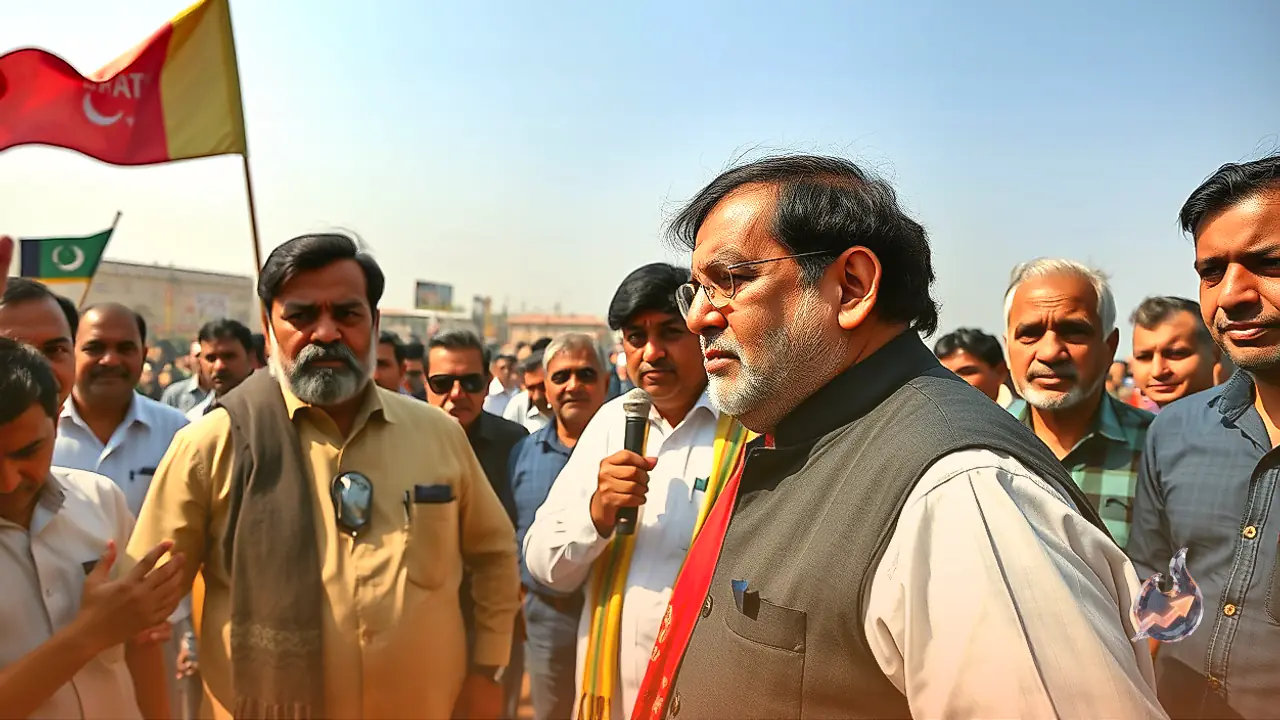

Challenging the central government's ongoing diplomatic strategy toward Pakistan, former Union minister Mani Shankar Aiyar has called for an immediate resumption of bilateral dialogue. Speaking at a public event, he leveled sharp criticism against the Bharatiya Janata Party and the ruling administration, arguing that while the country demonstrates the courage to carry out surgical strikes across the border, it lacks the necessary political determination to sit at the negotiating table and work through long-standing bilateral disputes. He emphasized that merely arguing over past historical grievances does not qualify as foreign policy.
Advocating Diplomatic Re-engagement with Islamabad
Mani Shankar Aiyar expressed deep concern over the total freeze in diplomatic communications between the two neighboring countries. He questioned why the government displays bold military capability against Pakistan yet hesitates to engage face-to-face in bilateral discussions. The former minister maintained that true diplomatic maturity lies in resolving conflicts rather than perpetuating hostile stances, questioning why peaceful coexistence and friendly relations should be treated as unachievable goals.
Highlighting shared historical, geographic, and cultural ties, he asked whether there is any nation in the entire world with which Indians feel more natural and comfortable than Pakistan. Conversely, he pointed out that Pakistan also possesses no international partner with which its diplomats and citizens can converse with the same ease and familiarity as they do with India.
The Wagah-Attari Border Dialogue Proposal
Looking back at previous negotiation mechanisms that operated between New Delhi and Islamabad, Mani Shankar Aiyar urged leaders to show the determination required to visit each other's countries. Acknowledging existing domestic reservations about official visits, he presented a distinct logistical solution at the international border between the two countries.
He suggested convening official bilateral meetings right at the Attari-Wagah border checkpoint. Under this plan, a negotiation table could be placed directly along the borderline. This setup would ensure that Pakistani delegates would not need to travel outside Pakistani territory to hold talks, while Indian officials would not need to step beyond Indian soil to participate in discussions. His principal point remained that contact between the two nations must continue without interruption, regardless of procedural hurdles.
Managing Deadlocks and Historical Precedents
Detailing the mechanics of conflict resolution, Mani Shankar Aiyar maintained that regular interaction is essential to identify which disagreements can be solved quickly and which require extended deliberation. Where mutual agreement is reached, immediate administrative action should follow. Issues lacking consensus should simply be deferred with an explicit understanding that talks will persist, allowing unsettled matters to be revisited once the broader diplomatic climate improves.
He cited the diplomatic conduct of the United States and Russia during the height of their historical rivalry, noting that even through severe friction, Washington never terminated diplomatic relations or abandoned conversations with Moscow. Sensible countries preserve lines of communication at all times, whereas shutting down discourse entirely represents an unwise strategy.
Domestic Coalitions and Jammu and Kashmir
Shifting focus to national politics, Mani Shankar Aiyar asserted that the current domestic political imbalances can be rectified with relative ease. He drew upon guidance given to Kashmiris by PDP president Mehbooba Mufti, who observed that individual visits by fragmented local leaders to Delhi would yield no influence unless the people of the region spoke in a single, united voice.
Aiyar argued that this exact principle governs the wider national political landscape. A political turnaround at the Centre requires all non-Hindutva parties to forge a united front. He contended that had his political collective governed from Delhi, statehood for Jammu and Kashmir would have already been restored, alongside a potential return of Article 370 and Article 35A in a modified form. He concluded that meaningful progress across both domestic governance and diplomatic reconciliation with Pakistan ultimately hinges on whether differing opposition groups can unite around a shared objective.