























A notable agricultural shift is unfolding in Uttar Pradesh's Lakhimpur Kheri district, where farmers are increasingly branching out from traditional grain cultivation to embrace fast-yielding vegetable crops. Among these short-cycle options, commercial cucumber farming has emerged as a reliable vehicle for generating regular cash flow. Agricultural pockets including Bankeyganj, Mohammadi, and Barwar have seen farmers commit significant acreage to cucumber vines. When supported by meticulous field management and favorable weather conditions, cucumber plants typically reach maturity and yield their initial harvest within roughly 45 to 60 days following sowing.
A distinct advantage of growing cucumbers lies in the staggered nature of the harvesting cycle. Growers are not required to clear the entire field at once; instead, fruits are plucked at planned, periodic intervals based on their development, size, and market readiness. This staggered approach ensures a steady, daily supply of fresh produce that farmers can consistently dispatch to trading centers. With healthy demand across both local rural markets and surrounding major urban hubs, growers are finding readily accessible outlets for their volume.
Trellis Farming Enhances Crop Quality and Field Operations
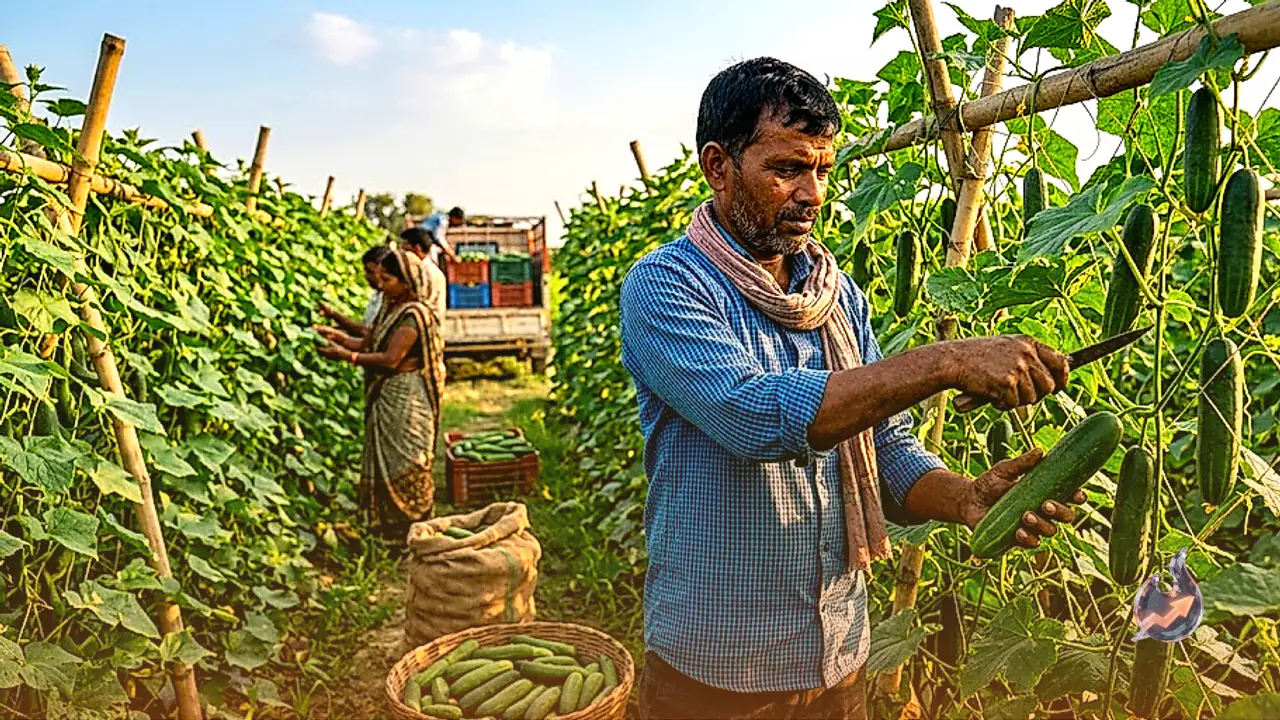
Rather than letting cucumber vines spread across the damp soil, agriculturalists in the area are adopting vertical trellis farming methods. Under this approach, the climbing vines are trained upward using a framework constructed from bamboo poles, wires, ropes, or comparable supports. Suspending the vines prevents the developing fruit from coming into direct contact with the ground, keeping the cucumbers straight, spotless, and uniformly colored, which in turn commands a higher market price.
Beyond fruit quality, vertical support structures streamline routine field activities. Laborers can execute weeding, soil loosening, pest monitoring, and daily harvesting with greater efficiency and ease without trampling over tangled vines. Farmers construct these trellises based on available resources and financial capacity, relying predominantly on bamboo stakes and durable twine. Consequently, the initial setup cost fluctuates depending on the total acreage and the grade of materials chosen. While adequate soil moisture is critical for vigorous vine growth, standing water around the root zones can be highly detrimental. In a low-lying Terai landscape where heavy rain can quickly cause water accumulation, farmers must remain particularly cautious.
Water Management and Irrigation Protocols in the Terai Belt
During warm spells, irrigation cycles must be calibrated strictly according to the crop's physiological needs. Deciding when and how frequently to irrigate depends heavily on soil composition, prevailing temperatures, seasonal factors, and the growth stage of the vines. Whenever rainfall occurs, growers are advised to inspect actual soil saturation before initiating irrigation. Crucially, fields must be equipped with functional drainage channels so that surplus rainwater is evacuated swiftly to avoid root suffocation.
Daily Yields and Economics on a Two-Bigha Farm
Sharing practical insights into farm operations, local grower Ramaasre stated that he has been cultivating cucumbers continuously across approximately two bighas of land over the past two years. According to his calculations, his plot is currently generating a daily harvest exceeding one quintal of fresh produce. In wholesale market transactions, he is realizing prices ranging between 25 and 30 rupees per kilogram for his daily output.
The grower pointed out that when market rates remain favorable alongside high yield rates, cucumber cultivation offers strong financial returns for smallholders. However, he noted that the operation involves multiple recurring and initial expenditures, including quality seeds, fertilizers, irrigation water, field labor, trellis infrastructure, and transport logistics. Thus, the ultimate net earnings of any farmer are strictly determined by the balance between operational overheads and daily market fluctuations.
Reaching Metropolitan Wholesale Terminals in Kanpur and Delhi
Local agricultural trader Ashish Gupta explained that cucumber cultivation has expanded significantly across the farming belts of Bankeyganj, Mohammadi, and Barwar in Lakhimpur Kheri district. The cucumbers harvested from these rural farms are no longer confined to local roadside stalls or district bazaars; commercial transport networks are actively moving consignments to distant metropolitan centers.
The trader stated that vehicular shipments are transporting sizeable volumes of cucumbers directly to high-consumption terminal markets, notably in Delhi and Kanpur. By securing access to these major urban markets that absorb heavy daily tonnage, growers in Lakhimpur Kheri are gaining valuable marketing leverage alongside their regional trade avenues.