


















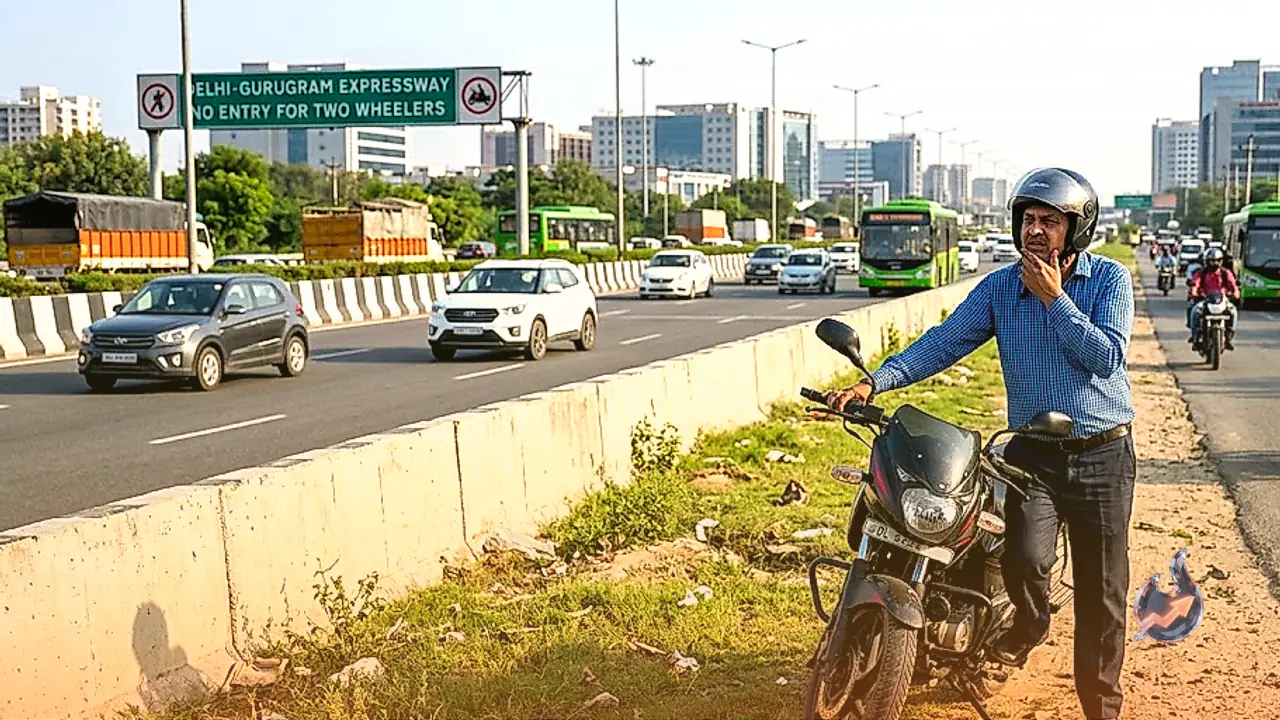

A recent traffic decision by authorities in Bengaluru has sparked serious concern among the lakhs of daily riders who commute between Delhi and Gurugram on their motorcycles. Bengaluru traffic police restricted two-wheelers from using their busiest airport and Electronics City elevated corridors. If a similar ban were to be enforced on the heavily congested NH-48 and IGI Expressway route connecting the national capital and Gurugram, the entire regional transport system could be thrown into disarray. While cars speeding along the expressway would experience a smoother, red-carpet style commute, riders diverted to the narrow service lanes below would face severe gridlock. Public transit networks would swell beyond capacity, and the delivery schedules of popular quick-commerce platforms would experience catastrophic delays, ultimately paralyzing traffic flow across the entire National Capital Region.
Spillover and Traffic Congestion on Lower Service Lanes
Lakhs of commuters travel between Delhi and Gurugram every single day, a demographic heavily populated by corporate professionals, delivery agents, and daily wage earners who rely on personal motorcycles and scooters. Removing two-wheelers from the elevated expressway lanes would force this massive volume of traffic down onto the adjacent service roads, Mahipalpur corridors, and inner cantonment streets. Because these service lanes are already quite narrow in several spots, an abrupt influx of thousands of two-wheelers would immediately create severe local bottlenecks and continuous traffic jams during peak hours.
Overwhelming Crowds on Metro and Public Transit Networks
Faced with a ban on expressway use, a vast majority of displaced riders would inevitably shift toward public transportation systems. This sudden migration would cause passenger numbers to surge dramatically on the Delhi Metro Yellow Line connecting HUDA City Centre to Samaypur Badli, as well as the dedicated Airport Express line. During peak commuting hours in the morning between 8 am and 11 am, and in the evening between 5 pm and 8 pm, major interchange stations such as Rajiv Chowk, New Delhi, and Dhaula Kuan would experience extreme crowding, making it difficult for passengers to even find standing room.
Direct Disruption to Quick-Commerce and Delivery Ecosystems
The modern quick-commerce and delivery infrastructure across Delhi-NCR, including platforms like Zomato, Blinkit, Swiggy, and Dunzo, operates almost entirely on the back of two-wheeler couriers. A vast quantity of parcels, food orders, and urgent packages are transported rapidly between Gurugram and Delhi via the main expressway. Implementing a two-wheeler ban would directly increase delivery turnaround times, inflate logistics overhead costs, and severely impact the daily livelihoods of thousands of gig economy workers whose primary source of income depends on unhindered transit.
• Positive Aspect: Lane discipline for cars and buses traveling on the expressway would improve noticeably, leading to a substantial decrease in fatal collisions and accidents that typically occur when high-speed four-wheelers and vulnerable two-wheelers share the same fast lanes.
• Negative Aspect: The extreme concentration of diverted two-wheelers crammed into narrow service lanes would sharply elevate the frequency of minor fender-benders and exponentially increase safety risks for pedestrians trying to navigate those congested local roads.
Infrastructure Contrast: Comparing Delhi-NCR and Bengaluru
Evaluating the proposal requires examining the structural differences between Bengaluru's airport corridors and the Delhi-Gurugram NH-48 route. Bengaluru's affected corridors have limited or developing metro connectivity, whereas the Delhi-Gurugram axis features a robust, extensive metro network comprising the Yellow Line and Airport Express. Furthermore, while passenger volumes on both routes are exceptionally high, Delhi's Mahipalpur approach roads transition abruptly from wide expanses to severely constricted bottlenecks. A blanket ban on two-wheelers along the Delhi-Gurugram route might benefit car drivers on the main expressway and lower accident rates, but in the absence of mature last-mile alternatives and adequate public transit readiness, it would paralyze NCR traffic. Before enacting any such rule, authorities must first expand electric bus fleets and develop dedicated two-wheeler corridors.