





















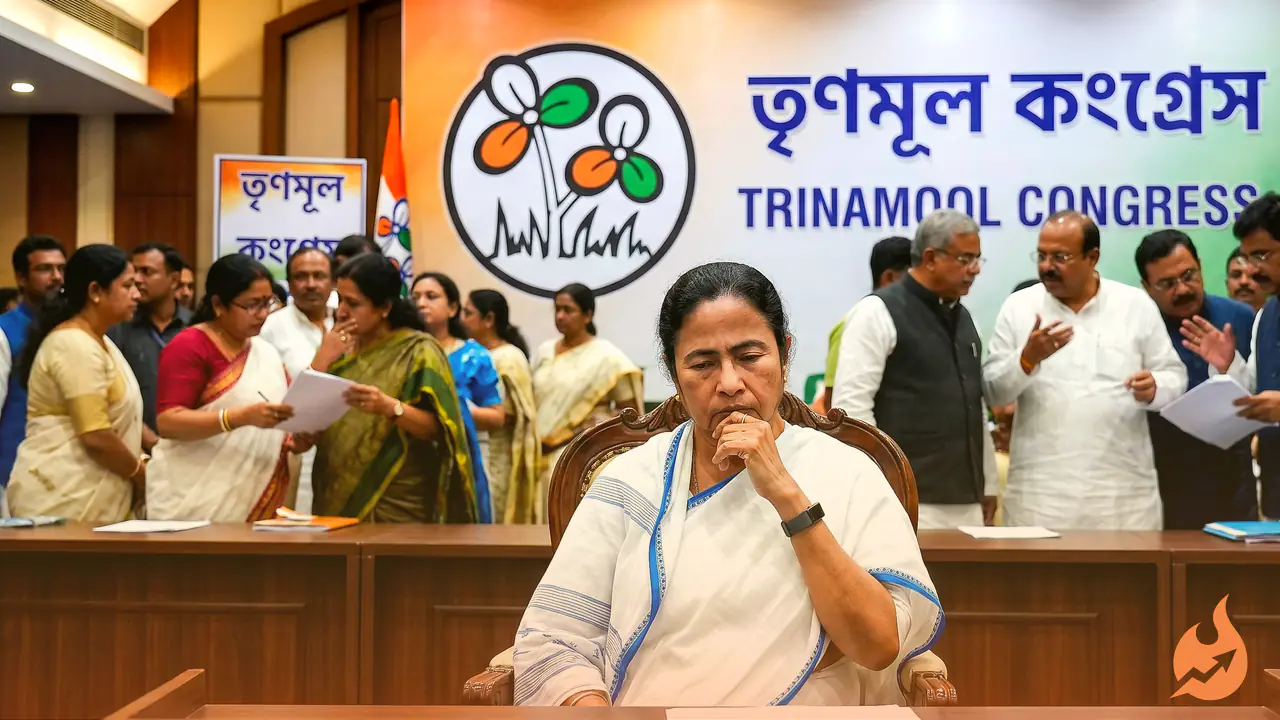

Defeats and revolts are nothing new in politics, but the most frightening moment for any party arrives when it is not the opposition but its own people who turn against it. When a party's seasoned leaders, popular MPs, film stars and most trusted faces rebel all at once, the fight is no longer just about seats — it hangs over the party's very future. West Bengal's politics is currently passing through exactly such a major upheaval. The rebellion brewing within the Trinamool Congress is no longer mere discontent; it has begun to look like a battle for the party's survival.
After MLAs, Now MPs Turn Rebel
A few days ago, under the leadership of TMC leaders Ritabrata Banerjee and Sandipan Saha, 58 of the Trinamool Congress's 80 MLAs revolted and formed a separate faction. Former state Chief Minister and party chief Mamata Banerjee had barely recovered from this blow when resignations from Rajya Sabha MPs began. And now, on Friday, a letter from 19 rebel Lok Sabha MPs of the party has surfaced, allegedly sent to the Speaker on May 18. The letter demands that these 19 MPs be recognised as a separate group.
Why Is This Blow So Big for Mamata?
If this entire sequence of events gains legal validity, it could turn out to be the biggest split in TMC's history. The real significance of this rebellion lies not merely in the numbers, but in the faces involved. The rebel MPs are said to include leaders who were once regarded as Mamata Banerjee's most trusted soldiers. Among them are popular names such as cricketer-turned-MP Yusuf Pathan, actress and MP Sayoni Ghosh, senior MP Kakoli Ghosh Dastidar, Satabdi Roy, Rachna Banerjee and Deepak Adhikari (Dev).
The Closest Aides Walked Away
It is worth noting that many of these leaders were promoted in politics by Mamata Banerjee herself. With the party's 'star faces' and old organisational leaders choosing a separate path together, it has become clear that their faith in the leadership has worn thin. Even Kalyan Banerjee, who appeared to be standing firmly with Mamata, bluntly stated on Thursday that the former Chief Minister would have to choose between him and her nephew Abhishek Banerjee. In such circumstances, few trusted faces seem to remain around Mamata Banerjee.
Has Mamata's Grip Really Weakened?
TMC has always been a party whose entire political identity was built around Mamata Banerjee. The party's organisation, electoral strategy and support base have largely depended on her leadership. But if two-thirds of the party's MLAs and MPs leave with a separate faction, it would not be wrong to say that her grip on the party has loosened. For a regional party like TMC, this situation is considered extremely serious, because the foundation of such parties often rests on a single strong leader. When that very leader's close associates begin to drift away, the roots of the organisation start to weaken.
Will the Separate Faction Get Legal Approval?
Under India's anti-defection law (the Tenth Schedule of the Constitution), a separate faction of a political party's MLAs or MPs can secure legal protection only if at least two-thirds of the members are with it. In the current scenario, 58 of TMC's 80 MLAs in the Assembly are said to have broken away, while in the Lok Sabha, 19 of the 28 MPs are reportedly in the rebel camp. In both cases the numbers are touching the two-thirds mark, and this is precisely why the rebel leaders could escape disqualification under the anti-defection law.
Has TMC's Foundation Been Completely Shaken?
Discontent is common in political parties, with some leaders coming and going. But when a party's experienced leaders, MPs, MLAs and popular faces revolt together, the matter ceases to be ordinary. This is why it is not just a 'rebellion' but the toughest test of TMC's existence. If this split takes full shape, the balance of power in Bengal's politics could shift. On the other hand, if Mamata Banerjee manages to contain this crisis, it would be hailed as a major achievement of her political career — though for now, that seems difficult.