


















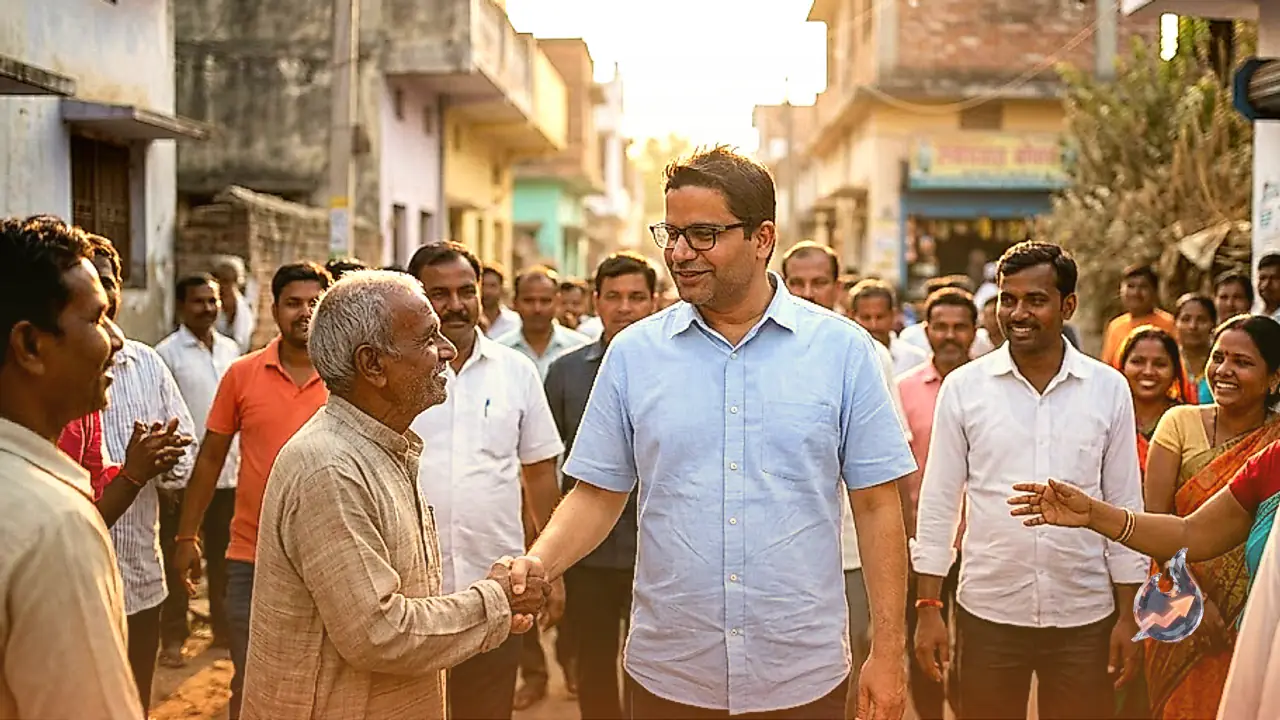

Prashant Kishor has secured a high-profile victory in the Bankipur by-election, drawing intense political attention from across India. For over a month, this single constituency contest remained the center of national and state curiosity. Now that the Jan Suraaj candidate has emerged victorious, political analysts are immediately drawing parallels between this result and the 1994 Vaishali Lok Sabha by-election. This historical comparison naturally raises questions about why a political event from three decades ago is suddenly dominating discussions today.
Why the Bankipur Contest Gained Massive Attention
Observers initially wondered why a single legislative by-election was generating such overwhelming noise. The primary reason was that the seat fell vacant after its former MLA, Nitin नवीन, became the BJP national president and a Rajya Sabha member. In terms of party hierarchy, this was effectively the home turf of the bosses right above Prime Minister Narendra Modi and Home Minister Amit Shah. The second major factor was that the constituency had remained under the firm grip of Navin Kishore Prasad and later his son Nitin नवीन for thirty-one years, making it widely regarded as the BJP's safest seat in all of Bihar. The third critical element was that Prashant Kishor, the political strategist turned politician and founder of Jan Suraaj, was contesting an election for the very first time.
BJP Efforts and the Surprising Outcome
All efforts deployed by the ruling party to safeguard the prestige of their top leadership ultimately proved unsuccessful. Jan Suraaj founder Prashant Kishor pulled off a massive upset by winning the seat with a margin of over nineteen thousand votes, stunning political watchers everywhere. This breakthrough victory is now being heavily compared to the massive political turnaround witnessed during the 1994 Vaishali Lok Sabha by-election.
The Backdrop of the 1994 Vaishali Event
Ever since taking oath as Chief Minister in 1990, Lalu Prasad Yadav had been dominating Bihar's political landscape in his own distinctive style. Across the entire undivided state of Bihar, the prevailing political atmosphere ensured that whatever move Lalu Yadav made seemed to work entirely in his favor. To secure the votes of OBCs and Dalits, he frequently used colloquial and sharp remarks regarding upper castes, yet his political dominance remained entirely unshakeable. Around that same period, through the special efforts of then Roads Minister Ilyas Hussain in the Lalu cabinet, a new block was established in Dehri-on-Sone. Then Chief Minister Lalu Prasad Yadav personally visited to inaugurate it, delivering a speech from the stage where he made controversial remarks against those wearing the sacred thread. He openly declared that to secure dignity for the poor and backward classes, he would teach a lesson to those wearing sacred threads in every possible manner, dismissing such traditions entirely.
Fiery Rhetoric and Caste Tensions of the Era
During that era, Lalu Prasad Yadav frequently deployed polarizing slogans that deeply shook the social fabric. With the implementation of the Mandal Commission recommendations, society across Bihar was burning in intense caste-based polarization between forward and backward communities. As a result of these unfolding events, upper-caste communities across the state, particularly Brahmins, Bhumihars, and Rajputs, were deeply alienated. At the same time, when Rajput leader Anand Mohan began strongly challenging Rajesh रंजन alias Pappu Yadav, widely regarded as an OBC strongman, Mohan's popularity among upper castes surged rapidly, much to the annoyance of Lalu Prasad Yadav.
The Story Behind the 1994 Vaishali By-Election
Following the sudden death of Janata Dal MP Shivsharan Singh, a by-election for the Vaishali Lok Sabha seat became necessary in 1994. Facing dominant OBC strongmen, Anand Mohan emerged as a formidable rallying figure for upper-caste strength. Acting on the advice of his supporters, he formed the Bihar People's Party (BPP), which upper castes across Bihar began joining in massive numbers. When the Vaishali by-election was announced, Anand Mohan fielded his wife, Lovely Anand, under the banner of the Bihar People's Party to directly challenge Lalu Prasad Yadav's political dominance. Meanwhile, Kishori Sinha, the wife of former Chief Minister Satyendra Narayan Sinha, contested on a Congress ticket with the direct backing and blessings of Lalu Prasad Yadav.
The Campaign and the Counting Day Drama
The 1994 Vaishali contest was fought not on local developmental issues, but squarely on the agenda of dismantling Lalu Prasad Yadav's supremacy. Throughout the campaign, Anand Mohan and his candidate wife Lovely Anand continuously urged upper castes to unite. Conversely, Lalu Yadav desperately wanted the Congress candidate to win in order to check Anand Mohan's rising stature. After polling concluded, votes were counted at LS College in Muzaffarpur. Because voting was conducted via paper ballots, counting took considerable time. Consequently, Anand Mohan and Lovely Anand waited in a house near LS College to track the numbers. At around 5:30 PM, Lovely Anand's victory was officially announced.
Celebrations and Anand Mohan's Bold Claim
Upon hearing the news, Anand Mohan arrived at the counting center wearing dark sunglasses and twisting his trademark mustache. He was accompanied by BPP candidate and wife Lovely Anand, both sporting black shades. Spotting them, supporters began tossing colored powder and shouting slogans of "Anand Mohan Zindabad" and "Lovely Anand Zindabad" with such intensity that the entire neighborhood resonated with the cheers. Anand Mohan then approached the media and declared with immense confidence that he would become the Chief Minister of Bihar within the next six months. The cheering grew even louder at this statement. Upper castes across Bihar felt that Anand Mohan was the leader who could free them from Lalu Prasad Yadav's rule. As the BPP's membership drive accelerated across the state, upper-caste expectations soared higher. However, just months after this historic result, prominent Bhumihar strongman Chhotan Shukla was murdered, altering the political landscape once again.