





















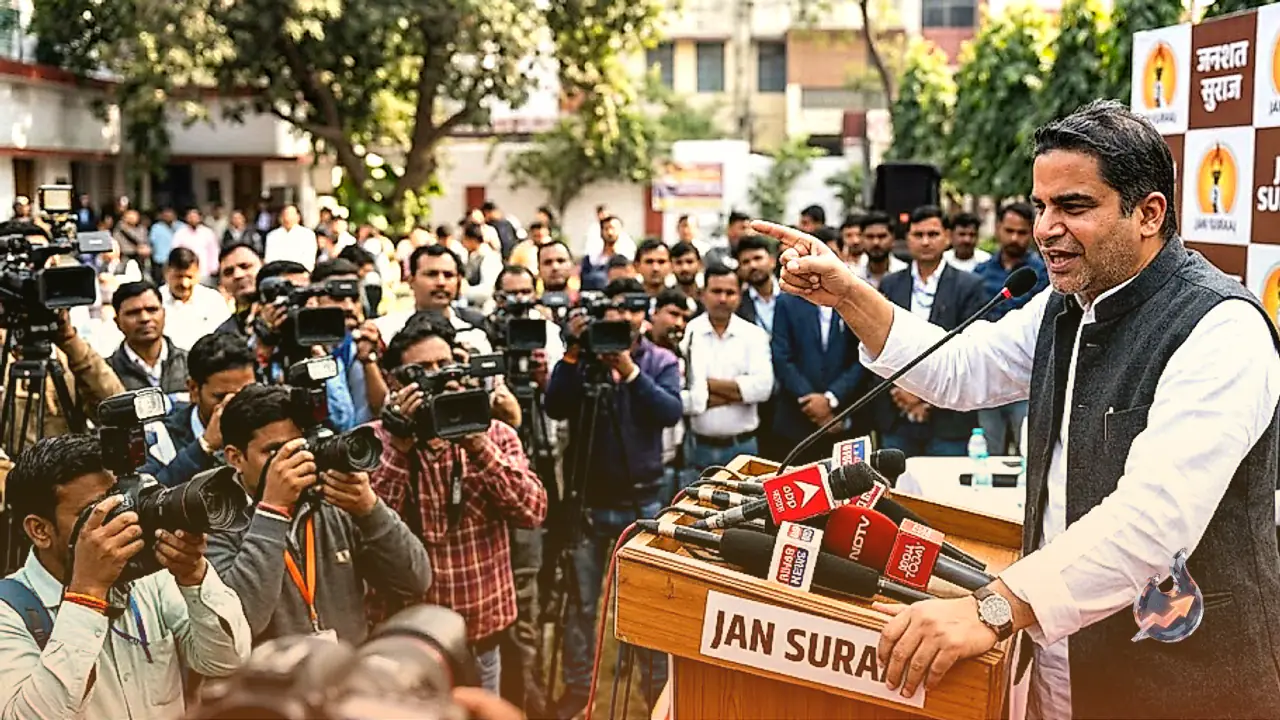

The political arena of Bihar is witnessing a sharp escalation in verbal warfare, with leaders trading direct and incisive blows. While internal discussions within the ruling Janata Dal United are reportedly focusing on a proposal to rename the party as 'Janata Dal (Nitish)', Prashant Kishor, the architect of the Jan Suraaj movement and MLA from Bankipur, has seized the opportunity to launch a scathing attack on the party's top brass. Mocking the potential renaming exercise, Kishor remarked that whether the party is called Janata Dal United or Janata Dal Nitish, its ultimate controller remains Amit Shah, with two local leaders acting merely as puppets under his command. This sharp criticism has put the JDU leadership on the defensive and raised questions about the growing influence of the BJP within the state's ruling coalition.
The Renaming Debate and the Metaphorical Attack
Over the past few days, intense speculation has surrounded the proposal to change the name of the Janata Dal United to 'Janata Dal (Nitish)'. Commenting on this development, Prashant Kishor argued that altering the name of the organization would do nothing to change the stark ground realities in Bihar. He asserted that the title of the party is irrelevant because the actual operations of the current JDU are not being directed by Nitish Kumar, but are instead being managed by Amit Shah. According to him, whatever the central BJP leadership decides is what ultimately gets implemented within the JDU. In a video shared on X, Kishor elaborated on this by stating that the party is effectively run from Delhi, while two subordinate figures, whom he described as "van damru" (puppet-like hand-drums), simply dance to the tunes of their central handlers.
Decoding the 'Van Damru' Reference
By using the term "van damru," Prashant Kishor has taken a direct swipe at senior JDU leaders who are believed to be executing decisions dictated by the BJP's central command. This metaphor refers to individuals who have no independent decision-making power and are entirely dependent on external instructions. Kishor's underlying message is that Nitish Kumar's party has lost its strategic autonomy, and its top decision-makers are merely carrying out orders arriving from Delhi. Although Kishor did not explicitly name the two leaders he was referring to, his remarks have sparked intense speculation and debate within Bihar's political circles regarding the identity of these key figures who supposedly hold no real authority of their own.
Shift in Strategic Focus from Samrat Choudhary to JDU
Until recently, Prashant Kishor's primary political target in Bihar was the state's Deputy Chief Minister, Samrat Choudhary. During the campaign for the 2025 Bihar assembly elections, when Samrat Choudhary referred to Kishor as a helpless figure in an interview, Kishor had quickly retaliated. He remarked that he was indeed helpless because he had no other option but to focus on reforming Bihar, adding that he could not leave the future of the state in the hands of leaders like Samrat Choudhary. However, Kishor's tactical focus has now shifted dramatically. Instead of engaging in a war of words with Choudhary, he has redirected his offensive directly toward the JDU's administrative apparatus and Nitish Kumar's governance model.
Targeting the Core Voter Base of Nitish Kumar
This shift in strategy is a calculated political move. Prashant Kishor is well aware that Bihar contains a significant block of neutral and Extremely Backward Class (EBC) voters who do not strongly align with either the RJD or the BJP. Historically, this segment has formed the core of Nitish Kumar's electoral strength. By portraying the JDU as a weakened entity and building a narrative around the decline of "Brand Nitish," Kishor hopes to pull this crucial voter base toward his own party, Jan Suraaj. He is using the renaming controversy as evidence of the JDU's dwindling relevance. Furthermore, Kishor has targeted the JDU on practical governance issues, such as the annual devastation caused by floods and the perceived mismanagement of the Water Resources Department, a critical portfolio that has remained under the JDU's control for several years.
Jan Suraaj's Alternative Agenda for Bihar's Future
Through his Jan Suraaj platform, Prashant Kishor is attempting to challenge the traditional political parameters of Bihar, which have long been dominated by caste equations, religious identity, and populist freebie schemes. He is trying to steer the political discourse toward substantive issues like quality education and employment opportunities. Characterizing the JDU as an organization managed by Amit Shah and criticizing its leaders as powerless entities is central to this strategy. By doing so, Kishor aims to present himself and Jan Suraaj as the only credible and powerful alternative to both the NDA and the Mahagathbandhan coalitions. As Bihar prepares for future electoral battles, including the 2029 Lok Sabha elections and the 2030 Bihar Assembly elections, it remains to be seen how effectively Kishor's strategic narrative will translate into actual votes at the polling booths.