





















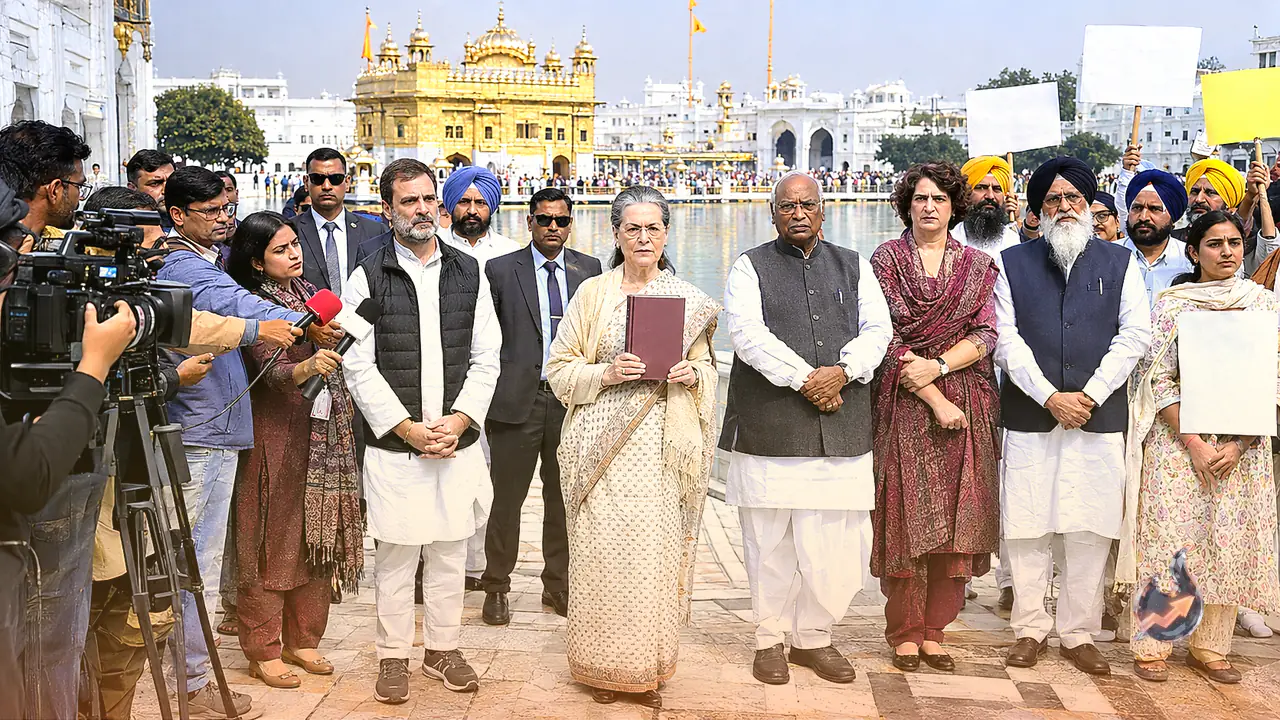

A sharp political debate has erupted across the country following the release of Congress Parliamentary Party Chairperson Sonia Gandhi's autobiography, titled 'Belongings: A Journey of Love', on Tuesday, November 10. The newly published memoir touches upon several deeply contentious chapters of modern Indian history, most notably the 1975 Emergency, Operation Blue Star in June 1984, and the anti-Sikh violence that followed later that year. Coming just months ahead of the Punjab assembly elections scheduled for early next year, the disclosures have handed fresh political ammunition to the Bharatiya Janata Party and the Shiromani Akali Dal, both of which have launched a coordinated offensive against the Congress party's historical conduct and leadership.
Operation Blue Star and Indira Gandhi's Immediate Reaction
In the socio-political arena of Punjab, the events of 1984 remain an extraordinarily delicate and enduring issue, with memories of the military assault on the Golden Temple and the subsequent nationwide riots etched into the consciousness of multiple generations. In her memoir, Sonia Gandhi reflects on the immediate aftermath of the June 1984 military action inside the Golden Temple complex. She writes that upon learning of the extensive physical damage inflicted upon the holy shrine, then Prime Minister Indira Gandhi was consumed by intense grief. According to her account, Indira Gandhi had tears of profound pain and deep remorse in her eyes as the magnitude of the destruction became apparent.
However, this emotional recollection has drawn sharp criticism from political opponents in Punjab. Leaders of the Shiromani Akali Dal have dismissed these passages as an exercise in diluting historical responsibility and softening the severity of state actions. They argue that personal sorrow and tears do not absolve the executive authority of the time, nor do they offer justice or adequate answers to the Sikh community for the immense collective trauma inflicted during that period. The regional party maintains that presenting the tragedy through a lens of private remorse attempts to circumvent hard political accountability.
The 1984 Anti-Sikh Violence and the Deployment Controversy
Addressing the anti-Sikh violence that erupted across the national capital and other regions following Indira Gandhi's assassination, Sonia Gandhi addresses the administrative failures of the time. In the memoir, she acknowledges that significant administrative delays plagued the ground deployment of military units tasked with controlling the bloodshed. At the same time, she argues that the brutal violence should not be interpreted as reflecting any deep-seated anti-Sikh mindset on the part of Rajiv Gandhi or the broader Congress party, portraying the tragedy instead as a breakdown of administrative coordination.
This interpretation has been strongly contested by senior advocate and BJP leader HS Phoolka, who questioned the timeline presented in the memoir. According to Sonia Gandhi's book, Rajiv Gandhi directly asked Chief of the Army Staff General AS Vaidya to call in the military on the night of October 31, 1984, and decisions were taken regarding the mobilization of troops stationed around Delhi. Countering this version, HS Phoolka claimed that approximately 6,000 army personnel were already available in Delhi through the evening of October 31 and the morning of November 1. Citing findings from the Justice Ranganath Misra Commission report, he asserted that had these available soldiers been actively dispatched onto the streets without hesitation, an enormous number of innocent Sikh lives could have been preserved. This discrepancy between issuing mobilization orders and achieving operational field deployment has reignited debate over administrative culpability.
Reflections on the 1975 Emergency and Sanjay Gandhi
Beyond the events of 1984, the memoir addresses the declaration of internal Emergency in 1975, with Sonia Gandhi describing the move as an unmistakable mistake. She suggests that Indira Gandhi herself came to realize the gravity of that misstep in subsequent years. Furthermore, the book notes that if Sanjay Gandhi had been kept under tighter restraint, the extensive excesses, administrative abuse, and collateral damage suffered by the public during the Emergency could have been substantially minimized.
The Bharatiya Janata Party seized upon these admissions to mount a wider critique of the Congress establishment. BJP national spokesperson CR Kesavan stated that the volume would have been more aptly titled 'Whitewashing' rather than 'Belonging', accusing the author of attempting to sanitize controversial historical actions undertaken by the Nehru-Gandhi family. Party representatives also questioned Sonia Gandhi's perspective on other major milestones, including the Babri Masjid demolition and the overarching narrative surrounding 1984. By tying these admissions together, the opposition is actively framing the book as an effort to rewrite historical accountability.
Electoral Repercussions for Punjab Assembly Elections
The controversy surfaces at a precarious juncture for the Congress party in Punjab, where assembly elections are scheduled for early next year. The party's campaign blueprint had been designed to focus heavily on pressing governance and agrarian issues, such as farmers' economic distress, rural debt, widespread youth unemployment, the ongoing substance abuse crisis, deteriorating law and order, and public resentment against the incumbent administration. The goal was to channel political discourse toward current socioeconomic challenges.
However, the emergence of this historical debate threatens to put Congress on the defensive throughout the campaign trail. Leaders from both the Shiromani Akali Dal and the BJP are expected to spotlight the book's contents during public rallies, pressing Congress candidates on Operation Blue Star, the 1984 riots, and the Emergency. Instead of dictating the agenda around bread-and-butter issues, Congress leadership may find itself expending critical campaign momentum defending decisions taken four decades ago, potentially altering voter dynamics in a state where historical memory carries decisive electoral weight.