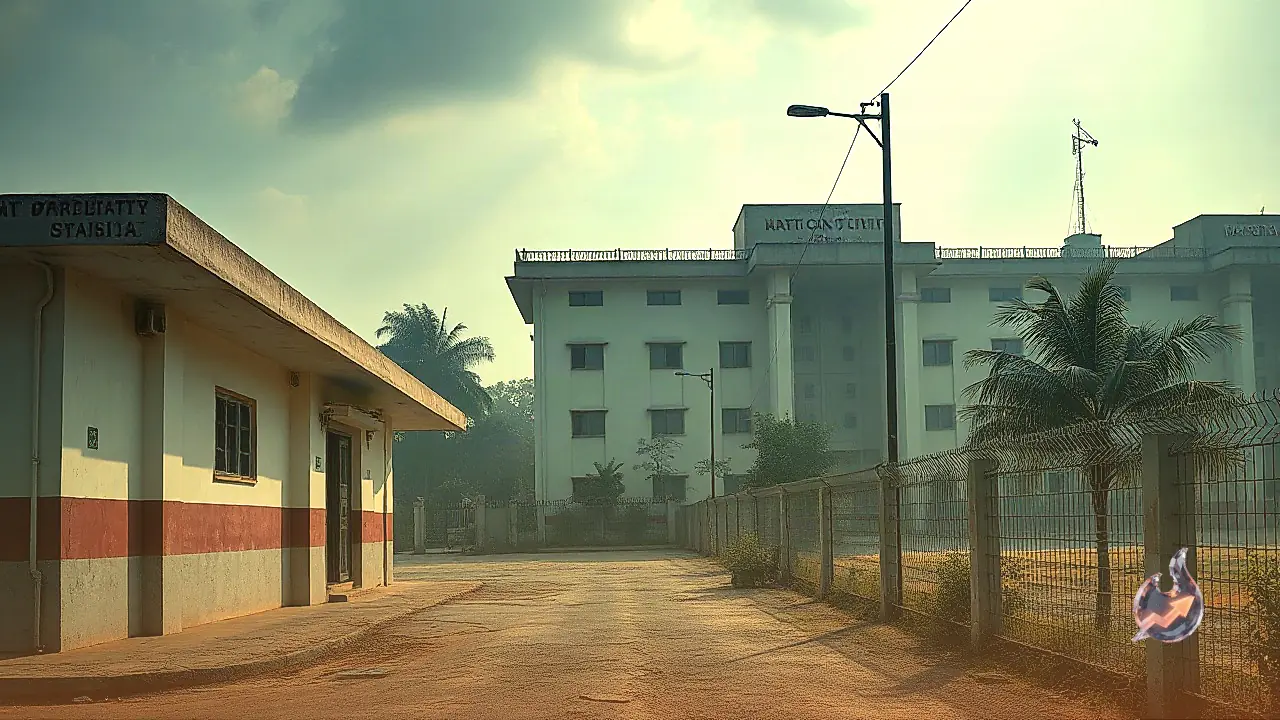























A recent government survey report regarding the pathetic state of government schools in Rajasthan has raised serious questions about the region's educational infrastructure and student safety. Out of the total 64,484 government school buildings across the state, 3,767 buildings have been found in a severely dilapidated condition. Of these, the government has officially declared only 2,558 school buildings as dilapidated so far, while about 1,210 buildings are still awaiting formal declaration. Most alarmingly, around 41,178 school buildings, which translates to roughly 75 percent of the total structures, require major repairs. If these buildings are not mended in time, their condition is bound to deteriorate further. Furthermore, there are 611 schools in the state that do not even possess a building of their own. The crisis extends far beyond structural integrity alone; out of 5,40,127 classrooms evaluated in the government survey, only 2,36,441 were found to be safe. This means that less than half of the classrooms are deemed completely secure, casting a shadow over the safety and well-being of thousands of children.
Ground Realities in Jaipur and District Disparities
The ground reality in various districts highlights a systemic failure. The issue of a government school operating inside a cattle shed near Rampura in Jaipur has already come to light, with the construction of a new building slated to begin on September 1. However, this is not an isolated incident. At the government school located in Tila Number 5, Jawahar Nagar, Jaipur, the building condition is precarious. Due to waterlogging on the ground floor, the rooms have become dilapidated, prompting authorities to lock them up and conduct classes for children in a single room on the first floor. Crises are visible across the walls, yet the building has not even been officially declared dilapidated in government records. Under administrative rules, students can only be shifted elsewhere after a building is formally declared unsafe, leaving children studying in hazardous unnotified rooms at continuous risk. District-wise data shows Jhalawar leading with 327 dilapidated school buildings, though only 19 have been officially declared as such. Pratapgarh reported 276 ruined structures with 86 declarations, while Jaipur recorded 142 vulnerable buildings with only 32 officially categorized as dilapidated.
Basic amenities are severely lacking alongside infrastructural decay. In a written reply to a question by Leader of the Opposition Tika Ram Juli in the legislative assembly, the government revealed that 2,047 government schools across the state lack toilet facilities for students. Additionally, 1,049 schools do not have proper drinking water arrangements. Consequently, students are forced to struggle with basic amenities while attempting to pursue their education.
Classroom Safety and the Rs 12,500 Crore Roadmap
The government assessment of 5,40,127 classrooms revealed that only 2,36,441 are safe, while 45,365 classrooms urgently require repairs. Shockingly, repair work has been approved for only 4,187 of these damaged classrooms. To address these infrastructural deficits, the state government has formulated a three-year roadmap worth approximately Rs 12,500 crore. This blueprint encompasses repairing existing buildings and constructing new ones. Moreover, the government has decided to allocate 20 percent of the MLA local area development fund towards school improvements, alongside plans to construct 3,587 new school buildings. The primary concern now remains how swiftly these corrective measures will be implemented to safeguard students.