























Transforming traditional farming into an economically viable collective business requires smallholders to manage their produce beyond the boundaries of their fields. Farmer Producer Organisations offer a structured platform where cultivators join forces to oversee the entire chain of agricultural operations, extending from cultivation and primary handling to advanced marketing and distribution. Collective action enables growers to eliminate dependency on multiple intermediaries and command better value for their seasonal harvest.
Membership Baseline And Jurisdictional Flexibility
Forming an operational collective requires a minimum assembly of seven farmers who are willing to pool their landholding interests and register as an entity. Once the formal registration formalities are finalized, the newly constituted collective gains institutional legitimacy to undertake a wide spectrum of commerce centered on agri-inputs and commodity marketing.
Clarifying the administrative structure, Bharatpur Joint Director of Agriculture Radheshyam Meena explained that the geographical establishment of such collectives is not restricted to the district headquarters. Agricultural producers retain the flexibility to form an organisation at the gram panchayat level, block level, or district level based on geographic accessibility, mutual trust, and production volumes. The guiding priority remains the unification of cultivators so that rural assets and commercial pathways can be jointly leveraged.
Adding Value Through Sorting, Packaging And Storage
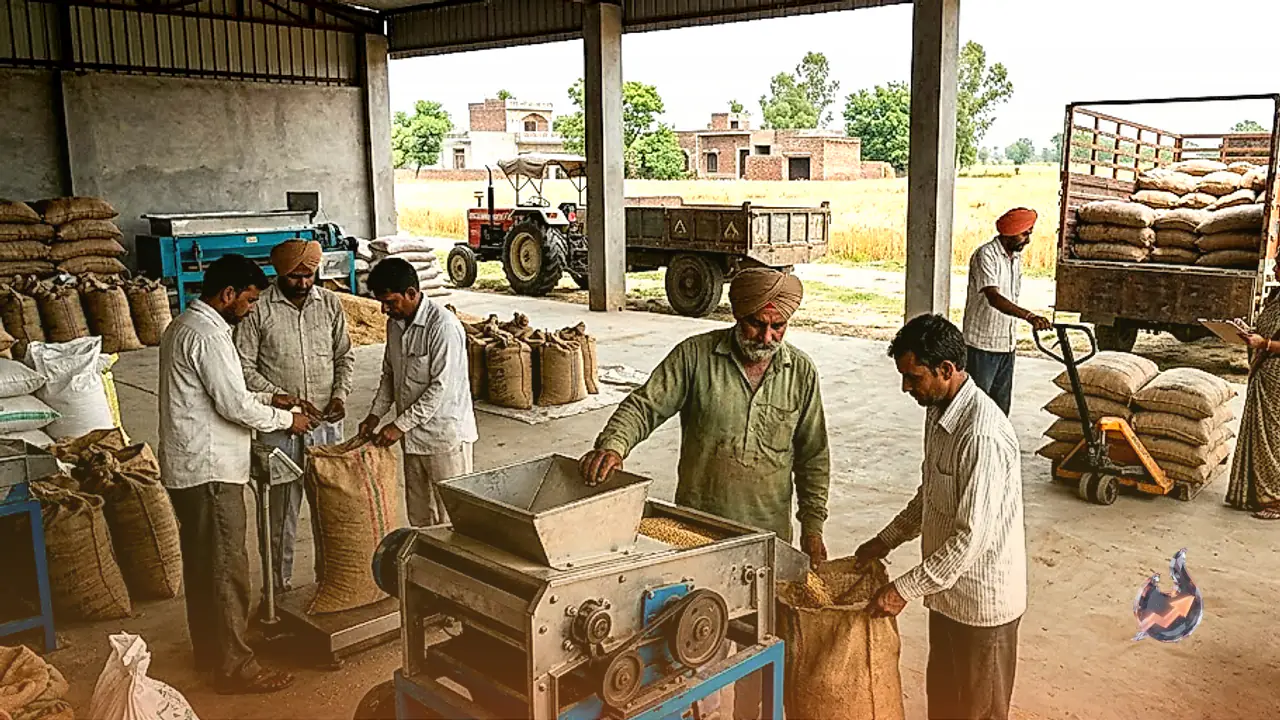
Individual farmers frequently face distress selling immediately after harvest due to an acute absence of holding capacity and packaging infrastructure. Operating within an institutional organisation removes this bottleneck by allowing producers to expand into grading, standardized packaging, post-harvest processing, and temperature-controlled storage.
By sorting crops according to market grades and packing them systematically, collectives elevate consumer appeal and safeguard quality during transit. Collective storage infrastructure empowers farmers to withhold stock during temporary market gluts and release produce when price movements become favorable. Direct bargaining from a consolidated inventory significantly enhances bargaining leverage when negotiating sales contracts with bulk institutional buyers.
Lowering Mechanisation Costs Via Custom Hiring Centers
Access to modern farm implements is vital for raising per-acre productivity, yet procuring costly tractors, seeders, or combine harvesters remains unfeasible for marginal growers. Agricultural collectives bridge this capital gap by establishing and managing Custom Hiring Centers.
Under this mechanism, specialized machinery and heavy implements are acquired under the collective banner and leased out to member farmers at economical user rates. Collective ownership ensures timely access to field equipment during critical sowing and harvesting windows without saddling individual farmers with hefty bank loans. Furthermore, the entity can buy seeds, fertilizers, and plant protection inputs in bulk directly from distributors, passing on significant volume discounts to its members.
Public Financial Support And Capital Building Norms
To nurture early-stage entities and assist them in establishing viable business lines, several government schemes provide focused financial and institutional backing. Assistance packages encompass formation expenditure, working capital requirements, infrastructure establishment grants, and equity capital support designed to strengthen the organization's creditworthiness. Nevertheless, the precise magnitude of financial subsidies, applicant eligibility criteria, and operational rules remain subject to the respective scheme frameworks and designated guidelines.