



















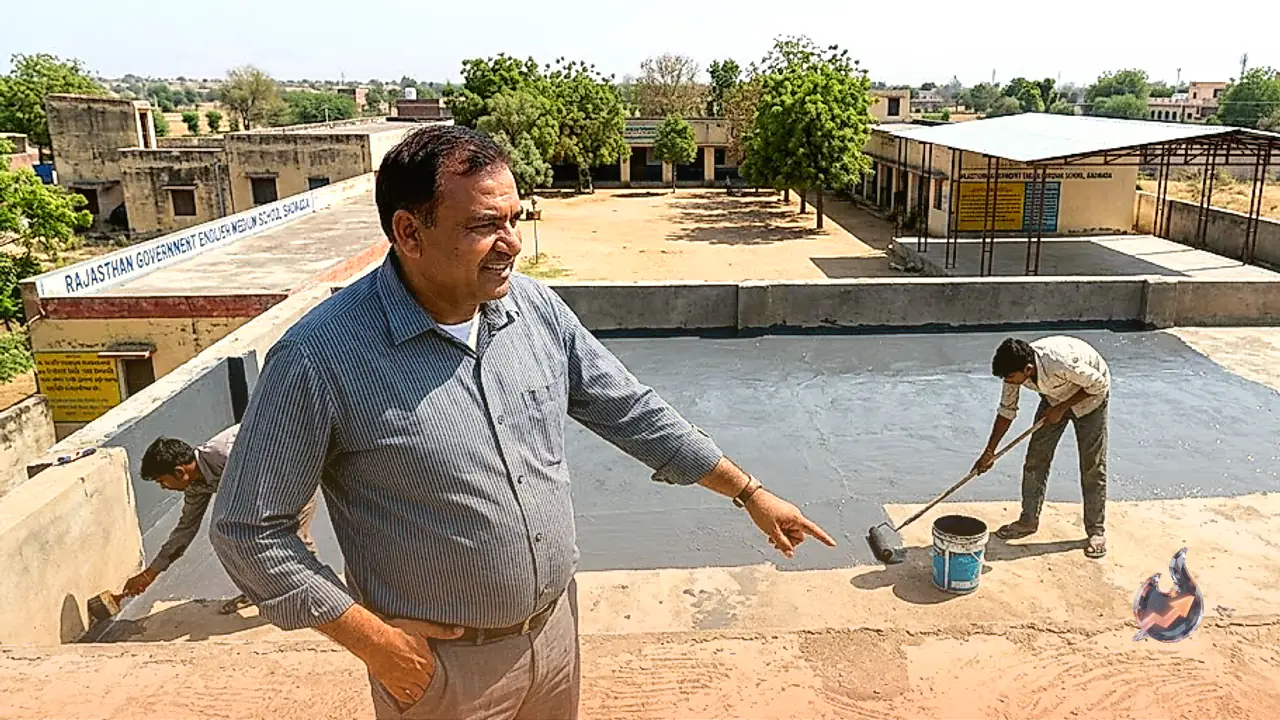

Educational facilities in rural government institutions frequently face infrastructure hurdles, but a dedicated school principal in the Chomu region of Jaipur Rural has demonstrated how personal initiative can transform an entire institution. At Mahatma Gandhi Government English Medium School in Bagwada, structural decay and persistent rainwater leakage during the monsoon season had long raised serious safety concerns for teachers and children alike. Rather than waiting through prolonged administrative approvals, Principal Vijendra Singh Kavia chose to personally finance comprehensive repairs for the entire school building, creating a secure learning environment for everyone present.
Waterproofing 7,000 Square Feet of Roof Structure
The physical condition of the school's aging structure created severe complications every rainy season. Water continuously seeped through the main concrete roof, leaving walls damp, loosening plaster, and making the overall environment unhealthy and unsafe for daily classes. To address these hazards directly, Principal Vijendra Singh Kavia prioritized student well-being and commissioned a full waterproofing treatment covering nearly 7,000 square feet of roof area. The extensive repair work involved surface sealing, crack filling, and protective layering carried out continuously over 15 days, entirely funded from his personal savings. This timely intervention has effectively halted water penetration, preventing further wall dampness and enabling children to pursue their education in a dry, comfortable, and risk-free setting.
Building a Tin Shed to Protect 200 Students
This substantial monetary contribution is not an isolated incident of proactive leadership by Principal Vijendra Singh Kavia. During heavy rainfall in the previous academic year, education department inspectors identified several classrooms as structurally vulnerable and issued strict orders forbidding students from sitting inside them. Faced with a sudden space crisis during peak academic months, Vijendra Singh Kavia viewed the predicament as an urgent duty. He personally funded the construction of a spacious tin shed over the school prayer assembly area. This immediate arrangement allowed around 200 students to continue their daily lessons uninterrupted despite the severe weather and classroom closures.
Mobilizing Donors and Local Community Support
Beyond making individual financial sacrifices, the principal actively worked to bridge the gap between public education and local community leaders. By engaging with philanthropic individuals, known locally as bhamashahs, he encouraged broader societal participation in public school welfare. His persuasive efforts inspired two prominent donors to step forward and fund the construction of two brand-new classrooms on the campus premises. Furthermore, school staff members and local residents joined forces, providing financial contributions and essential material resources to equip the school with modern teaching tools and basic amenities.
Promoting Greenery and Environmental Responsibility
Alongside structural renovations, environmental sustainability has become a core element of the school's identity in Bagwada. Under the guidance of Vijendra Singh Kavia, extensive tree-planting drives were organized across the entire campus. Regular maintenance, watering, and care by staff and students have converted the grounds into a flourishing green environment. This clean, vibrant setting not only enhances the visual aesthetic of the school but also instills environmental consciousness among students by connecting them directly with nature.
A Commitment to Safe and Quality Education
Emphasizing the philosophy behind his selfless efforts, Principal Vijendra Singh Kavia noted that students and working staff are fully entitled to a safe learning and working environment. He emphasized that persistent structural issues directly hamper student focus and long-term academic progress. Despite operating within constrained government resources, he resolved to act within his own personal capacity to ensure high standards. Local community members and parents have widely praised these initiatives, noting that public-private cooperation and strong educational leadership can dramatically elevate government schools.