



















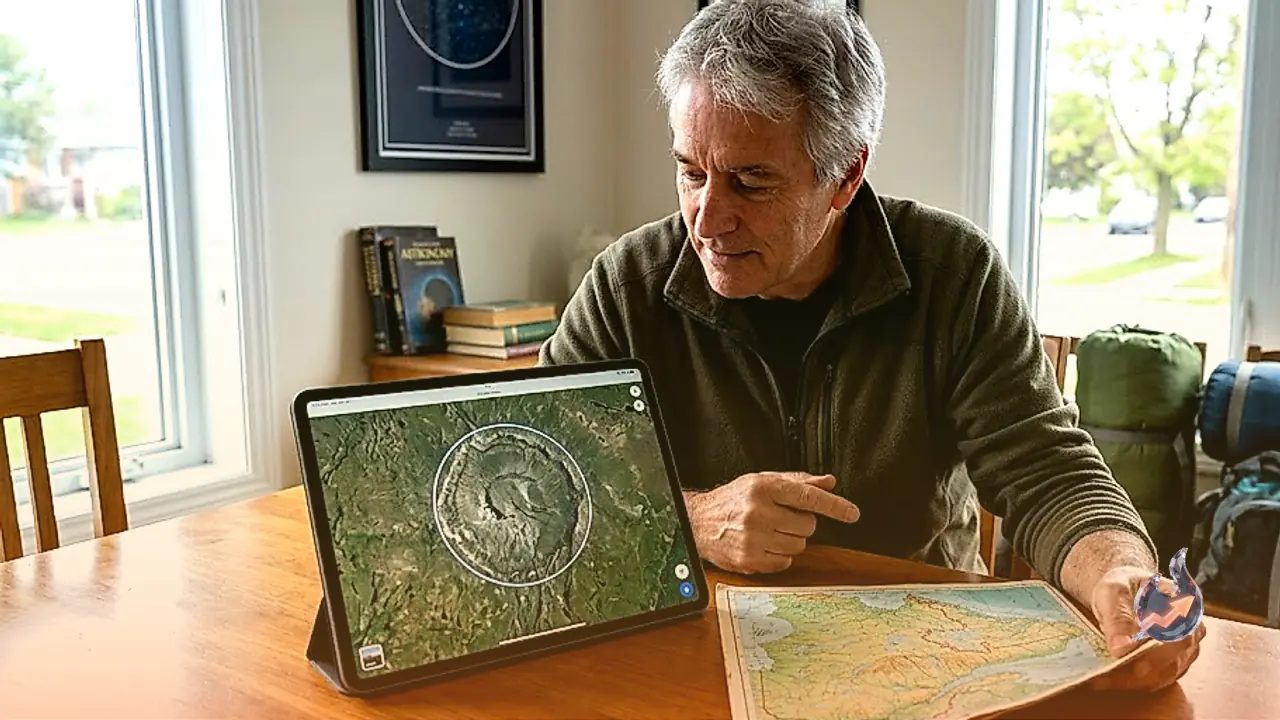

Joel Lapointe was only trying to plan a camping trip when he noticed something odd on his screen: a near-perfectly round depression roughly 25 kilometres wide near Lake Marsal in Quebec's Cote-Nord region. That accidental find in 2024 has now been confirmed by a team of scientists as a genuine asteroid impact crater, roughly 390 million years old, and one of the largest of its kind ever documented in Canada.
A Strange Round Mark on the Map
In 2024, Lapointe, an amateur astronomer, was scouting camping routes on Google Maps through Quebec's remote Cote-Nord region when a huge, near-circular scar on the landscape near Lake Marsal caught his attention. Stretched across roughly 25 kilometres, or about 15.5 miles, the shape looked nothing like an ordinary lake basin, ravine or natural erosion pattern. It was too round, too large and too regular to pass off as a coincidence of geography.
Rather than let the discovery sit in a screenshot, Lapointe decided to flag it to people who might actually be able to explain it. He reached out to French geophysicist Pierre Rochette, who studied the topography of the site and offered a striking theory: the depression could be the scar left behind by an ancient meteorite strike. That single observation from an amateur enthusiast was enough to draw the attention of professional researchers who specialise in exactly this kind of geology.
A Punishing Trek to Test the Theory
A satellite photograph, however striking, can never by itself confirm that a landform is an impact crater. Someone has to physically travel to the site, examine the rock and pull samples for laboratory analysis. That task fell to Gordon Osinski, a professor of planetary geology at Western University, who organised and led a team of geologists on a field expedition to the remote location in October 2025.
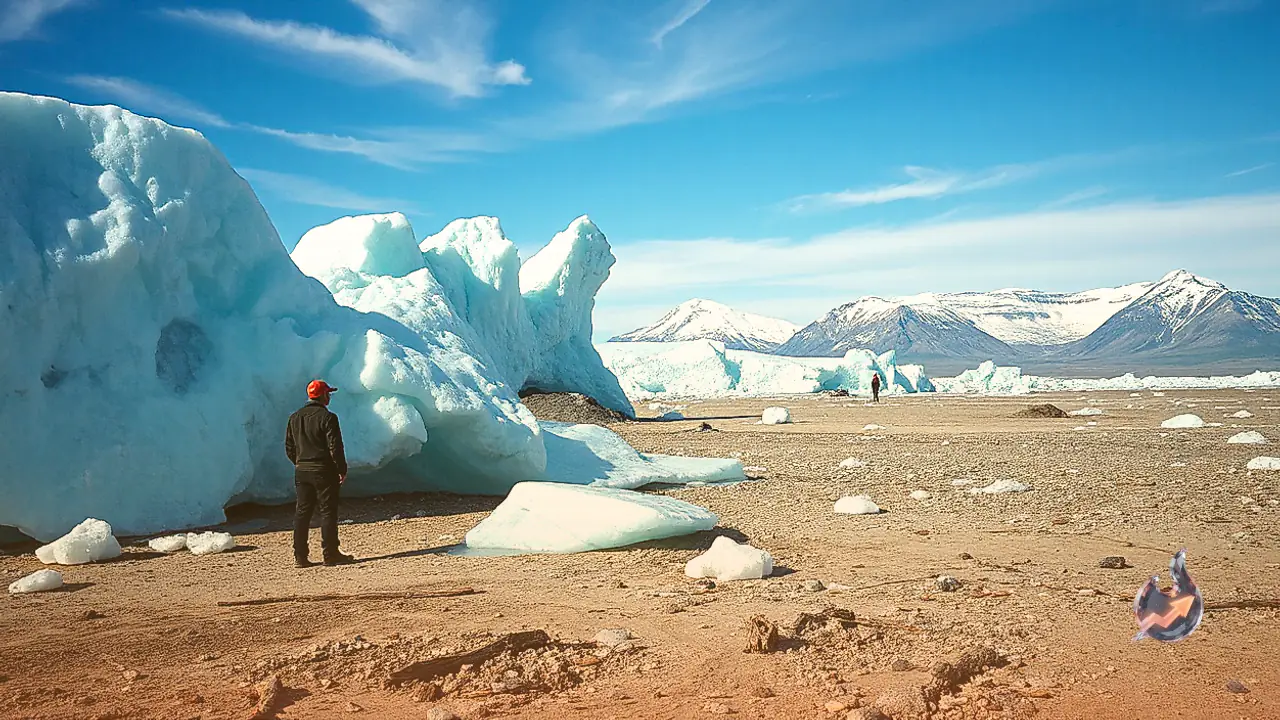
The journey was far from routine. Describing the trip afterwards, Osinski did not hold back on how demanding it had been: “This was one of the toughest expeditions I have ever done. I have done 25 expeditions in the Arctic and on 6 continents.” The terrain around Lake Marsal was rugged and difficult to move through, and the team also had to contend with swarms of insects throughout the fieldwork. Despite the conditions, the group pushed on and completed its sampling work at the site.
The Clues Buried in the Rock
Initial surveys of the crater turned up zircon, a mineral that is frequently produced during meteorite impacts because of the extreme heat and pressure involved. But the presence of zircon on its own is not enough to prove that a crater was carved out by a space rock rather than some other geological process, so the team needed stronger, more direct evidence.
What Osinski's team was really hunting for was shock metamorphism, structural changes in rock that occur only under the kind of extreme pressure generated by an asteroid strike or a nuclear explosion. He explained that most of this evidence is far too small to spot in the field: “Most of these things are microscopic, so you can only confirm them with samples in the lab.” One telltale sign, though, did not require a microscope at all.
The team located shatter cones at the site, distinctive fractured, fan-shaped patterns etched into the surface of rocks, along with large blocks of impact melt rock scattered across the ground. Documentation from the site, credited to researcher Gattacceca and colleagues, shows a shatter cone right at the centre of the structure and melted rock recorded about 4 kilometres, or 2.5 miles, west of that centre. Osinski pointed out just how much destructive energy is needed to produce that kind of rock: “When a large asteroid hits, you can literally melt tens of cubic kilometres of Earth's crust.” Samples pulled from that melted rock were later dated in the lab, and the results placed the age of the impact at 390 million years.
A Discovery So Rare It Beats the Odds
Osinski also runs a website called Impact Earth, which is dedicated to verifying claims of meteorite craters sent in from around the world. He regularly receives emails from members of the public who are convinced, based on odd satellite images, that they have stumbled onto an impact site. By his own account, the overwhelming majority of these tips lead nowhere: “I get a lot of messages from people who think they have found a crater, and 99 times out of 100 that is not the case.” He described the Lake Marsal find as one of the rare exceptions that shows such citizen discoveries are still genuinely possible.
Scientists have so far catalogued roughly 200 confirmed impact craters on Earth, and 31 of those lie within Canada alone. Osinski noted that researchers typically confirm one or two new craters every year worldwide, but almost all of them measure less than 5 to 10 kilometres across. A crater as large as the one near Lake Marsal, at roughly 25 kilometres wide, is exceptionally rare by comparison. Canada itself had not confirmed a new meteorite crater since 2010, which makes this the country's first such find in fifteen years.
A New Name, and Work That Continues
Once the impact origin of the crater had been confirmed, the research team moved to give the site an official name. They consulted the Ekuanitshit Innu Council, which represents the Indigenous community of the region, before the crater was formally named the Uhachatik Crater. The researchers now plan to present their full findings at the Meteoritical Society's annual meeting in Germany next month, where the discovery will be laid out in detail before the wider scientific community.
For Lapointe, the whole experience has been deeply satisfying. Reflecting on how a chance glance at a map led to a scientifically confirmed discovery, he said it is unusual for an ordinary person to stumble onto something of this scale, and urged others to trust their own instincts: “It is not every day that an ordinary citizen discovers a crater 390 million years old. I encourage everyone not to ignore their intuition or their observations.” Osinski and his colleagues are continuing their laboratory analysis of the rock samples collected during the October 2025 expedition, work that is expected to reveal further details about the impact and the ancient asteroid that caused it.