






















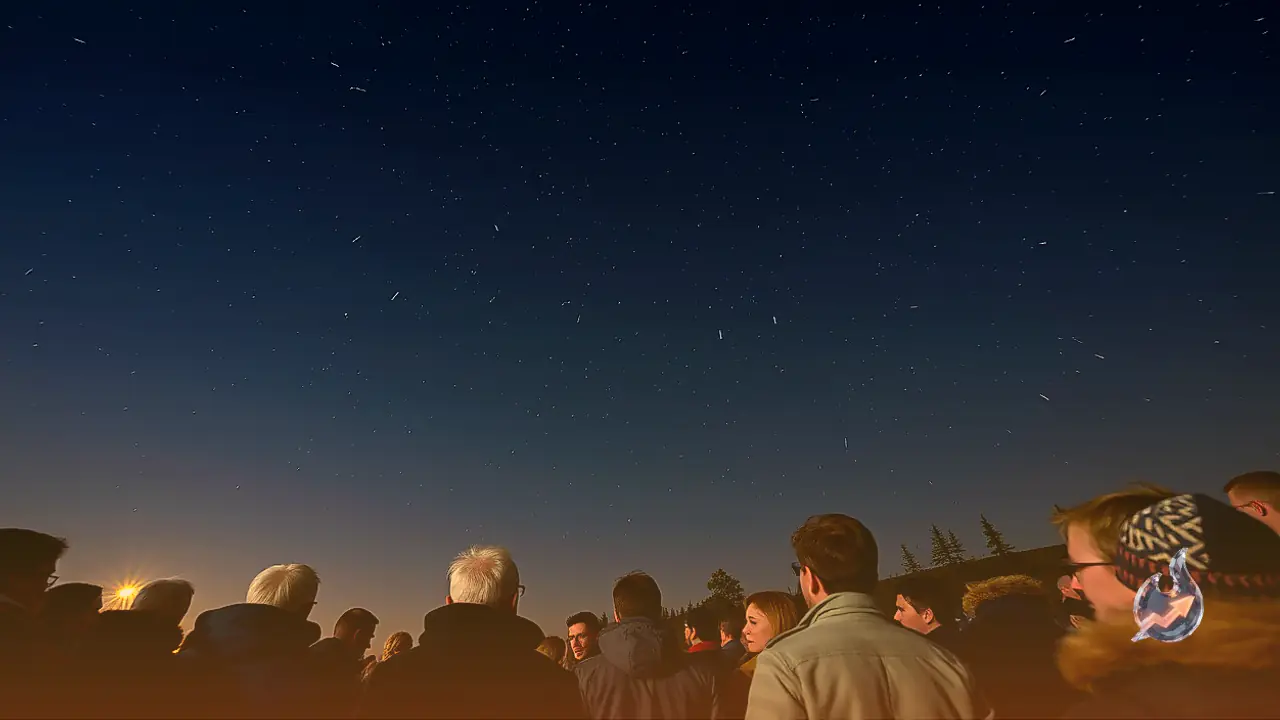

Stargazers are currently treated to a series of impressive celestial phenomena as the Orionid meteor shower remains active through November 7. For viewers in the United States, the optimal viewing window runs between dusk on October 21 and dawn on October 22. Under pitch-dark conditions, observers can catch up to 20 meteors every hour during this peak period. However, the moon will be approximately three-quarters full at the same time, which threatens to wash out some of the fainter shooting stars. Astronomy enthusiasts recommend the early morning hours, specifically the dark interval between moonset and sunrise, as the absolute best time for maximum visibility.
Understanding Orionid Meteors and Fireballs
These specific meteors have earned widespread recognition for their exceptional brightness and remarkable speed. In rare instances, particularly fast-moving meteors can evolve into brilliant fireballs that match the luminosity of the planet Venus. Total darkness is equally crucial for spotting secondary phenomena associated with this display, such as the glowing trains of debris that Orionids occasionally leave lingering in their path. The shower derives its familiar name from the constellation Orion, which serves as the radiant point from where a vast majority of the meteors appear to originate. Despite this, finding Orion is entirely optional for anyone hoping to enjoy the spectacle, as shooting stars should remain visible across any region of the night sky.
Saturn Opposition and Atmospheric Discoveries
Earlier in the month, Saturn reached its opposition phase, a point where Earth moves directly between the sun and the distant gas giant. Because the ringed planet ascends in the eastern sky around sunset and climbs to its highest meridian near midnight, it stays visible nearly all night long. On October 24, the moon will pass into close proximity with Saturn. This planetary alignment not only creates prime viewing conditions for amateur astronomers but also grants researchers another vital opportunity to examine a bizarre geometric structure embedded within Saturn's atmosphere, specifically a decagon centered directly over the planet's south pole. This recent observation follows roughly half a century after scientists discovered a massive 18,600-mile-wide hexagon encircling Saturn's north pole.
Researchers theorize that these unusual atmospheric phenomena stem from powerful currents that confine atmospheric waves, and the southern hemisphere wave appears to be gathering increased momentum. Because opposition places the gas giant at its closest point to Earth, scientists gain invaluable viewing conditions to study the planet's peculiar atmospheric dynamics.
Observing the Pleiades Star Cluster
As October draws to a close, the moon will sweep closely past the famous Pleiades star cluster. The Pleiades have populated ancient folklore and cultural stories for centuries, likely because these luminous stars can be spotted from virtually any region across the globe. The best timing for observing the Pleiades near the moon spans from the evening of October 27 through the morning of October 28. Observers should look toward the eastern horizon and wait for both the moon and the stellar cluster to ascend higher into the night sky. Unaided human vision can typically pick out what appears to be a faint grouping of six to seven distinct stars. Because this event unfolds shortly after a full moon, the cluster might initially prove difficult to spot with the naked eye, though binoculars or a standard telescope will bring the cluster into sharp focus.