




















Two powerful earthquakes struck Venezuela's northern coast in late June, and scientists have now produced a striking visual record of just how dramatically those events reshaped the ground beneath the affected region. Using radar signals gathered from satellites in orbit, researchers built a detailed map showing that the surface deformed by as much as 30 centimeters in the worst-hit areas, a measurement that no ground-based instrument could have produced so rapidly across such a wide zone.
How Radar Satellites Detect Invisible Ground Shifts
The imagery comes from the Sentinel-1 satellites, spacecraft operated under the European Copernicus program. These satellites do not capture ordinary photographs. Instead, their radar instruments send pulses of energy toward Earth's surface and record the precise time the return signal takes to bounce back to the sensor. That timing data allows scientists to measure the distance between the satellite and the ground with extraordinary accuracy.
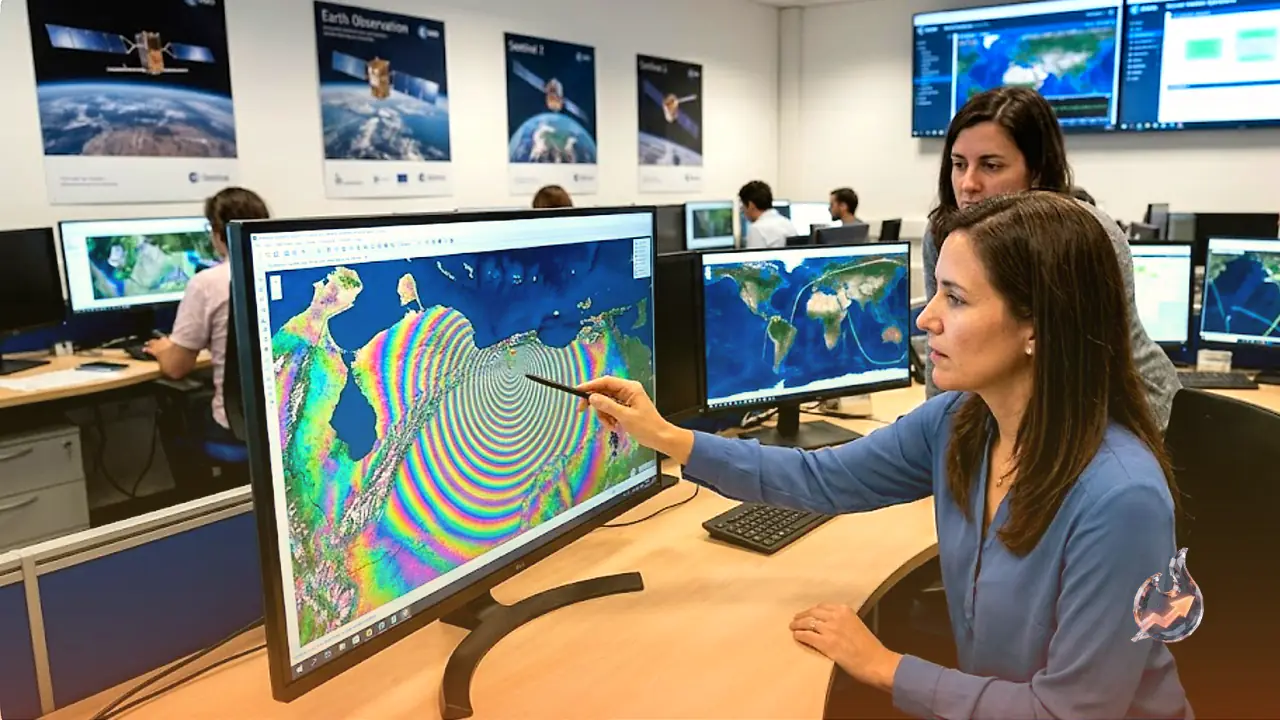
To detect how the earthquakes altered the landscape, scientists compared a Sentinel-1 reading taken on June 18, exactly one week before the earthquakes, with a second measurement captured on June 25, the day after the pair of earthquakes struck. Those two earthquakes reached magnitudes of 7.2 and 7.5 respectively. By calculating the difference between the two radar scans, researchers constructed what is called an interferogram, a specialized map that converts even the smallest surface movements into vivid color patterns visible at a glance.
The Meaning Behind the Colored Bands
An interferogram's most striking feature is its pattern of repeating colored bands arranged in horizontal rows, particularly dense across the northern portion of the map. Each complete cycle of the color sequence, running from blue through green, yellow, and red and back to blue again, represents a fixed increment of change in the distance between the satellite and the ground below. The more complete cycles that appear stacked between one area and another, the greater the total surface displacement at that location.
In the Venezuela interferogram, the densest concentration of these color cycles sits directly over the northern epicenter region. Those bands closely trace the path of the San Sebastián fault system, one of the dominant tectonic structures running through northern Venezuela. The European Space Agency estimates the total ground displacement across this zone reached approximately 30 centimeters, or about 12 inches.
What 30 Centimeters Does and Does Not Tell Us
That number requires careful interpretation. A 30-centimeter reading from an interferogram does not simply mean the ground rose or sank by that distance. Earthquakes can push the Earth's surface upward, pull it downward, slide it sideways, or produce some combination of all three movements at once. An interferogram captures the total change in the satellite-to-ground distance, which could reflect any or all of those motions. Determining the exact direction of movement will require additional types of satellite imagery as well as traditional surveys conducted on the ground itself.
Those on-the-ground surveys will not happen anytime soon. Buildings have collapsed, infrastructure has been destroyed, and Venezuelan authorities together with international partners are urgently focused on the humanitarian emergency spreading across the region. Ground-level measurement work to pin down the precise nature of the surface shifts is unlikely to be possible until the immediate crisis stabilizes.
A Global Network of Space Agencies Joins the Response
Even as rescue operations continue, space agencies and data processing centers from around the world have been pooling satellite information to assist with recovery planning. NASA is among those that stepped in, activating its Disaster Response Coordination System to identify the sites posing the greatest risk to survivors and rescue crews. The rapid availability of satellite-derived deformation maps like this interferogram means that emergency planners can understand the geographic scope of the damage far sooner than any ground team could establish on its own.