



















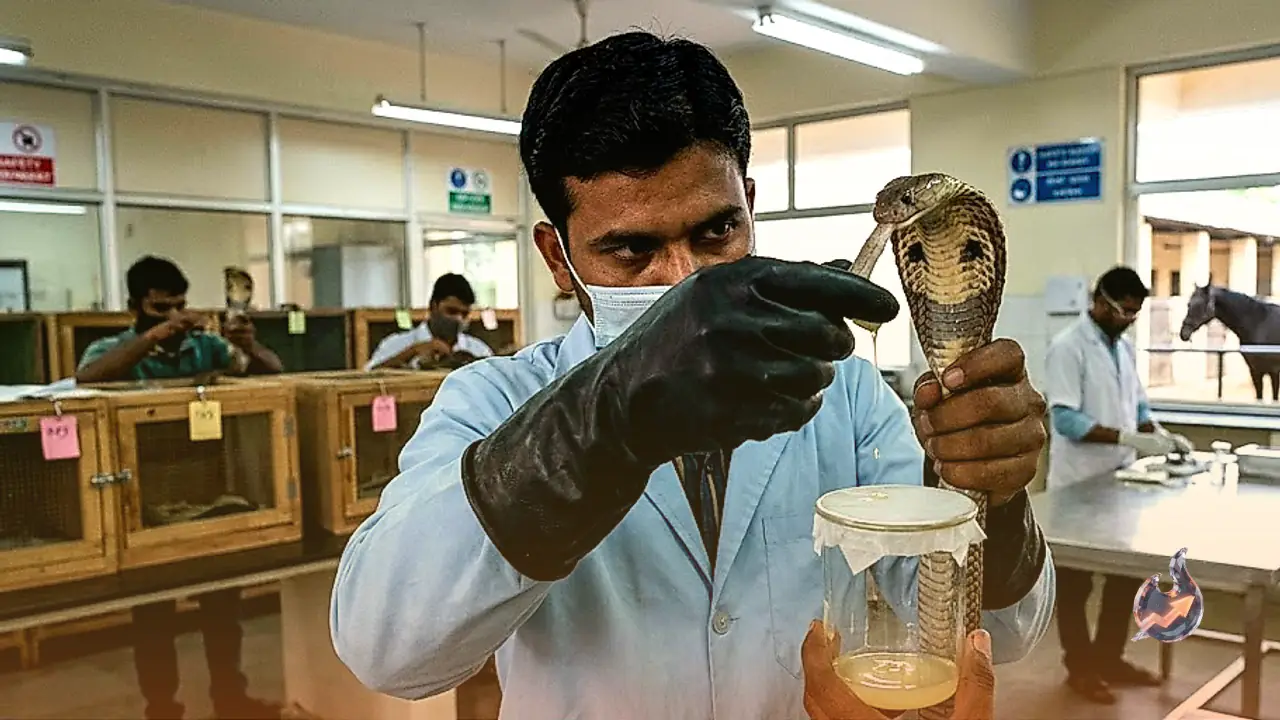

A report from West Champaran has shed light on how the medicine that saves lives after a snakebite is, quite literally, made from snake venom itself. Across the world, antivenom is prepared using the venom of exactly those snake species responsible for the highest number of bites and deaths. In India, four such snakes are behind nearly 40,000 deaths every year.
The 'Big Four' snakes behind most snakebite deaths
According to Abhishek, an expert who has worked on wildlife for close to two decades, antivenom in India is developed keeping four snake species in mind. These are the spectacled cobra, also known locally as gehuwan, the Russell's viper, the saw-scaled viper and the common krait. Data shows that roughly 40,000 people die of snakebite in India every year, and 36,000 of those deaths are caused by just these four species. That is why they are collectively referred to as the Big Four.
How horses turn venom into a life-saving antidote
The process of making antivenom is carried out with great care. Venom is first extracted safely from the Big Four snakes. A small and carefully controlled amount of this venom is then injected into the bodies of specially bred horses, not ordinary ones, but horses raised specifically for this purpose. Once the venom enters their system, their immune system begins producing antibodies to fight it. These antibodies are later drawn from the horses and separated from the plasma in a laboratory. The plasma is then purified to produce the antivenom that hospitals eventually administer to snakebite patients.
Why even a small mistake can prove fatal
Abhishek explains that antivenom, at its core, is still venom, just processed and prepared as an antibody before use. He points out that even the slightest lapse in handling it can cost a life. His advice is straightforward: ordinary people should never try to handle snake venom or its antidote themselves, and this work should be left entirely to trained experts.