






















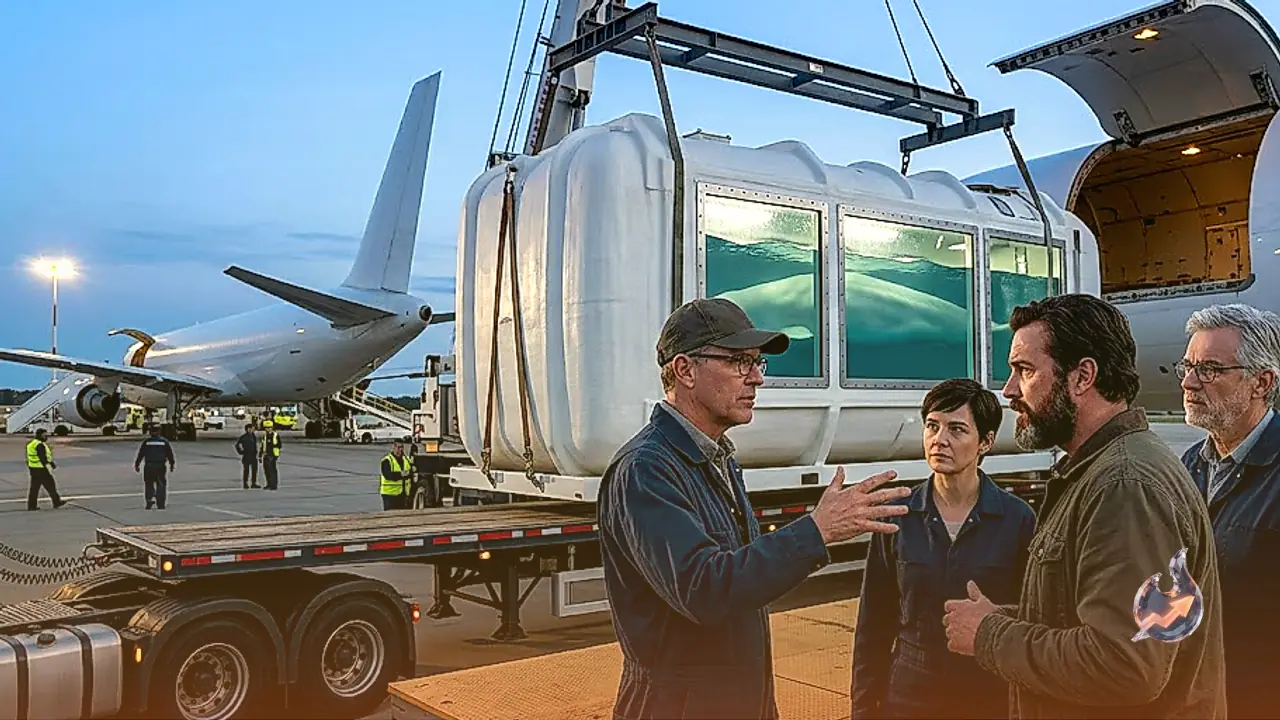

Four adult female beluga whales made a remarkable and unprecedented journey from their enclosures in Niagara Falls through Toronto Pearson Airport to Chicago, accompanied by animal care experts including Shedd’s director of animal behavior and training, Charlie Jacobsma. Two additional belugas joined the flight aboard a chartered Boeing 777 freighter before being transported onward to an aquarium located in San Antonio.
The marine mammals previously resided at Marineland of Niagara Falls, a long-running and notorious amusement park that faced bankruptcy following the death of its owners and shut down its operations to the public in 2024. As the park ran out of financial resources to properly maintain the animals, it had earlier appealed to the Canadian government for intervention. By 2025, Marineland announced that it had reached the painful conclusion of considering euthanasia for the animals if a relocation plan could not be secured.
The broader marine biology community was already debating potential solutions by that point, and rescue team members traveled to Ontario by January 2026 to evaluate logistical transport methods. Canada finalized an agreement with Marineland in June to permit a rehoming initiative allowing animals to transition to a consortium of aquariums across Georgia, San Diego, and Spain, alongside the transfers directed to Chicago and Texas. It was a mission unlike any attempted before in scope and complexity.
The arduous move of thousand-pound aquatic mammals across hundreds of miles proceeded with remarkable smoothness, featuring a gentle takeoff and an easy landing. The accompanying team remained stationed close to the whales throughout the flight, continuously monitoring their condition and pouring water over their backs to ensure their comfort.
Visitors arriving at the Shedd’s Oceanarium section days later were greeted by signage requesting complete quiet to help the newly arrived belugas acclimate to their unfamiliar surroundings. A secluded habitat under round-the-clock surveillance by veterinarians and marine specialists currently houses Acadia, Lillooet, Osiris, and Sierra away from public view while their new caretakers help them settle in.
The quartet of adult females, all in their twenties, swam through their enclosure displaying signature slow and graceful movements. They showed no outward signs that mere hours earlier they had been hoisted into custom stretchers, loaded into transport boxes filled with chilled saltwater onto truck beds, driven to an airfield, and flown to an entirely different country. Accomplishing the initial leg required the consortium to inventory every available resource and piece of equipment.
Navigating cross-border regulations introduced significant hurdles, requiring coordination alongside government bodies such as Fisheries and Oceans Canada and the United States Department of Agriculture while strictly adhering to international trade treaties for animals.
Beyond logistical hurdles, the planning team carefully evaluated how to separate the animals and determine optimal placement based on existing social groups from Marineland and compatibility with resident whales at receiving aquariums, such as the eight belugas already housed at the Shedd. Decisions involved minute details regarding group dynamics and leadership roles within newly forming pods.
Shedd personnel expressed deep gratitude for the widespread assistance encountered throughout the journey, ranging from Marineland staff members to the customs agents at O'Hare who boarded the aircraft to verify passports so handlers could remain beside the animals constantly.
The operation has nonetheless drawn criticism from advocates demanding greater transparency and an end to captive breeding programs. With limited alternatives available, Fisheries and Oceans Canada noted that the animals could not survive independently in the wild, while the Shedd emphasized its commitment to providing elite care without focusing on breeding initiatives. Although advocates champion sea pens as retirement options, only one such facility exists in Iceland and currently lacks capacity, while the Canadian nonprofit Whale Sanctuary Project plans a 2027 opening in Nova Scotia and has criticized the transfer.
Shedd staff remain cautiously optimistic as the animals exhibit positive behavioral signs, including regular feeding and foraging for enrichment items. With dozens of animals still remaining at Marineland, the institution has indicated its openness to accepting up to ten additional belugas.