






















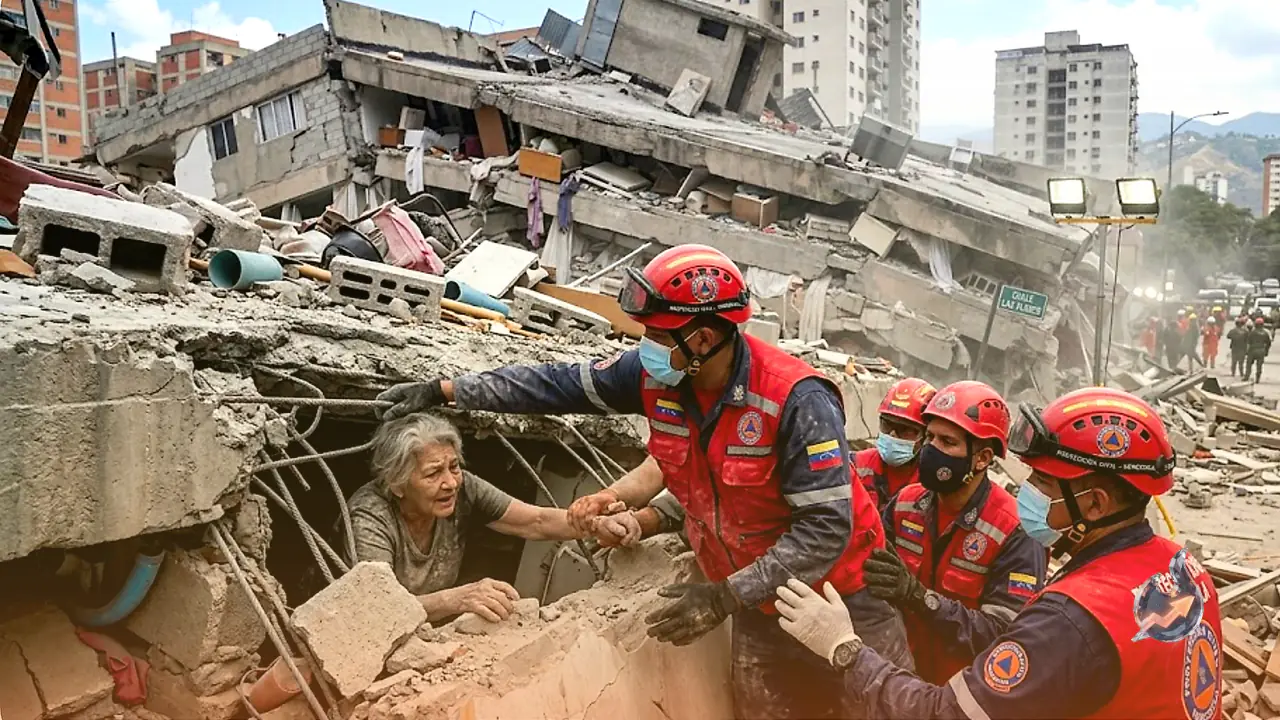

Within moments of each other, two powerful earthquakes ruptured beneath Venezuela and shook the country's northern region. This was no ordinary tremor but a rare event that scientists call a 'seismic doublet.' That is exactly why geologists around the world are now studying the sequence closely, because such cases help explain how stress moves through the Earth's crust and how nearby geological faults interact with one another.
According to the US Geological Survey, both earthquakes had their epicenters northwest of the town of Yumare, near the city of Morón and about 160 kilometers (99 miles) west of the Venezuelan capital, Caracas. One quake struck at a depth of 20.3 kilometers and the other at 10 kilometers. The shaking was felt across much of northern Venezuela as well as in several Caribbean countries.
What a Seismic Doublet Actually Is
The sequence has been classified as a severe seismic doublet. It happens when two earthquakes of similar magnitude strike almost simultaneously in nearby areas. By USGS estimates, the probability that an earthquake will be followed within a week by a larger one in a nearby area is roughly 5 percent.
One of the most notable seismic doublets in recent years occurred about three years ago in Turkey and Syria, when a 7.6-magnitude quake was followed by a 7.8-magnitude one. A study suggested the event was the result of tectonic stress that had built up over more than two centuries along the fault responsible for the first quake. When that fault ruptured, the released stress transferred to a nearby fault, rapidly setting off the second event.
How the Pairing Formed in Venezuela
Experts believe something similar unfolded in Venezuela. Mark Allen, a professor in the Department of Earth Sciences at Durham University, says it is "likely that the first earthquake caused a segment of the fault to rupture and transferred the stress to another fault, which in turn ruptured, triggering the second earthquake."
Allen also noted that the geological makeup of the region around the epicenters played an important role. "The events appear to have taken place at the plate boundary between South America and the Caribbean. In this region, the plates move laterally relative to one another, similar to what occurs along the San Andreas Fault in California," he says.
Such conditions favor strike-slip earthquakes, which occur when two blocks of the Earth's crust move horizontally along a fault and suddenly release stress that has accumulated over long periods.
Why Shallow Quakes Are More Dangerous
This kind of movement often causes serious damage because it originates at relatively shallow depths. Unlike subduction earthquakes, in which one tectonic plate slides beneath another, strike-slip earthquakes tend to occur closer to the Earth's surface. As a result, the released energy travels a shorter distance before reaching populated areas, which makes the tremors feel more intense and raises the risk of destruction.
Allen warned that, because of these circumstances, "there is a risk of further earthquakes (aftershocks) in the Caracas region. The Venezuelan capital is located in an area prone to seismic activity, and it is possible that local faults have been subjected to additional stress following the recent events."
That outlook matches the USGS assessment. The agency notes that after earthquakes of this size, seismic activity can continue for days, weeks or even longer. While the frequency drops over time, the chance of powerful aftershocks remains.
The Death Toll and the Risk Ahead
Official reports indicate that the two earthquakes recorded in Venezuela have so far claimed at least 164 lives and left nearly 1,000 people injured. The USGS estimates that the final death toll could climb as high as 10,000 to 100,000, owing to factors tied to the intensity of the quakes and the vulnerability of the affected areas, including construction quality and population density.