



















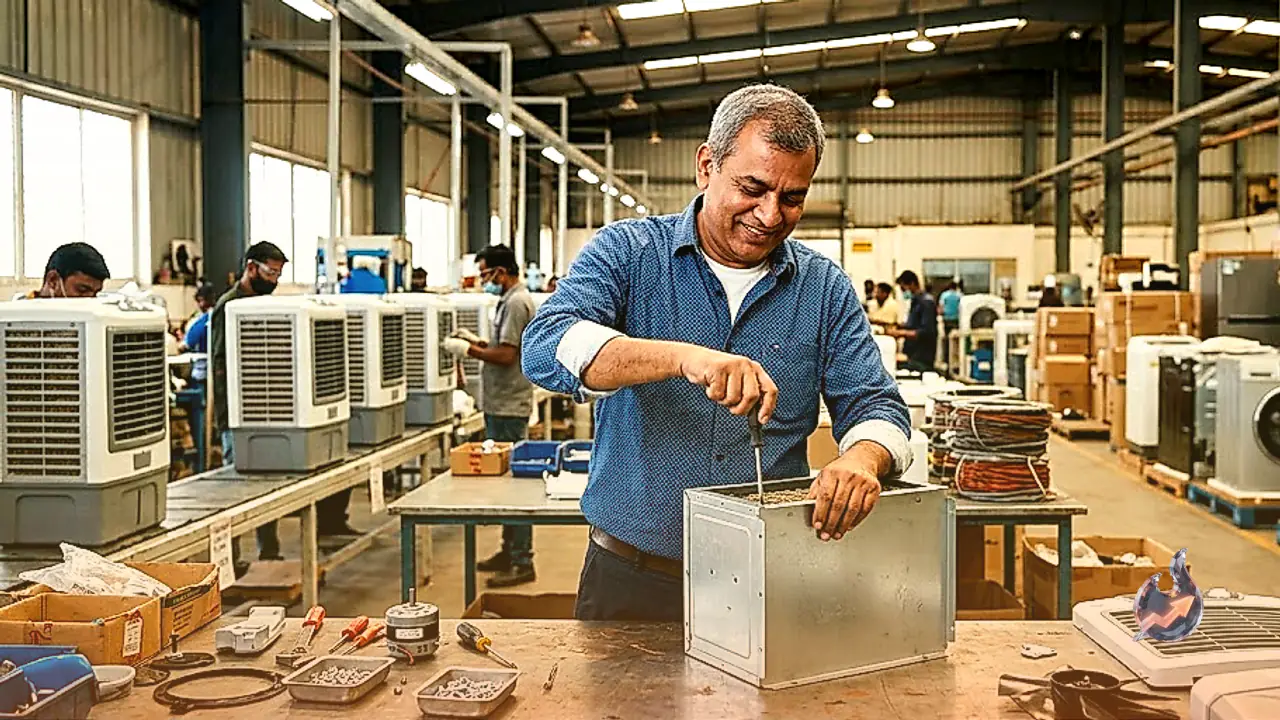

Building a massive commercial enterprise is often assumed to demand vast institutional capital right from the start, but steady perseverance, continuous practical learning, and unwavering fiscal discipline can transform the humblest beginnings into an industry powerhouse. The entrepreneurial journey of Noida-based industrialist Rajiv Gupta stands as an exceptional illustration of this principle. From balancing school studies with long hours at a small shop and setting aside just 50 rupees each day, he went on to master the technical craft of electronics from the ground up. He assembled air coolers with his own hands, serviced mechanical breakdowns, and absorbed the foundational realities of customer demand. Today, those grassroots efforts have culminated in a manufacturing and consumer durable enterprise generating an annual turnover of approximately 300 crore rupees.
Early Hardships and the Habit of Daily Saving
The foundations of Rajiv Gupta's business career were established under demanding personal circumstances. According to his son Tanuj Gupta, Rajiv Gupta began sitting at a grocery store to work alongside his schooling while he was only in the fifth grade. Even during that early stage of life, he made it a strict personal rule to save 50 rupees every single day out of his earnings. As time passed, he relocated to the city and immersed himself in electrical and electronic appliances. Rather than observing operations from a distance, he worked directly on workshop benches, assembling cooling units part by part, conducting repair services, and learning why machinery fails and how cooling efficiency can be enhanced. This direct technical grounding allowed him to understand consumer priorities long before stepping into large-scale production.
Founding the Venture with 25,000 Rupees
Decades of disciplined personal savings and hands-on technical experience eventually came together roughly 25 years ago, when Rajiv Gupta decided to launch his own formal manufacturing business. Tanuj Gupta stated that his father started the company with an accumulated personal corpus of just 25,000 rupees. The enterprise initially focused on producing standard electrical products. As operations stabilized, the venture progressed to manufacturing traditional metal sheet air coolers. Later, as domestic market preferences began shifting toward modern aesthetics and corrosion resistance, the enterprise adapted rapidly, expanding from fabricated metal frames into engineered plastic air coolers. This prompt reaction to shifting consumer taste allowed the business to stay competitive and profitable.
Expanding Product Portfolios and Generational Transition
To keep pace with the growing requirements of Indian households, the company steadily diversified its catalog. Operating under the corporate identity of Thermocool Home Appliances Limited, the firm now commands an extensive portfolio spanning between 150 and 200 distinct SKUs across the electrical and electronics categories. Following the disruptions of the Covid pandemic, the next generation of the family stepped into core executive responsibilities to modernize operational structures. The business is currently centering its strategic growth around comprehensive pan-India supply logistics, seeking to place its cooling appliances into retail stores nationwide.
Evolving Market Dynamics in the Cooling Segment
Outlining the brand's long-term market posture, marketing expert Tushar Gupta explained that the primary objective is to solidify their reputation within the broader consumer durables industry. Speaking on the economics of cooling equipment, he emphasized that air conditioners remain beyond the financial reach of countless households across the country due to both upfront purchase costs and recurrent electricity expenses. Consequently, air coolers continue to serve as an indispensable summer appliance for a vast section of the population. The company's expansion roadmap focuses on reinforcing its distribution network in North India first, before executing systematic commercial rollouts across other geographic regions in the country.
Changing Shopper Behavior: Digital Discovery Meets Physical Validation
Tushar Gupta pointed out that today's consumer is no longer driven strictly by rock-bottom pricing; instead, buyers actively look for enhanced aesthetics, durability, and upgraded performance features tailored to their living spaces. This shift has pushed the manufacturer to continually upgrade its designs and technical components. Furthermore, the post-Covid environment has reshaped purchasing pathways, even across Tier-2 and Tier-3 urban markets. Consumers now routinely perform initial product research online, reviewing specifications, feature lists, and prices over the internet. Despite this digital shift, when dealing with substantial electronics and home appliances, buyers still strongly prefer visiting local brick-and-mortar storefronts to inspect the actual finish, color, and build quality in person before completing the purchase.