






















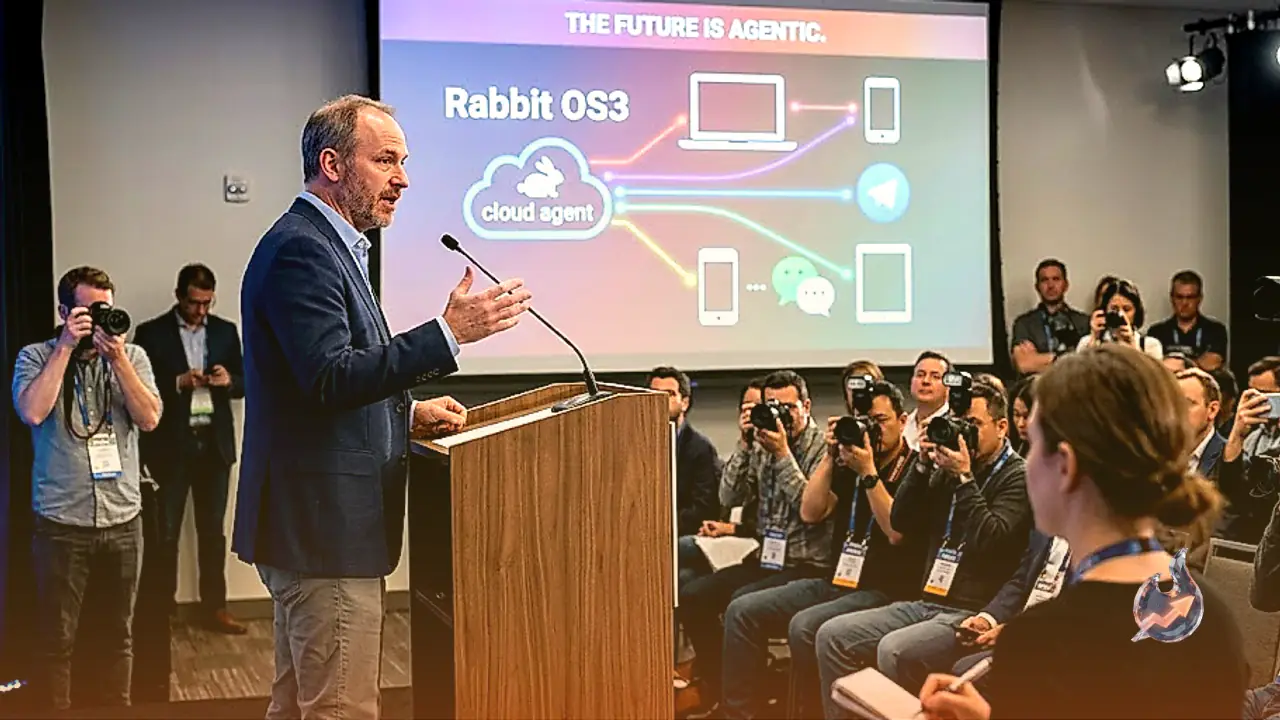

The feverish rush to persuade consumers that they needed a dedicated artificial intelligence pocket companion has officially hit a major turning point. Rabbit, the startup that captured massive industry attention during CES 2024 with its bright orange-red R1 assistant, is radically shifting focus away from single-purpose handheld hardware. The company has rolled out OS3, a standalone agentic operating system designed to operate directly across the personal computers, mobile messengers, and web browsers people already use every day. Spearheaded by founder Lyu, the software pivot signals a quiet admission that dedicated consumer AI gadgets were an unnecessary middleman.
The Stumble of the R1 and the Limits of Early AI Gadgets
When the R1 was originally introduced to the public, it was marketed as a revolutionary leap beyond traditional smartphones. Users were told they could speak into the compact, Teenage Engineering-designed box and let its internal systems autonomously book an Uber or place a food order through DoorDash. However, once the gadget landed in consumers' hands, the practical reality fell drastically short of the marketing hype. The device suffered brutal evaluations from reviewers, including an abysmal 3/10 score from prominent tech critics, largely because its autonomous action systems routinely broke down or failed to execute basic requests.
Despite the critical drubbing, Lyu maintains that the initial hardware run was financially solid for the startup. Because Rabbit avoided charging an ongoing subscription for its core functions, the company relied entirely on hardware sales, delivering over 100,000 units globally while generating a gross margin of roughly 45 to 50 percent on each device sold. According to Lyu, product return rates remained under 5 percent. From his viewpoint, the engineering hypothesis behind autonomous agents was sound, but the company suffered from being a tiny, resource-constrained startup going up against tech behemoths that commanded billions of dollars in development capital.
Regulatory Roadblocks in India, Internal Unrest, and Software Repairs
The aftermath of the rough product rollout forced Rabbit into severe survival measures. Rather than expanding operations, management chose to keep its workforce capped at just 15 employees. Roughly a year ago, the startup ran into acute financial strain when a planned commercial debut in India was blocked by local regulatory issues. The resulting cash crunch became so intense that several staff members initiated a strike, alleging that their wages had been withheld. Lyu acknowledged the dispute, noting that he respected the staff's reaction, but insisted the company subsequently stabilized its operations by securing additional funding. To date, Rabbit has raised around $60 million in total venture backing.
Instead of rushing a second-generation gadget to the assembly line, the startup chose to steady itself through an aggressive software cadence. Over the course of eighteen months, Rabbit deployed approximately 50 software updates to repair and expand the R1's capabilities. Working closely with a dedicated Discord community of over 12,000 users, the company made the handheld hardware significantly more flexible, allowing owners to bypass Rabbit's internal models in favor of third-party alternatives like OpenClaw or Hermes. While inventory continues to clear out through retail channels like Amazon, Target, Best Buy, and Rabbit's direct storefront, the company has officially ceased manufacturing new R1 units.
Inside OS3: Cross-Screen Automation and Local Device Control
Rather than anchoring software to proprietary plastic, OS3 operates as a cloud-hosted platform that bridges directly to a user's local operating system. By installing a lightweight background node on Windows, macOS, or Linux, OS3 can interface directly with native desktop software, system directories, and active web sessions. Using Rabbit's proprietary DLAM, or Direct Large Action Model, the software can autonomously manipulate desktop applications, inspect documents, and write or debug source code. A single account can synchronize up to five distinct machines, with the cloud engine automatically deciding which computer is best suited to complete an incoming instruction.
The interaction model discards traditional sidebars and fragmented chat lists in favor of an uninterrupted conversational stream. Lyu characterizes the workflow as a brain-dump console: users paste a natural language instruction or drop a public web link for any third-party agent skill, and OS3 installs and activates the capability automatically. Remote execution is supported out of the box through messaging channels like Telegram or Apple's iMessage. In one routine workflow example, Lyu described receiving weekly R1 sales spreadsheets from commercial partners; instead of manually transferring figures into a master workbook on his computer, he simply messages his desktop node via Telegram on his phone to execute the data entry automatically.
Lyu highlighted another real-world demonstration where the agent filled in for him during an all-day video shoot. Unable to monitor workplace messages directly, he tasked OS3 with managing his Slack channel. The autonomous agent engaged in a 50-minute technical exchange with an engineer, identifying itself transparently as Lyu's automated surrogate while reading reference files from his hard drive to answer procedural questions accurately.
Privacy Architecture and the Road Toward a Cyberdeck
Handling desktop applications and local hard drives naturally raises critical privacy concerns. Rabbit insists that its local desktop node does not copy, harvest, or monetize personal information, keeping actual file contents on the user's local drive while conversation threads and operational memories reside on the company's servers. The software operates under a Bring Your Own Key (BYOK) architecture, avoiding recurring platform fees by requiring users to plug in their own paid API keys from providers like OpenAI and Anthropic, or point the system toward locally hosted open-source models. When a task demands complex cloud reasoning, prompts are routed through Rabbit's relay infrastructure to the chosen model provider, subject to that vendor's privacy policies.
Looking ahead, Rabbit has formally ruled out producing an R2 handheld companion. While current R1 owners can still use their existing pocket gadgets as remote voice input and output accessories for the new software, Rabbit's upcoming hardware project, expected within several months, is an entirely different creation: a dedicated Cyberdeck machine built specifically around OS3 to facilitate vibe coding. With industry giants like Meta facing scrutiny over automated virtual machine shopping agents on retail sites, Rabbit's pivot demonstrates that the dream of personal automation will ultimately take root on the hardware users already rely on every day.