



















In Lakhimpur Kheri district of Uttar Pradesh, beekeeping has become one of the most promising routes for farmers to earn an income outside traditional crop cultivation. The Horticulture Department runs an online application process where farmers are selected on a first-come, first-served basis and receive a government subsidy of 40 to 50 percent on beekeeping equipment. Those who have taken up the opportunity are already seeing their incomes rise, selling honey and other bee-derived products into a market with growing appetite for natural alternatives.
Why Beekeeping Works: Low Investment, Multiple Revenue Streams
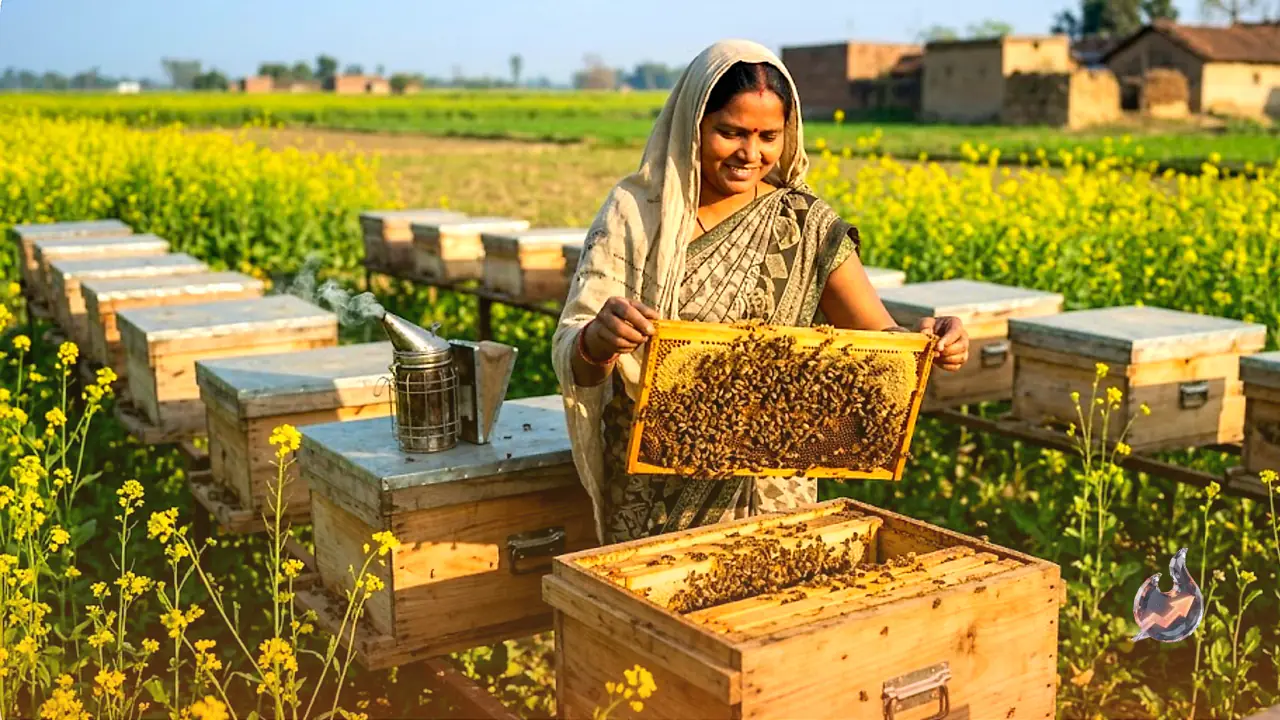
The appeal of beekeeping is its accessibility. A farmer can start with a handful of boxes placed at the edge of a field and build the operation gradually without needing large land or significant capital. Bees also carry out pollination across crops as they work, naturally boosting agricultural output alongside the honey income. A single box can yield roughly 30 to 35 kilograms of pure honey over a year, and pure honey consistently commands strong prices in the market. Beyond honey, beekeeping also produces wax, royal jelly, and pollen, each with its own established market value.
Rita Devi: Twenty Boxes and a Growing New Income
Rita Devi, a farmer from Kheri district, received 20 boxes through the Horticulture Department's scheme and has been profiting steadily from them. She says that rising demand for pure honey in markets means thousands of rupees can be earned with relative ease. With lychee fruit currently in season, her bees are visiting lychee trees and collecting honey abundantly, making this a particularly productive period for her operation.
Kapil Verma: Running 100 Boxes While Continuing His Education
Kapil Verma, a young resident of Kheri district, has been keeping bees for around 3 years while simultaneously continuing his studies. He currently manages around 100 boxes. Kapil notes that the operation demands very little space since boxes can be placed at any corner of a field. Each box yields an average of 30 to 35 kilograms of pure honey, and demand for it in the market remains consistently strong.
Dharmu: A Kalhouri Village Farmer on a New Path
Dharmu, from Kalhouri village in Kheri district, is another beneficiary of the scheme and currently operates around 20 boxes. He highlights the Horticulture Department's practice of providing training before handing over the boxes as a key part of what makes the scheme work. That preparation has helped him run the operation correctly with the goal, as the department intends, of doubling his income.
Shivam: Six Years of Experience and Still Scaling
Shivam, from Parsadpur village in the Gola tehsil area, is among the most experienced beekeepers in the district, having practiced the work for around 6 years. He currently runs around 100 boxes. Shivam points to a broader cultural shift as the engine behind demand: people are increasingly choosing natural honey over sugar, and honey holds a special place in Ayurvedic and home remedy traditions. That combination keeps pure honey pricing favorable in the market. He does acknowledge that the rainy season presents some challenges for the work.
How the Scheme Works: Online Application, First Come First Served
Mrityunjay Singh, the District Horticulture Officer for Lakhimpur, explained that the department actively spreads awareness of this opportunity among farmers. Applications are submitted online and selection follows a strict first-come, first-served principle. Farmers who qualify receive both the 40 to 50 percent subsidy and dedicated beekeeping training, giving them the practical grounding they need to run a successful operation and meaningfully increase their earnings.