






















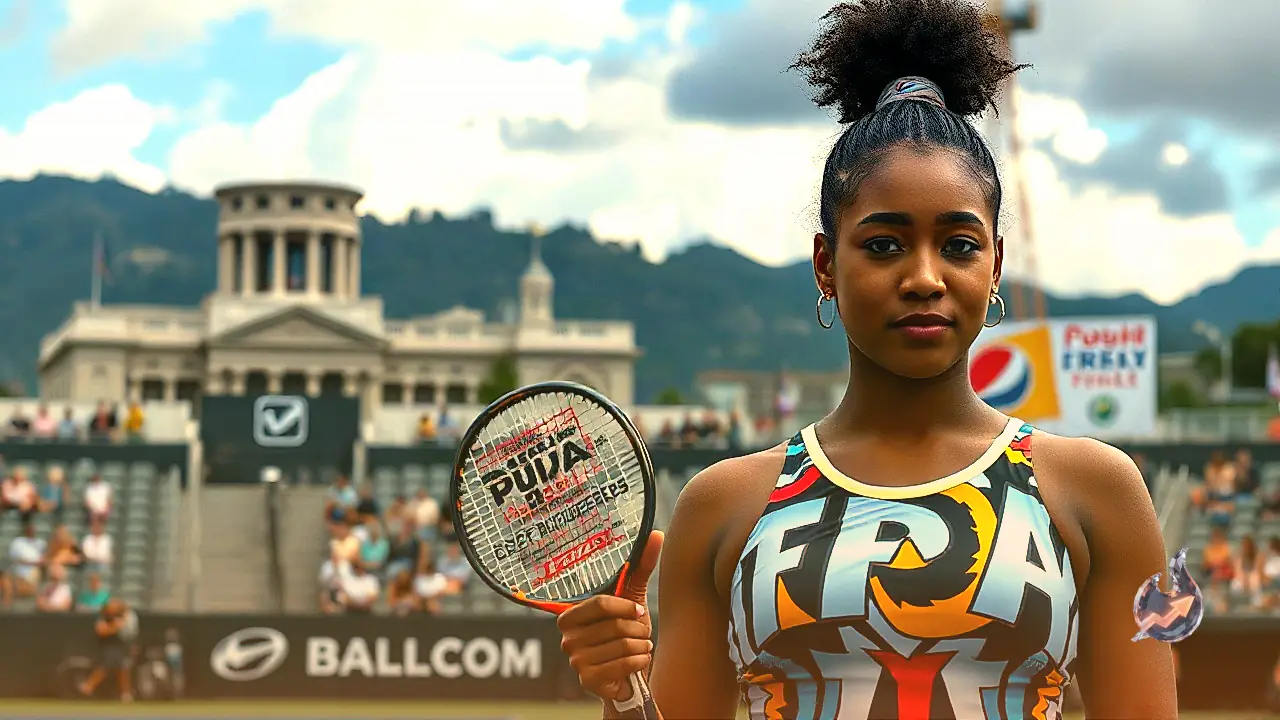

Japanese tennis star Naomi Osaka has built a reputation not only for her elite performance as a four-time Grand Slam champion but also for pushing aesthetic boundaries with her high-fashion on-court wardrobe. Addressing the recurring public debate surrounding her striking match day choices, the 28-year-old player made it clear that negative reactions will not alter her approach. She emphasized that being a pioneer often involves enduring backlash, a trade-off she embraces if it ultimately broadens self-expression for future generations of athletes.
US Open Fashion Statements and Homage to Allen Iverson
Throughout her US Open campaigns, Osaka has repeatedly turned the entrance walk into a high-concept fashion showcase. In her first-round victory over Anastasia Zakharova, she made her entrance wearing a dramatic white hooded gown. Beneath the outer garment, she revealed an all-black basketball-style playing outfit, complemented by braided hair and a headband.
This specific look was designed as an explicit homage to former NBA icon Allen Iverson. Describing Iverson as a true fashion trailblazer, Osaka pointed out how his distinctive style reshaped cultural norms surrounding sports and fashion, leaving a lasting influence regardless of whether it was done intentionally.
Her wardrobe continued to evolve in subsequent rounds. For her match against Croatia's Antonia Ruzic, Osaka walked out in a custom creation designed by Robert Wun. At the 2024 US Open, she sported a lime green and white ensemble adorned with decorative bows, including a prominent large bow across her back. Later, during her last-16 encounter against Elena Rybakina, she made her court entry wearing an intricately decorated coat before removing it to play.
Cultural Identity and Mental Health Advocacy Parallel
Osaka's unique background heavily informs her personal style. Born to a Haitian-American father and a Japanese mother, she frequently highlights her dual heritage. Addressing the online commentary about her wardrobe on social media, she reflected on how public scrutiny has followed key moments of her career.
She pointed out a clear parallel between the current reactions to her outfits and the pushback she experienced when she initially spoke out about mental health awareness in professional sports. Noting that her Haitian ancestry instills a natural inclination toward bold self-expression, Osaka reiterated that taking the brunt of public criticism is entirely acceptable to her if it results in a more welcoming environment for those who follow in her footsteps.
A Spectrum of Grand Slam Style Across the Globe
Osaka's fashion-forward approach spans all four Grand Slam venues, with custom designs tailored to reflect different artistic concepts and cultural references. At the 2026 Australian Open, she unveiled a marine-inspired look featuring an ocean blue tie-dye tracksuit jacket paired with wide-leg white trousers, taking inspiration from the movement of jellyfish.
During the French Open in May, she chose a striking metallic gold attire that commanded immediate attention on the clay courts. Meanwhile, on the grass courts of Wimbledon, where strict tradition often reigns, Osaka made her grand entrance wearing a classic Japanese kimono, honoring her maternal roots before stepping down to play her match.
Redefining Athlete Expression on the World Stage
By blending high fashion, basketball culture, and ancestral heritage, Naomi Osaka continues to challenge the conventional boundaries of tennis apparel. Her refusal to conform to standard dress expectations highlights a broader shift in women's sports, where athletes increasingly view the court as a platform for personal identity and cultural storytelling.