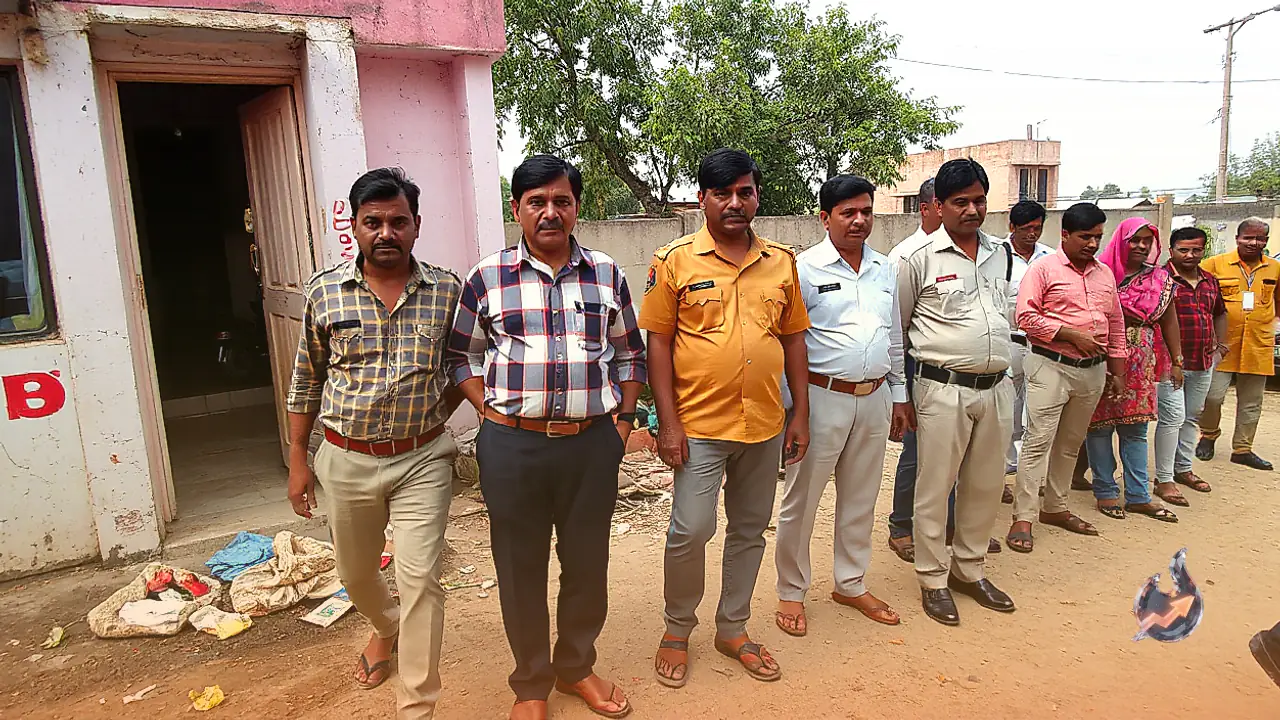





















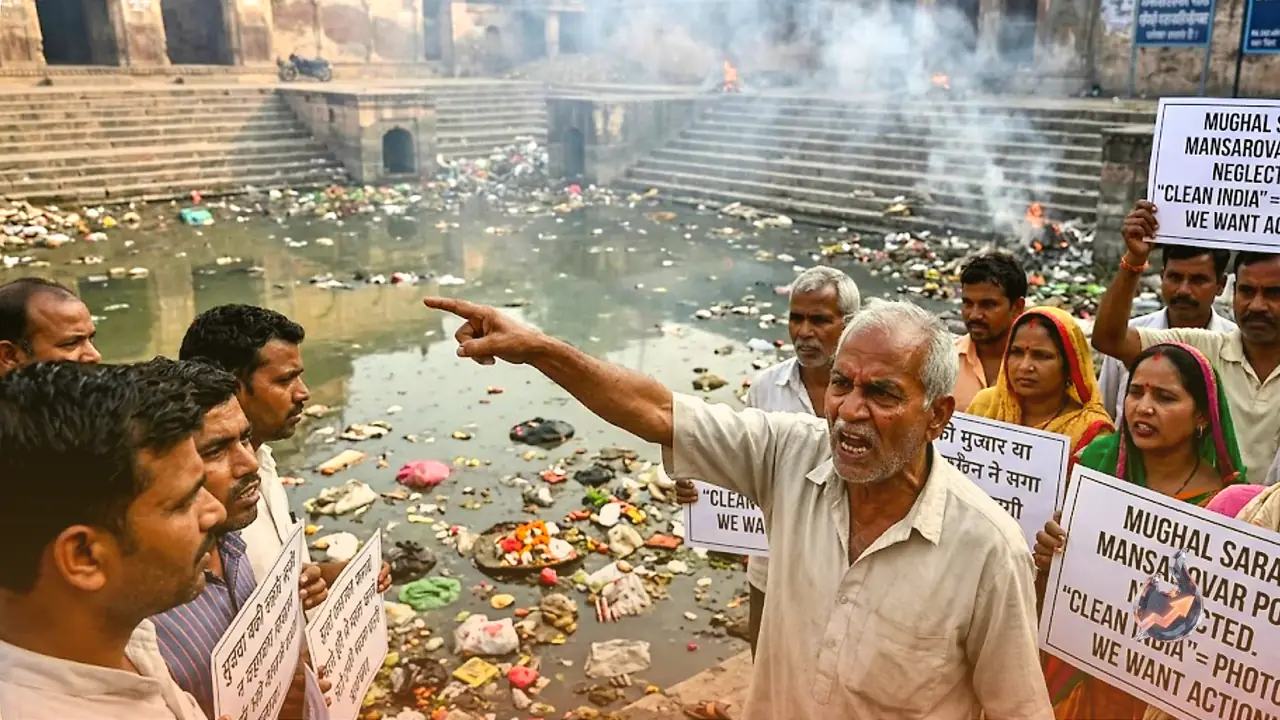

The current deplorable state of the historic Mansarovar Pond, located in the Mughal Sarai region of Chandauli district in Uttar Pradesh, has raised serious questions about the tall claims made under the central government’s Clean India Campaign (Swachh Bharat Abhiyan). While nationwide campaigns emphasize cleanliness and sanitation, the ground reality of this significant water body tells a completely different story. The Mansarovar Pond of Mughal Sarai is not merely a reservoir, but a deep-seated symbol of cultural identity and religious faith for thousands of local residents. It serves as a major focal point during the Chhath Puja festival, when thousands of devotees gather along its banks to offer prayers. Although the pond undergoes a dramatic transformation during the festive season, it is quickly abandoned by the administration and municipal authorities once the celebrations end. Today, this sacred site has degenerated into a dumping ground for garbage, thick with toxic smoke and a foul stench. The most frustrating aspect of this situation is that no administrative department is willing to assume responsibility for its regular upkeep. Local residents complain that a persistent deadlock between the railway administration, the municipal corporation, and local political representatives has left this vital religious landmark in a state of utter neglect.
Festive Diligence Followed by Year-Round Abandonment
According to local residents, the dedication shown toward cleaning the pond during the Chhath Puja festival is remarkable. During the preparation phase, the entire area is scrubbed so thoroughly that it resembles the deep cleaning of a private household. The steps of the ghats are cleared of all debris, garbage is carted away, and the entire structure is beautifully illuminated and decorated with flowers. Administrative staff and local officials are frequently seen inspecting the site during this period. However, as soon as the festival concludes and the devotees leave, the pond is immediately relegated to neglect. Within days, it reverts to its chaotic and highly polluted state. Currently, massive piles of trash line the perimeter of Mansarovar Pond, with smoldering refuse releasing a continuous, suffocating odor. For local citizens who visit the pond for morning and evening walks to breathe fresh air, the experience has become unbearable. They report that the stench has grown so intense that it is impossible to stand near the water body for even a few minutes.
Cleanliness Drive Labeled a Mere Photo Opportunity
Expressing deep frustration over the apathy of local authorities, Santosh Pathak, a local advocate, stated that Mansarovar Pond remains choked with filth for most of the year. He emphasized that the only comprehensive cleaning efforts occur during Chhath Puja, driven primarily by the initiative of local youth groups and festive committees rather than official intervention. Pathak alleged that neither the central government, the state administration, nor the local municipal body shows any genuine concern for the pond's preservation. He asserted that the cleanliness drive has been reduced to a mere publicity stunt, serving as little more than a backdrop for photo opportunities. He questioned how public roads, local neighborhoods, and historic common spaces can remain in such a disgraceful state when crores of rupees are officially earmarked for sanitation and development. Pathak also charged that while administrative officers ensure their own residential quarters and designated VIP zones are kept immaculately clean, the neighborhoods of ordinary citizens and shared public spaces are completely ignored.
Smoldering Garbage Heap Unleashes Health Hazards
Ajay Yadav, another resident of the area, pointed out a severe environmental hazard right next to the pond, where a large pile of garbage has been burning continuously. He stated that thick, acrid smoke has been rising from this smoldering dump for nearly a month. According to Yadav, the fire brigade did make an attempt to extinguish the fire on one occasion, but they were unable to put it out completely, and the pile has continued to smolder ever since. The persistent toxic smoke is now a major health concern for nearby residents, increasing the risk of respiratory illnesses. Despite the fact that thousands of commuters use this path every single day, the departments responsible for public health and safety have turned a blind eye. Yadav further criticized the overall state of sanitation across various wards in Mughal Sarai, noting that most neighborhoods suffer from a complete breakdown of waste management. He mentioned that ordinary citizens are forced to cover their noses when walking down the streets, contrasting this with the pristine conditions maintained in the gated colonies of government officials.
Depleted Oxygen Levels and the Death of Aquatic Life
Attributing the neglect of the pond to rampant institutional corruption, Madhavendra Murti Ojha, a local citizen, shared his concerns about the structural failure of development programs. He pointed out that while the government routinely allocates substantial budgets for the restoration, excavation, and beautification of public water bodies, as well as for promoting fisheries, none of these investments are visible on the ground. Gesturing toward dead fish floating on the surface of Mansarovar Pond, Ojha explained that severe water pollution and a critical lack of dissolved oxygen have led to the mass death of aquatic life. He asserted that if the government’s welfare and environmental schemes had been executed with transparency and integrity, the ecological collapse of this historic pond could have been easily avoided.
Unrealized Promises of the Amrit Sarovar Initiative
Local resident Arun Dwivedi also raised doubts about the efficacy of various state-sponsored initiatives. He pointed out that while the government claims to spend crores of rupees under high-profile schemes such as the Amrit Sarovar initiative, the wretched state of Mansarovar Pond completely refutes these official narratives. The vast accumulation of plastic waste, rotting organic matter, and the smoke from burning trash pose a serious threat to public health and the local ecosystem. Dwivedi alleged that although massive budgets are sanctioned in the name of development, the benefits never trickle down to the public due to administrative leaks and systemic corruption.
Older residents recall that just a few years ago, a major beautification drive was carried out at the pond. In an effort to transform it into a peaceful civic attraction, beautiful swans were even released into the water. However, due to continuous administrative neglect, that beauty has been entirely destroyed. Today, a thick crust of waste covers the water, which has turned black and highly toxic. Residents believe that with consistent maintenance and a proper management plan, Mansarovar Pond could easily be restored to its former glory, serving as both a scenic tourist spot and a proud religious landmark for Mughal Sarai.
The fundamental question that remains unanswered is which department actually holds the mandate to maintain this historical reservoir. Locals express deep frustration that whenever they attempt to file a complaint, officials simply indulge in bureaucratic finger-pointing. The municipal corporation claims the pond falls under the jurisdiction of the railway administration, while the railway authorities shift the blame back to the municipality or other state departments. The general public is left to bear the consequences of this endless administrative evasion.
A Landmark Tied to the Faith of Thousands
It is important to recognize that the Mansarovar Pond of Mughal Sarai is not just an ordinary body of water. It is an integral part of the region's cultural heritage, its historical identity, and the spiritual sentiments of thousands of families. The stark contrast between the beautifully lit ghats during Chhath Puja and the rotten, neglected dumping ground it becomes for the rest of the year exposes the deep failure of local governance. This issue goes beyond simple aesthetics; it is about administrative accountability and the lack of a sustainable maintenance framework. If the concerned departments and local leaders do not act immediately to address this crisis, the rotting waters of Mansarovar Pond will continue to stand as a silent, powerful indictment of grand cleanliness campaigns and development promises.