


















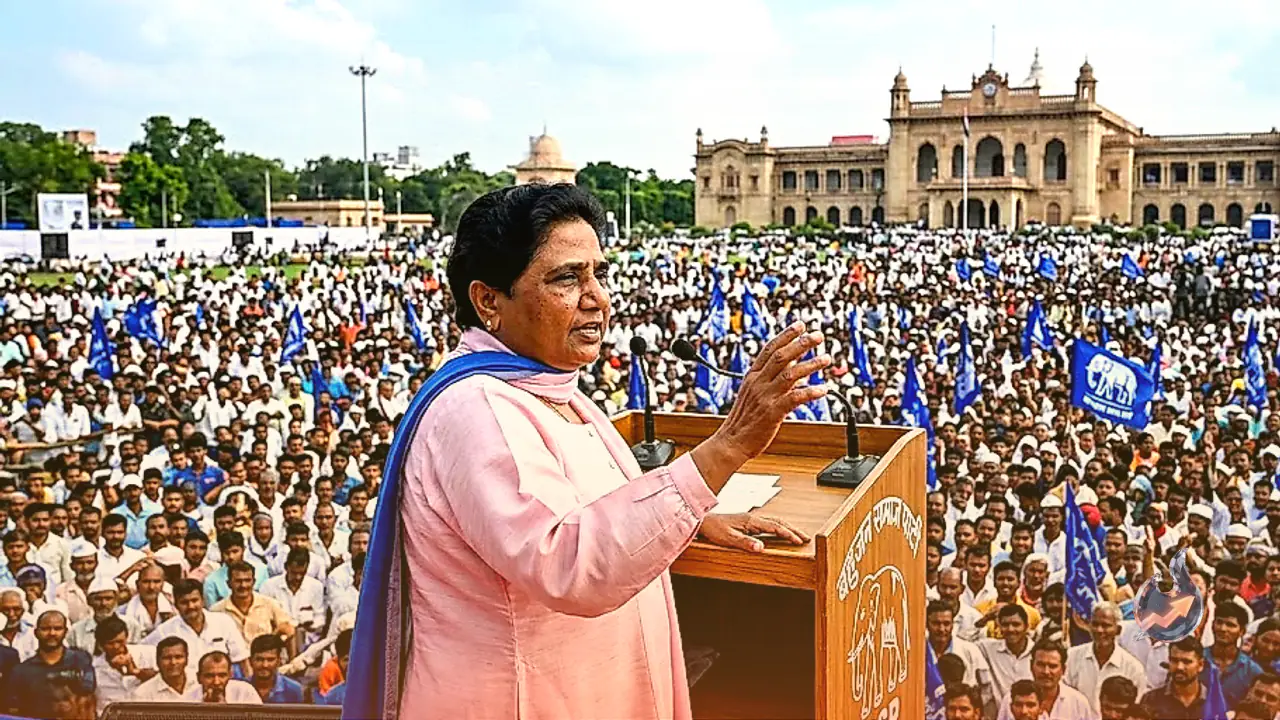

In the high-stakes theater of Uttar Pradesh electoral politics, the Bahujan Samaj Party stands out as an organization that has captured power four times under the leadership of Mayawati. Yet, each of those four ascents followed an entirely distinct political blueprint. In both 1995 and 1997, the BSP came to power by navigating the complex mechanics of alliances and external support. In 2002, Mayawati once again took the oath of office backed by the BJP, before stunning political observers in 2007 by clinching a standalone majority of 206 seats without leaning on any partner. Now, ahead of the 2027 assembly polls, the BSP is attempting to revive its traditional social foundation and rebuild its grassroots organization. This effort raises an inescapable question: can Mayawati reconstruct the very electoral ground that previously carried her party to power? Having managed to secure only a single assembly seat in the 2022 election, understanding the basis of the BSP's revival push requires a close examination of its political history and numbers.
Four Stints in Power Built on Four Distinct Mathematical Formulas
The core strength of the Bahujan Samaj Party across Uttar Pradesh has never been restricted merely to its loyal Dalit base; it has equally relied on a proven capacity to seize governance through shifting legislative balances. Mayawati took the oath as chief minister of Uttar Pradesh for the first time on June 3, 1995. Subsequent tenures followed on March 21, 1997, May 3, 2002, and May 13, 2007. Her fourth term, inaugurated in 2007, ran until March 15, 2012, marking her first and only full five-year tenure in office. Consequently, should the BSP reclaim authority in 2027, it would represent an effort to place Mayawati in the chief executive's chair for a fifth time. Evaluating those prospects requires understanding how the electoral calculus diverged across each past victory.
The 1995 Breakthrough: A Government Born from Broken Alliances
The BSP's maiden government in 1995 did not stem from an outright legislative majority won at the ballot box. In the 1993 assembly elections, the BSP had contested in an alliance with the Samajwadi Party. In that contest, the BSP won 67 seats with an 11.12 percent vote share, while the SP secured 109 seats, allowing Mulayam Singh Yadav to assume the chief ministership. Approximately eighteen months later, relations between the two alliance partners deteriorated sharply. Following the infamous Lucknow guest house incident on June 2, 1995, the BSP withdrew its support from the Yadav administration. Backed by the BJP, Mayawati took the oath as chief minister for the first time on June 3, 1995. Her inaugural tenure lasted around four and a half months. That initial pathway to power relied on a concentrated social base, an alliance structure, and rapidly changing legislative alignments, proving that even without a majority, the party held decisive leverage.
The 1997 Power-Sharing Arrangement with the BJP
The 1996 assembly election yielded another hung legislature in Uttar Pradesh, with no individual party reaching the majority mark. In this election, the BSP retained its 67 seats but expanded its popular support, capturing approximately 19.64 percent of the vote. The BJP emerged as the single largest entity with 174 seats. After roughly five months of protracted political deadlock over government formation, the BSP and BJP hammered out a unique compromise. Under the terms of this arrangement, the two parties agreed to rotate the chief ministership every six months. In accordance with the pact, Mayawati assumed the chief minister's office for the second time on March 21, 1997. She governed for about six months before Kalyan Singh took over on September 21, 1997. While the BSP seat count remained at 67, its vote share had climbed from 11.12 percent in 1993 to 19.64 percent in 1996, demonstrating that its footprint was expanding far beyond a narrow demographic cluster.
The 2002 Expansion: Growing Tall in a Fractured Assembly
The 2002 assembly election marked the next phase of the BSP's steady expansion across Uttar Pradesh. The party bagged 98 seats and grew its vote share to roughly 23.06 percent. The SP finished as the largest party with 143 seats, while the BJP secured 88 seats, leaving the state once again without an outright winner. Amid these fractured numbers, Mayawati was sworn in as chief minister for the third time on May 3, 2002, supported by the BJP. This third administration continued until August 29, 2003. The trajectory from 1993 to 2002 revealed clear momentum: having maintained 67 seats in both 1993 and 1996, the party surged to 98 seats in 2002, while its statewide vote share climbed from 11.12 percent to 23.06 percent. The groundwork for a standalone majority was laid through this steady, election-by-election accretion of electoral support.
The 2007 Watershed: Absolute Majority Through Social Engineering
The 2007 assembly contest remains the most consequential milestone in the BSP's entire timeline. Departing from past dependencies on rival major parties, Mayawati steered her party to an outright majority on its own strength. In the 403-member assembly, the BSP secured 206 seats, four seats above the required majority threshold of 202, while capturing 30.43 percent of the popular vote. Mayawati took office for the fourth time on May 13, 2007, overseeing her longest and most stable administration until March 15, 2012.
This election was defined by the party's strategic pivot from a traditional identity focus toward a broader collective umbrella, widely characterized as a move from Bahujan to Sarvajan. The BSP deliberately combined its core Dalit constituency with Brahmin communities and other social groups. Prominent Brahmin figures such as Satish Chandra Mishra were placed at the forefront of this outreach, creating an expansive social coalition. This formula pushed the party's vote share past the 30 percent mark and delivered an absolute majority without external leverage.
The Post-2012 Slide and the 2027 Crossroads
Following the peak of 2007, the BSP entered a prolonged electoral downturn. In the 2012 assembly elections, the party lost power as its tally dropped to 80 seats, though it retained a significant 25.91 percent vote share. By 2017, its legislative presence fell further to 19 seats, even as its vote share hovered near 22.23 percent. The sharpest contraction arrived in the 2022 election, where the BSP managed to win just a solitary seat in the assembly, with its vote share shrinking to approximately 12.88 percent. The slide from 206 seats in 2007 down to a single seat in 2022 underscores the steep challenge facing Mayawati ahead of 2027, as she seeks to reconstruct the grassroots organization and social coalitions that previously powered four administrations.