


















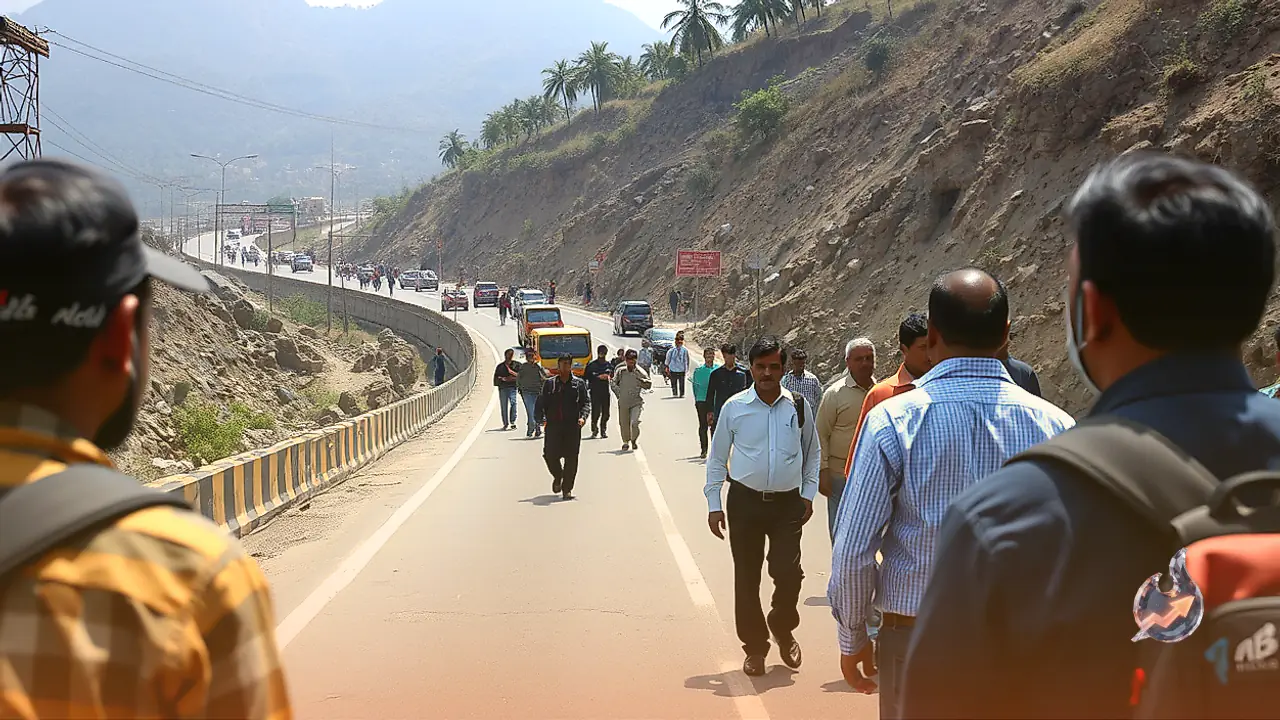

A short segment of the Delhi-Dehradun Expressway near Uttarakhand's capital has become a persistent danger zone for motorists, frustrating local authorities and safety officials alike. The stretch covering approximately 3.5 kilometres between Asharodi and Mohabbewala continues to witness severe vehicular collisions despite repeated administrative interventions. With routine enforcement and makeshift safety arrangements failing to produce results, serious questions are being directed at the fundamental engineering of the highway. To identify underlying structural defects, authorities have formally engaged the Central Road Research Institute to conduct a comprehensive technical evaluation.
Scientific evaluation by Central Road Research Institute specialists
The Central Road Research Institute serves as India's premier scientific body for road engineering, traffic management, highway safety standards, and infrastructural quality assessment. Specialists from CRRI will conduct on-site field inspections along the problematic Asharodi-Mohabbewala corridor to evaluate its structural geometry, gradient profiles, vehicular speed management systems, and overall safety measures. Corrective civil works will be carried out only after the research institute submits its formal diagnostic findings and structural recommendations.
Fatalities mount along 3.5-kilometre corridor
While the broader Delhi-Dehradun Expressway project was designed to slash travel times between the national capital and Dehradun, this particular 3.5-kilometre corridor has emerged as an alarming trouble spot. Since the expressway route became operational, this brief stretch alone has registered more than 50 major traffic accidents. Even more concerning is the human toll, with approximately 18 people having lost their lives on this specific section of the road.
Rumble strips and speed breakers fail to curb collisions
Local authorities initially rolled out several conventional mitigation measures to curb the rising accident rate, but none produced a meaningful reduction in crashes. In a bid to force traffic to slow down, administrative officials installed rumble strips and speed breakers across the sector, despite such installations deviating from standard National Highway rules. The makeshift additions brought a fresh set of complications, triggering persistent traffic congestion without resolving the core danger of severe collisions. Consequently, highway engineering flaws have come under active scrutiny, and CRRI investigators will examine whether severe gradients, suboptimal layout geometry, or inadequate braking mechanisms are responsible for the pattern of failures.
Steep gradient creates severe braking challenges for heavy commercial vehicles
The physical topography between Asharodi and Mohabbewala features an extended downhill slope that complicates vehicular control. Commercial trucks and other heavy vehicles gain dangerous momentum as they descend this extended incline, leaving drivers struggling to brake safely or maintain steering stability. Traffic specialists stress that this runaway momentum remains the primary contributor to severe collisions. In light of these risks, experts advocate an exhaustive road safety audit encompassing heavy-vehicle velocity limits, strict lane discipline, speed-calming placements, warning signage visibility, crash barriers, overhead illumination, surveillance cameras, and rapid emergency medical response units.
Traffic leadership seeks empirical engineering solutions
Addressing the persistent hazards, CO Traffic Jagdish Pant explained that joint surveys involving multiple departments had already been conducted on multiple occasions across this corridor. However, because local survey recommendations failed to yield any drop in collision numbers, technical intervention from CRRI became necessary. Jagdish Pant affirmed that CRRI's empirical assessment will pinpoint exact structural flaws in the highway design, allowing authorities to execute targeted engineering corrections based entirely on verified technical data.