






















Handcrafted candle manufacturing has evolved far beyond an emergency lighting solution, turning into a thriving enterprise within interior decoration, gifting, and event styling. Today, fragrant, sculptural, and personalized candles are sought after for home styling, weddings, festive gatherings, and private celebrations. Because production requires minimal capital and modest floor space, this craft offers a viable pathway for individuals seeking an independent home business. Chandra Bhanu Singh Bhakuni, an RSETI faculty member based in Bageshwar, alongside artist Richa Joshi, outlined the foundational steps, manufacturing techniques, and commercial avenues essential for establishing a small candle venture.
Raw Materials and Equipment Needed to Start
The principal advantage of candle making lies in its low barrier to entry, as the entire operation can run from a study table or a quiet domestic corner without industrial machinery. According to RSETI faculty member Chandra Bhanu Singh Bhakuni, the fundamental raw materials comprise soy wax or paraffin wax, candle wicks, concentrated fragrance oils, and specialized candle dyes.
To shape the products, makers rely on glass jars and flexible silicone molds available in varied geometric and artistic contours. On the hardware side, wax melting requires a standard double boiler setup, while an accurate thermometer ensures temperature control. The final stage requires packaging supplies including rigid boxes, branding labels, and ornamental accents. By purchasing raw materials in modest batches initially, aspiring entrepreneurs can test product designs while keeping financial risk minimal.
A Straightforward Production Workflow
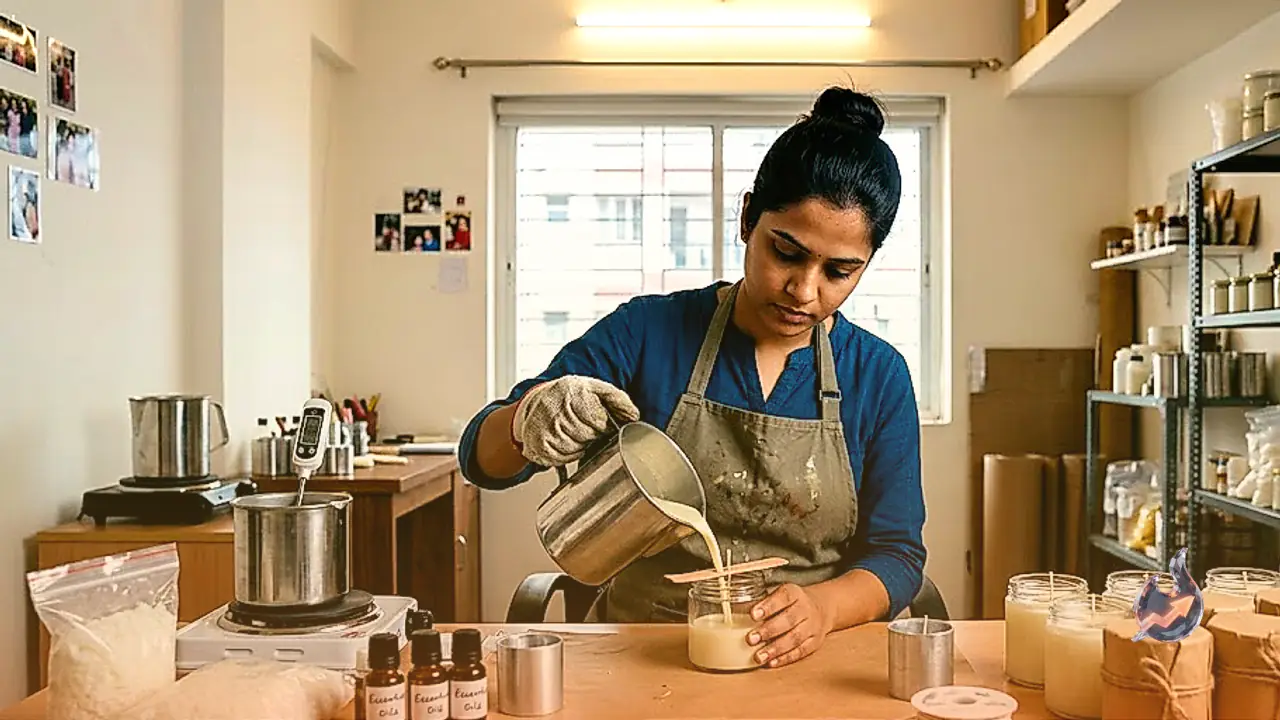
Artist Richa Joshi explains that hand-pouring candles follows a precise yet uncomplicated sequence. First, wax blocks are gently liquefied in a double boiler until reaching the recommended pouring temperature. Monitoring heat closely is crucial to prevent overheating and maintain smooth consistency. Once fully melted, proportional amounts of color pigment and aromatic oils are stirred thoroughly into the liquid wax to ensure uniform distribution.
Next, the wick is positioned firmly in the exact center of the chosen mold or glass container. The hot wax is steadily poured into the vessel and left undisturbed until it cools and cures completely into a solid mass. Free-standing molded candles are carefully unmolded, while container candles remain housed within their glass jars. The process concludes with trimming the wick, cleaning surface blemishes, affixing product labels, and packing the items in protective presentation boxes.
Unit Economics and Financial Prospects
Initial expenditure depends largely on the variety of silicone molds, wax quantity, and decorative packaging procured. Producing a standard-sized handmade candle generally requires a production cost between 15 and 50 rupees, which covers wax, wick, coloring, and fragrance oil.
In the consumer market, retail pricing varies according to scent profile, volume, artistic complexity, packaging aesthetic, and wax composition, fetching anywhere from 100 to 300 rupees or more per piece. For example, if an average piece costs 30 rupees to fabricate and sells for 100 rupees, it yields a healthy gross margin. Net earnings are finalized only after subtracting packaging, delivery charges, platform commissions, and administrative overheads. Selling an average of 20 candles daily translates into roughly 600 units monthly, generating a meaningful secondary income stream. Realized earnings naturally fluctuate based on sales volume, buyer retention, finish quality, and promotional reach.
Target Retail Channels and Buyer Demographics
Finished goods do not need to rely solely on neighborhood grocery shelves. High-margin sales can be achieved through specialty gift boutiques, lifestyle stores, cafes, resorts, and home furnishing outlets. In addition, demand spikes sharply during festive cycles and milestone events, such as Diwali, birthdays, Valentine's Day, weddings, anniversaries, and Christmas.
Another lucrative outlet is the return gift segment for matrimonial ceremonies and milestone functions. Tailoring candles with inscribed attendee names, event dates, or specific color schemes allows makers to secure bulk orders with healthier profit margins.
Marketing Across Social Media and Digital Storefronts
During the nascent phase, founders can circulate their initial batches among personal acquaintances, local community networks, and nearby retailers. Creating crisp photographs and short behind-the-scenes video reels helps establish an organic promotional footprint on Instagram, Facebook, and WhatsApp.
As output stabilizes and operational logistics mature, catalog listings can expand onto prominent e-commerce platforms like Amazon and Flipkart to reach a nationwide customer base. Direct outreach to local boutique homestays, hotels, and wedding planners can also unlock recurring wholesale contracts.
Standing Out Through Customization
Customization serves as the primary differentiator in a crowded gift market. Beyond generic tapers and pillars, artisans can produce bespoke candles featuring personal monograms, celebration dates, uplifting messages, and corporate emblems. Curating coordinated gift hampers for corporate clients or custom wedding favors positions the brand in the premium gifting tier. Starting small from a domestic workshop, this creative enterprise can steadily evolve across local retail, social media, and digital marketplaces into a sustainable commercial brand.