

















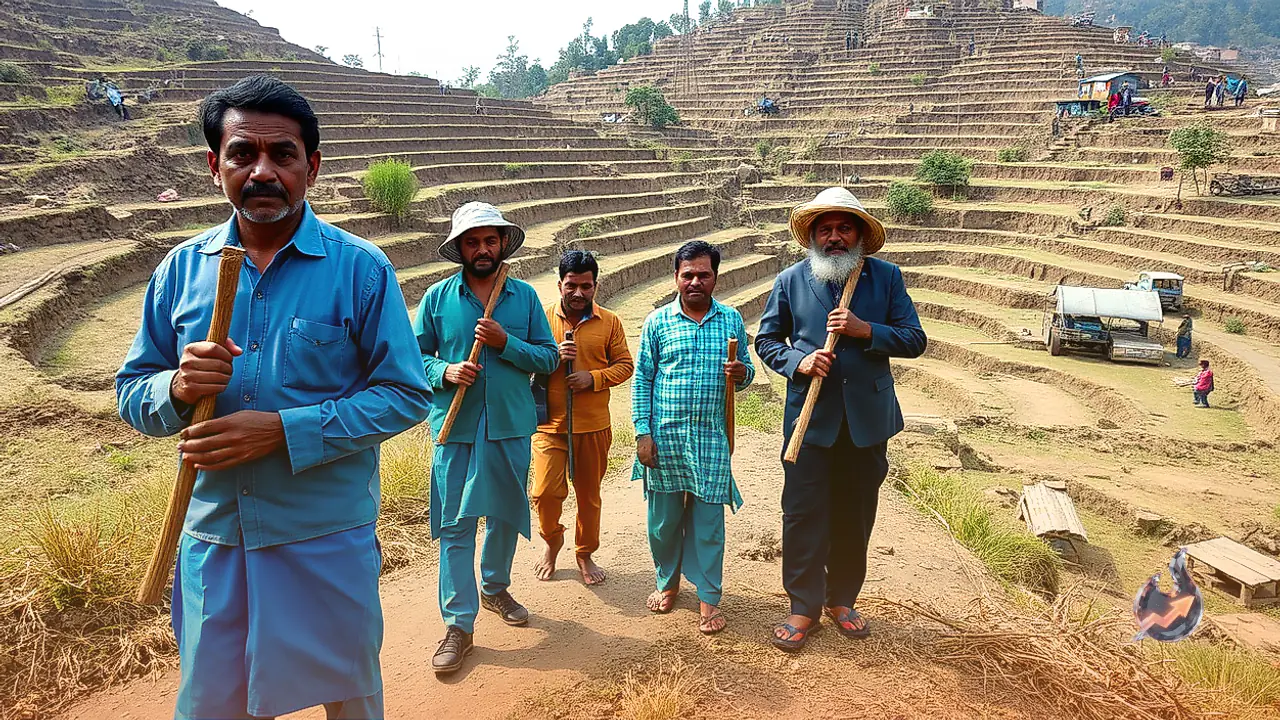

In the rugged mountain villages of Uttarakhand, traditional agricultural implements handed down through countless generations remain fundamental to daily survival. Foremost among these age-old tools is the sickle, locally recognized across mountain hamlets under names such as daranti or hansiya. Whether harvesting standing crops on terraced hillside plots, collecting nutritious fodder for livestock, or clearing dense undergrowth along narrow field boundaries, this curved cutting tool continues to serve farming households faithfully. It is not merely an everyday farming device, but an enduring symbol deeply interwoven with the historic rhythms, heritage, and labor of mountain life.
From Stone and Bone Implements to Resilient Iron
Local observer Himanshu notes that the use of curved, sharp-edged implements dates back to distant prehistoric periods. In earliest times, ancient communities crafted such cutting implements by shaping tough stones and animal bones. When metallurgy developed and iron working took root, these tools transformed into far sturdier, long-lasting implements capable of holding a sharp edge through extensive use. Even now, across mountain settlements in regions like Bageshwar, the sickle remains in regular use for an array of domestic and agricultural duties.
Diverse Regional Dialect Names Across Kumaon and Garhwal
Across the diverse geographical valleys of Uttarakhand, the tool goes by distinct regional nomenclature. In the Kumaon region, residents frequently refer to it as daranti, darant, dathuli, or aansi. Meanwhile, in the Garhwal belt, local communities commonly identify it by names like darat or koda. The physical construction typically features a curved iron cutting blade secured to a sturdy wooden grip. Depending on the precise nature of the intended chore, subtle variations are introduced into the curve, weight, and sharpness of the blade.
Essential Utility Across Terraced Plots and Fodder Gathering
The primary task demanded of the sickle in mountain terrain is grass cutting. Rural women venture onto forested hillsides, narrow field embankments, and grassy slopes to gather fresh green feed for domestic livestock. The tool has likewise served as the primary instrument for harvesting staple regional crops including wheat, barley, manduwa (finger millet), and jhangora (barnyard millet). Furthermore, it proves indispensable for weeding vegetable patches, clearing thorny shrubs, and harvesting nutritious fodder. Families also rely on it to cut winter-stored dry grass and chop thin firewood branches. On the steep gradients and narrow terraced steps characteristic of Himalayan agriculture, deploying cumbersome modern farm machinery is practically impossible, making the lightweight hand sickle by far the most convenient choice.
A Constant Companion for Mountain Women in Demanding Terrain
The sickle occupies a central role in the rigorous daily routine of mountain women. Whenever women set out toward high-altitude forests to collect cattle fodder or gather fallen wood, the sickle is an inseparable part of their kit. Across rocky trails and dense woodland expanses, it functions as their essential work partner. While it can potentially serve as an impromptu implement for self-defense in sudden emergencies, relying on a small blade to ward off dangerous wild animals is neither safe nor advisable. Consequently, villagers are urged to maintain strict alertness and caution whenever venturing into dense jungle tracts and wildlife habitats.
Reflecting the Craftsmanship of Traditional Village Blacksmiths
The lineage of crafting sickles is intimately intertwined with the traditional iron-forging craft of rural blacksmiths. Historically, local blacksmiths in mountain hamlets would heat raw iron until incandescent inside their charcoal hearths. Employing hammers and anvils, they skillfully beat the heated metal into precise curves and ground it to a keen edge. Consequently, the sickle became not just a farming necessity, but a living testament to the skill, labor, and craftsmanship of community blacksmiths. In earlier eras, villagers obtained virtually all of their vital household and agricultural hardware directly from these local craftsmen.
Significance in Folk Festivals and Temple Traditions
The significance of the tool extends far beyond agricultural furrows and timber trails, reaching deep into regional social customs and spiritual rites. During the traditional Ghee Sankrant festival, celebrated locally as Olgia, community lore records the customary exchange where blacksmiths presented freshly crafted iron tools to their patrons. Similarly, at the renowned Daranti Temple situated in Fatehpur village within Nainital district, deeply held devotional beliefs center on offering sickles to the shrine. Devotees perform this offering as an act of faith to seek spiritual protection for their domestic cattle and the fulfillment of personal prayers.
Sustained Relevance Despite Expanding Farm Modernization
Although mechanized agricultural tools and motorized grass cutters are steadily gaining ground across the country, altering traditional farming practices, the sickle has by no means disappeared from the mountains of Uttarakhand. Across remote terrace farms, forested hillsides, and domestic homesteads, this humble curved implement continues to hold its ground as an enduring pillar of Himalayan rustic life.