























Situated in northern Tanzania against the backdrop of the active volcano Ol Doinyo Lengai, Lake Natron stands out globally for its surreal crimson and orange hues alongside its punishing ecological conditions. The expansive saline lake resembles an alien landscape from a distance, capturing international curiosity through an extraordinary combination of striking natural beauty and harsh chemical extremes that define this African wetland.
The Haunting Imagery and Cemetery of Stone
The global reputation of Lake Natron as a petrifying water body accelerated significantly during 2013, when British photographer Nick Brandt captured haunting portraits of dead birds and bats along its shoreline. Preserved in rigid, statue-like poses, these animal remains appeared as though carved directly from solid stone. The striking photographic collection sparked worldwide fascination, prompting widespread intrigue and popular references to the site as a macabre cemetery of stone.
Extreme Alkalinity and Harsh Chemical Profile
The aquatic environment of Lake Natron differs radically from conventional freshwater ecosystems, with water alkalinity reaching an intense pH level of up to 10.5. Runoff from the nearby volcanic terrain deposits dense concentrations of sodium carbonate and bicarbonate into the lake basin. This caustic chemical cocktail creates an environment that severely challenges organic tissues, turning immersion into an immense physiological hazard for most living creatures that wander into its shallows.
The Calcification Mechanism Explained
Scientific evaluations make it clear that animals falling into the lake do not instantly turn to stone through supernatural means, but rather undergo an intricate chemical process. When creatures perish in or near the water, the heavy saturation of alkaline minerals steadily encrusts their remains as the moisture evaporates. Known scientifically as calcification, this gradual mineral deposition hardens the organic remnants into rigid, stone-like structures. Popular notions suggesting a human would immediately turn to stone upon touching the water are entirely inaccurate.
Thermal Extremes Adding to the Danger
The severity of Lake Natron is further compounded by extreme thermal conditions during hot weather periods, when water temperatures can surge as high as 60 degrees Celsius. The lethal conjunction of scalding heat and caustic chemical alkalinity creates a punishing environment that can quickly prove fatal to unadapted wildlife. These unforgiving baseline factors ensure that only highly specialized biological organisms can navigate the terrain safely.
A Thriving Nursery for Lesser Flamingos
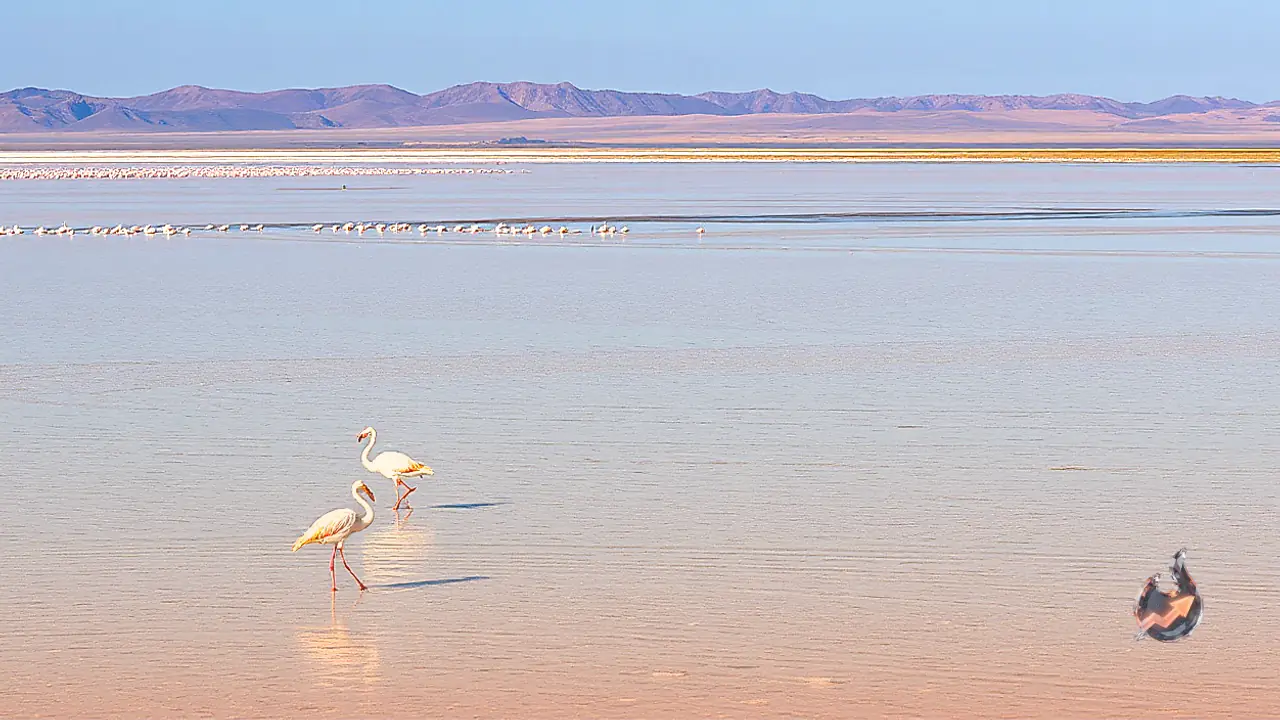
Remarkably, the very qualities that render Lake Natron perilous to general wildlife transform it into a crucial sanctuary for millions of lesser flamingos. These majestic birds treat the lake as their primary breeding haven, gathering in massive colonies to lay eggs and nurture their offspring. The evolutionary adaptations of flamingos, including tough protective skin on their legs and specialized salt-filtering mechanisms, enable them to flourish comfortably within this otherwise hostile environment.
Natural Shield Against Predators and Rich Sustenance
The forbidding chemical barrier of Lake Natron acts as an impenetrable moat, preventing land predators from venturing across the caustic mudflats to disturb flamingo nests or hunt young chicks. Furthermore, the specialized alkaline water fosters abundant blooms of unique algae and microorganisms, which serve as the primary food supply for the nesting flocks. Lake Natron thus embodies an astounding ecological duality, existing simultaneously as a deadly obstacle for standard fauna and a thriving cradle of avian life.