





















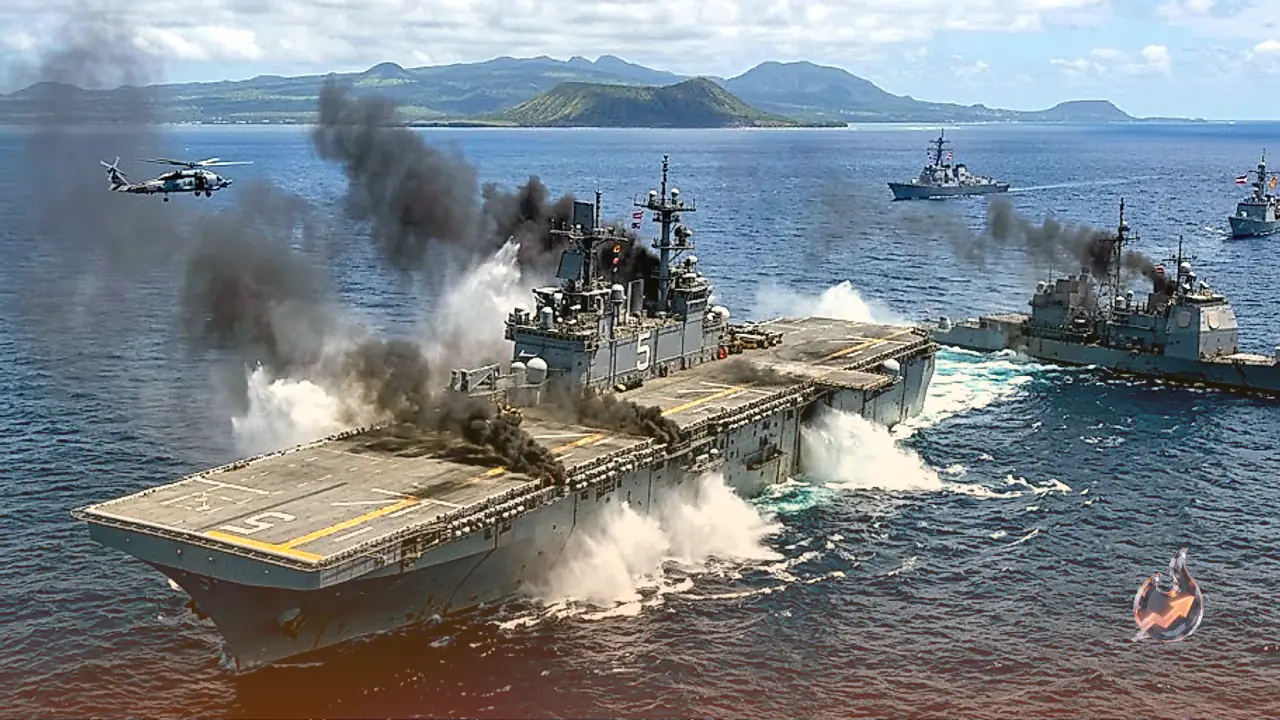

The US Navy, known for projecting its massive maritime power across the globe, recently executed a highly strategic operation in the Pacific Ocean by sinking two of its own iconic warships. Rather than being the result of a hostile engagement, this double sinking was a calculated tactical decision. Sinking these decommissioned, steel giants under the waves is not a wasteful display of billions of dollars, but a carefully planned strategy aimed at testing cutting-edge weapons, training multinational forces, and avoiding the astronomical costs of traditional ship recycling.
The Exorbitant Costs of Warship Decommissioning
Disposing of retired military vessels has become an incredibly expensive and logistically complex challenge for modern navies. For instance, the US Navy recently awarded a contract exceeding $400 million just to recycle USS Enterprise, its first nuclear-powered aircraft carrier. Dismantling nuclear vessels requires strict adherence to environmental safety protocols to safely isolate and dispose of radioactive components, driving up the costs. Consequently, for non-nuclear retired vessels, utilizing them as targets in live-fire Sinking Exercises (SINKEX) is highly cost-effective compared to commercial scrapping. It offers invaluable, real-world combat training for sailors while serving as a practical disposal method for retired hulls.
Rigorous Environmental Cleanup Protocols
Before any decommissioned warship is permitted to be sunk, it undergoes an extremely thorough cleaning process to protect the marine ecosystem. This environmental preparation is so intense that the vessel is often cleaner than at any point during its active service. Under strict regulations enforced by the US Environmental Protection Agency (EPA), every trace of hazardous material is scrubbed from the ship. This includes the removal of polychlorinated biphenyls (PCBs), mercury, fluorocarbons, toxic chemicals, and any residual oil from the engine rooms and fuel tanks. Sinking is only authorized once the vessel meets all EPA clearance standards.
A Six-Nation Missile Barrage
During the RIMPAC 2026 multinational exercise off the coast of Hawaii, the retired amphibious assault ship USS Peleliu and the guided-missile cruiser USS Mobile Bay were designated as primary targets. Forces from six different nations unleashed a coordinated barrage of advanced weaponry to test their offensive capabilities in realistic combat scenarios. The weapons deployed included the US Navy's Long-Range Anti-Ship Missile (LRASM), the US Army's High Mobility Artillery Rocket System (HIMARS), and Spike NLOS missiles launched from Apache helicopters. Additionally, Japan's Type-12 surface-to-ship missiles, Harpoon missiles fired from the US submarine USS Columbia, and Harpoon missiles launched from a Spanish navy warship struck the targets. This exercise provided critical data on the performance of modern precision-guided munitions against real armored hulls.
Decades of Distinguished Military Service
Both of the sunken vessels boast long, historic careers within the US Navy. USS Peleliu (LHA-5), an amphibious assault ship, served the nation for 35 years before being decommissioned in March 2015. Over its decades of active duty, the warship participated in major operations including the Gulf War and the Iraq War. It also played a vital role in humanitarian missions, such as disaster relief operations following a volcanic eruption in the Philippines and the devastating 2010 floods in Pakistan. Similarly, the cruiser USS Mobile Bay (CG-53), decommissioned in August 2023, was a veteran of both the Gulf War and the Iraq campaign, serving at the forefront of American naval operations.
Resting in the Deep Ocean Trenches
After enduring the multi-nation missile assault, both warships sank to their final resting place in the Pacific Ocean, approximately 50 nautical miles off the coast of Kauai, Hawaii. The vessels now lie at a depth of about 15,000 feet (approximately 4.75 kilometers), far beyond the reach of human salvage operations. US environmental and defense regulations dictate that such sinking exercises must take place at least 50 nautical miles from land and in water depths of at least 6,000 feet, ensuring that the sunken hulls do not interfere with commercial shipping lanes or coastal marine life.
The World’s Largest Maritime Exercise
This operation was a key component of RIMPAC 2026, widely recognized as the premier international maritime exercise. Established in 1971, this year's event marked the 30th edition of the biennial maneuvers. The massive exercise brought together 30 nations, 30 surface warships, 5 submarines, more than 190 aircraft, and approximately 30,000 military personnel, serving as a powerful platform for fostering international naval cooperation and tactical readiness.