






















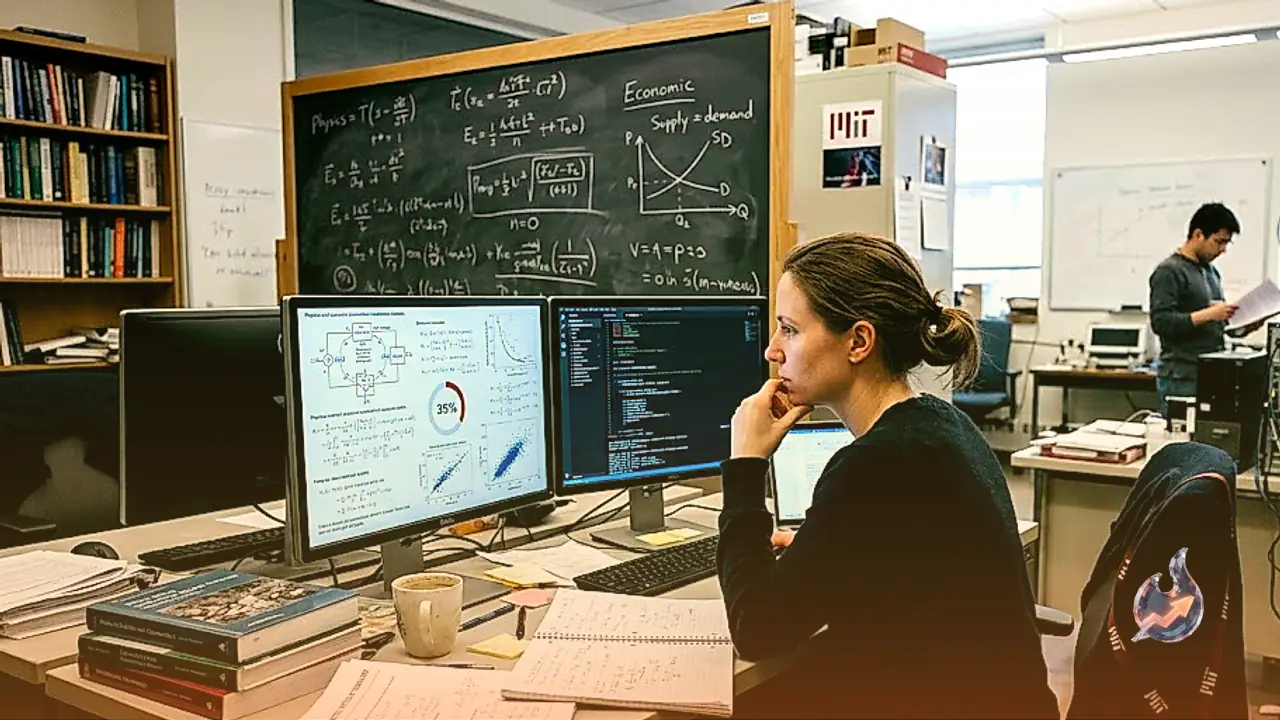

Artificial intelligence is expanding its reach well past mathematical puzzles, moving aggressively into the deep theoretical domains of physics, cosmology, and economic modeling. Neil Thompson, who investigates computing developments and artificial intelligence at the Massachusetts Institute of Technology (MIT), presented findings from a comprehensive research project demonstrating that advanced frontier models are rapidly transforming foundational sciences that previously demanded exceptional human intellect.
Rapid Leap in Problem-Solving Precision
The study documents a remarkable shift in capability over a two-year window. Between the middle of 2024 and the middle of 2026, the performance of leading AI models on complex theoretical scientific problems climbed from resolving a mere 2 percent of questions correctly to roughly 35 percent. Researchers involved in the project emphasize that this steep trajectory shows no indications of leveling off. Thompson noted that across the coming years, theoretical inquiry across numerous fields will likely undergo a complete restructuring due to automated reasoning systems.
Conducted within Thompson's research laboratory, which tracks how computer science breakthroughs influence innovation and society, the project was co-authored by PhD student Gabriel Manso and research scientist Claudio Mayrink Verdun. The trio gathered challenging theoretical questions from scientific papers uploaded online between December 2025 and May 2026. They subsequently evaluated the reasoning capacities of diverse OpenAI systems, including o1, o3, GPT-5, GPT-5.1, GPT-5.4, and GPT-5.5.
Rigorous Testing Without Memorization
A vital component of the experimental design involved the publication dates of the benchmark papers. Every problem was selected from research made public strictly after the training cutoff dates for GPT-5.5 and its companion models. Consequently, the machines could not depend on cached knowledge or pre-digested answers. The models were forced to deduce logical deductions entirely independently, using the newly published findings as ground-truth baselines. Furthermore, the researchers severed all internet connectivity during testing, ensuring that the systems could not scan academic repositories for outside help.
The investigation intentionally concentrated on theory-heavy disciplines that do not require physical lab experiments or computationally intensive simulations. The subjects tested included quantum physics, gravitation and cosmology, high-energy theory, economic theory, probability, and theoretical statistics. Despite the focused scope, the results illustrate that the disruptive forces currently unsettling professional mathematics will soon sweep through other theoretical branches of science.
The Math Precedent and Emerging Resistance
The current anxiety across scientific faculties mirrors earlier shocks within pure mathematics. In September, OpenAI sent shockwaves through academia by claiming that an unreleased internal model solved the Navier-Stokes challenge, a renowned mathematical open problem describing how fluids flow. That announcement sparked immediate conflict when a New York University (NYU) mathematician, collaborating with a scholar tied to Anthropic, asserted that OpenAI had gazumped their ongoing project after discovering their progress.
Following that dispute, OpenAI and rival organizations unveiled hundreds of additional solutions to long-standing mathematical problems. This deluge provoked an intellectual crisis. Many mathematicians began campaigning for formal boundaries on automated tooling, emphasizing that the journey of rigorous derivation provides educational and conceptual understanding that cannot be replaced by merely producing a final answer.
The Imperative for Human Rigor and Verification
Even as algorithms accelerate discovery, theoretical breakthroughs continue to serve as the foundation for practical applied science. Prominent researchers have recently established specialized laboratories dedicated exclusively to scientific AI, while major corporate labs are pouring immense capital into automated research programs. These teams are examining ways to empower autonomous agents to carry out physical experimentation alongside mathematical deduction.
However, researchers stress that replacing human labor in calculation does not eliminate the need for experienced scientists. Gabriel Manso highlighted that human intuition remains indispensable for connecting disparate concepts and producing fundamentally creative questions. Furthermore, cutting-edge models still produce subtle errors on hyper-complex problems. OpenAI itself had to retract multiple mathematical proofs from its recent dataset following post-publication analysis. As Manso observed, a model can present an incorrect deduction with absolute confidence, making human oversight and independent proof-checking essential for the scientific process.