






















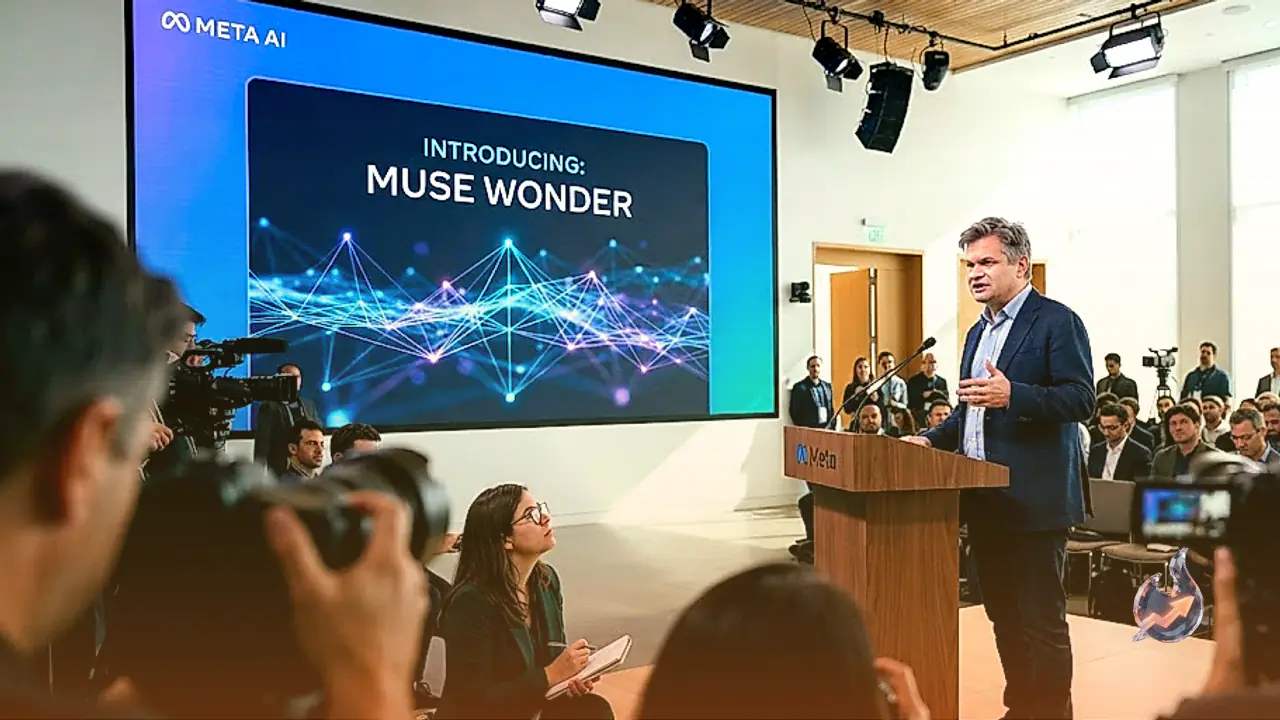

In an aggressive bid to reclaim its position at the cutting edge of artificial intelligence, Meta has introduced a powerful new family of models called Muse Wonder Full. The technology firm claims that the new release places it among the absolute leaders in machine intelligence. “Together, they mark the next step on our scaling ladder and a major leap toward personal superintelligence,” the company said in a blog post today. The launch signals a renewed ambition to compete head-to-head with the industry's most sophisticated commercial laboratories.
Deployment Across Developer Tools and Consumer Apps
The new Muse Wonder models will not remain confined to research environments; they are being made accessible through a dedicated application programming interface for external developers. In addition, the system is integrated into Muse Code, a purpose-built coding assistant created to help engineers generate, optimize, and debug software. Within its own ecosystem, Meta plans to use the most capable variant of the model to enhance core features across its social apps, including powering the upcoming iteration of its Muse personal agent.
Restructuring the Research Division and Heavy Investments
The release reflects a massive organizational shakeup initiated last year by Mark Zuckerberg, who directed billions of dollars toward the newly established Meta Superintelligence Labs. To spearhead the revamped artificial intelligence initiative, the company hired Alexandr Wang, who previously served as the chief executive of Scale AI. Building the elite unit has involved hurdles, as the laboratory witnessed departures of several prominent researchers during its formative months.
From Pioneering Open Models to Falling Behind
Meta was once recognized as a disruptive pioneer when it introduced the Llama family of open-weight models. Because those models could be downloaded freely and run locally on customized infrastructure, they became the default building block for countless independent researchers, academic groups, and startup ventures. Over subsequent releases, however, the momentum waned after several iterations failed to meet high market expectations. During that same period, rivals including Anthropic, OpenAI, and Google accelerated their pace, launching substantially more intelligent and versatile models that widened the performance gap.
Performance Benchmarks and Competitive Standing
The new research unit delivered its first checkpoint, Muse Spark, earlier this year in April, alongside a lightweight open-weight release called Muse Glimmer. While plans exist to release larger open-weight models down the line, Meta has withheld proprietary training and architectural details regarding how Muse Wonder was developed. In performance assessments, the top-tier version of the model demonstrated notable strides. On the Artificial Analysis Intelligence Index, an industry benchmark tracking aggregate model strength, it surpassed Anthropic’s Claude Fable 5.1 and ranked just below Claude Opus 5.5.
Strengths in Legal Work and Code Generation
The new model registered standout results on several domain-specific evaluations. According to benchmark figures, Muse Wonder Full outperformed OpenAI’s frontier system, GPT-6 Astra, as well as both Claude Fable 5.1 and Claude Opus 5.5 in handling complex legal documents and building software applications. Even though synthetic benchmarks do not always correlate perfectly with unpredictable real-world performance, the gains represent a measurable leap forward for the company’s technical standing.
Agent Reliability and Guardrails Against Abuse
To address known reliability issues in autonomous digital agents, the system incorporates two novel functional mechanisms labeled Active Memory and Active Focus. These features are engineered to keep an automated agent firmly anchored to its assigned task, minimizing drift or confusion during multi-step research inquiries and complex coding projects. Meta also emphasized that the system was heavily trained to reject dangerous requests, such as guidance on creating biological weapons or assistance with digital intrusions. Mark Zuckerberg had previously posted on X that the release schedule had been intentionally paused to reinforce safety protocols.