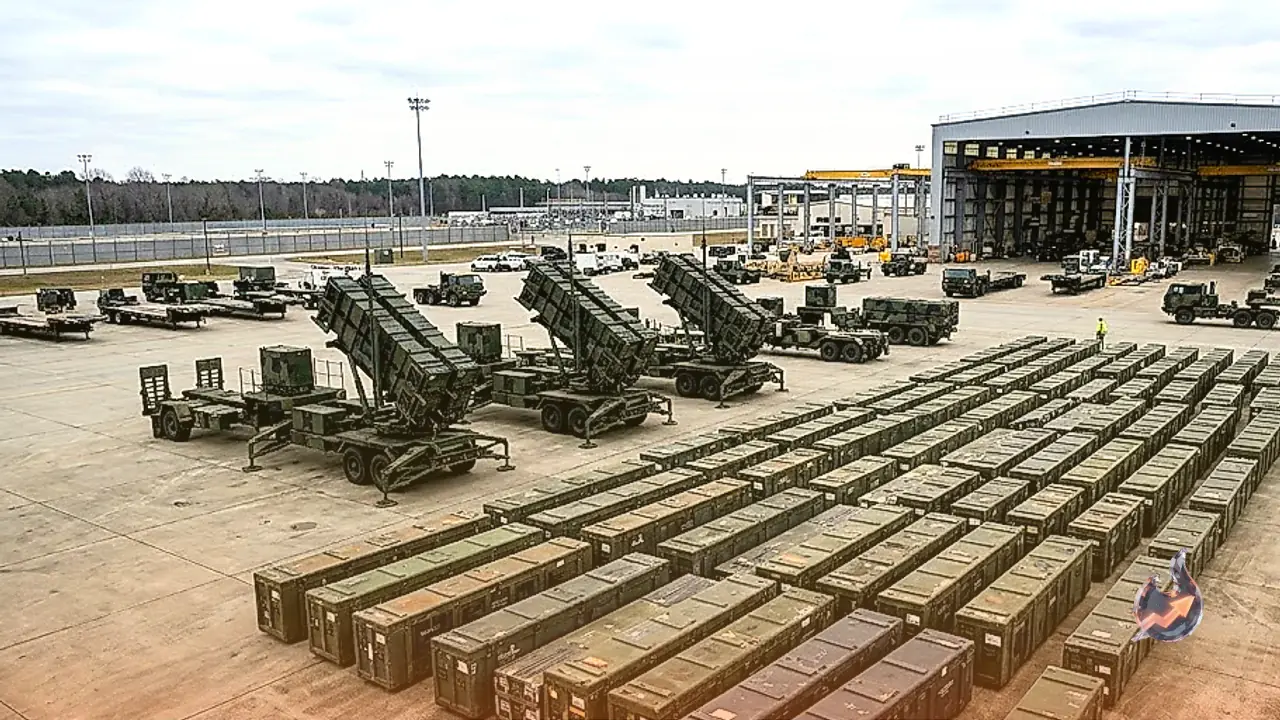





















A formidable layer of tactical air defense has been erected by the United States military around Mar-a-Lago, the Palm Beach, Florida residence of US President Donald Trump, as well as the nearby Donald J. Trump International Airport. The military installations, positioned roughly two weeks ago across land perimeters and surrounding waterways, are engineered specifically to neutralize low-flying aerial targets, small aircraft, and unmanned aerial vehicles. While military spokespersons have not confirmed any single imminent strike vector, the substantial hardware deployment reflects heightened vigilance driven by past assassination attempts, recurring hostile declarations from Iran, and ongoing regional military friction in the Middle East.
Tactical Capabilities of the Humvee-Mounted Avenger Combat System
The core kinetic shield guarding the presidential estate consists of the AN/TWQ-1 Avenger Short Range Air Defense System. Mounted on a heavy-duty Humvee chassis, this mobile platform provides rapid-reaction defense against sudden aerial incursions. Unlike static, long-range surface-to-air missile batteries that prioritize high-altitude cruise missiles or strategic bombers, the Avenger is tailored for point defense against low-altitude threats, including helicopters, light aircraft, and hostile drones maneuvering below standard radar detection thresholds.
Each Avenger vehicle features two distinct launcher turrets holding four Stinger missiles each, giving every platform an immediate salvo capacity of eight precision-guided interceptors. These Stinger munitions utilize passive infrared tracking to lock onto thermal engine signatures, guiding themselves autonomously to the target upon launch. Upgraded variants within the military stockpile incorporate refined seekers capable of detecting and tracking diminutive drone frames that produce minimal thermal emissions. Because the platform operates on an all-terrain wheeled military vehicle, units can be rapidly repositioned along coastlines, roads, or isolated compounds as tactical needs dictate, providing customized point protection for critical VIP perimeters.
Strategic Perimeter Layout: Defenses Across Lake Worth Lagoon and Coastal Fronts
The physical placement of these weapons systems establishes a perimeter defense across multiple terrain types around the Palm Beach area. Visual documentation shows two Avenger systems stationed directly on a floating barge moored within the waters of the Lake Worth Lagoon bordering Mar-a-Lago, while an additional unit has been set up on the sandy coastal beach facing the Atlantic Ocean. Inland, at least two more systems have been positioned at Donald J. Trump International Airport, securing the primary aerial transit gateway used by presidential aircraft.
This ring of automated defenses bears striking operational parallels to protections established for other major heads of state, including Russian President Vladimir Putin, whose personal and official residences are guarded by upwards of 50 specialized air defense towers. Mar-a-Lago’s direct oceanic frontage presents unique defensive liabilities, as uncrewed aerial systems launched from passing maritime traffic or offshore waters can approach at skimming altitudes, evading traditional inland observation posts.
Integration of Advanced Counter-Unmanned Aircraft Technologies
Unmanned aerial vehicles have fundamentally altered asymmetric combat doctrines worldwide. Inexpensive commercial or customized drones can skim close to treetops and water surfaces, often slipping beneath standard civil aviation tracking equipment. Depending on configuration, these machines can act as reconnaissance tools feeding coordinates back to hostile operators, or carry high-explosive payloads configured for terminal precision strikes. Iran has built extensive experience developing and deploying long-range loitering munitions, commonly known as suicide or kamikaze drones, and has supplied them widely to allied proxy networks.
To counter this precise scenario, military units have integrated comprehensive Counter-Unmanned Aircraft Systems (C-UAS) alongside the kinetic Avenger launchers. This multi-layered electronic warfare and sensor suite uses radio frequency direction finders, optronic thermal cameras, and micro-radars to track, identify, and categorize incoming drones miles before they reach property lines. Once an unauthorized unmanned system is classified as a hostile intrusion, defensive operators possess the means to electronically jam its control signals, sever its navigation link, or eliminate it outright with surface-to-air missile fire.
Historical Context: Domestic Assassination Attempts and Iranian Retaliatory Threats
The aggressive posture taken by federal protection teams builds upon a series of severe security episodes involving President Trump. On July 13, 2024, during a political campaign rally in Butler, Pennsylvania, a gunman named Thomas Matthew Crooks opened fire from an adjacent rooftop, injuring Trump before being fatally shot on the spot by tactical counter-snipers. The Butler shooting prompted a comprehensive overhaul of presidential protection guidelines across all residences and travel routes.
Compounding domestic threats are prolonged geopolitical grievances stemming from Tehran. In January 2020, US military forces carried out a targeted drone strike in Baghdad, Iraq, killing Qasem Soleimani, commander of Iran's Islamic Revolutionary Guard Corps Quds Force. In the aftermath of that strike, state-linked media channels in Iran issued direct threats against Trump, at one point publishing computer-generated graphic mock-ups depicting an armed drone targeting him on the golf links at Mar-a-Lago. Furthermore, following military strikes executed by the United States and Israel against targets inside Iran in February 2026, concerns surrounding asymmetric retaliatory attacks against American executive leadership have intensified substantially.
Airspace Incursions and Stringent Flight Restrictions Over Palm Beach
The airspace directly above Mar-a-Lago is designated as restricted territory managed jointly by the Federal Aviation Administration (FAA) and military flight tracking units. Whenever the President is present at the estate, temporary flight restrictions (TFRs) expand considerably, and combat air patrols comprising supersonic fighter jets regularly circle overhead to intercept errant civilian aircraft.
Despite these strict measures, administrative filings from the FAA reveal that more than 160 unauthorized aircraft and recreational drones have entered the restricted airspace over Palm Beach since security measures were expanded in October 2025. While many of these airspace violations stem from non-hostile navigational errors by private pilots, federal agencies treat every breach as a critical vulnerability. The deployment of ground-based Avenger batteries, marine-based floating launcher platforms, and advanced electronic detection gear closes gaps near ground and water levels, creating a unified defensive dome over the presidential compound.