
















Minutes before the Chinese leader stepped onto American soil, an unusual scene unfolded along the runway at a major military airfield near Washington DC. As ground crews rushed to conclude ceremonial preparations, uniformed members of the American armed forces were observed bending down on their hands and knees along the tarmac, meticulously smoothing out folds and sweeping away specks of dust from the runner. The intent behind this extraordinary effort was to guarantee an impeccable path as the foreign dignitary disembarked. Soon after, the American president and the first lady broke customary protocol by walking out directly to the edge of the aircraft stairs to welcome the visiting delegation in person.
Tarmac Video Captures Last-Minute Carpet Prep
Pre-arrival protocols at Joint Base Andrews had reached their final stages when cameras caught an unexpected working posture from the service members on duty. In a 12-second video clip that rapidly circulated across digital networks, soldiers in full dress uniform were positioned on the floor, using their bare hands to flatten creases and wipe dust from the 30-meter expanse of red textile. Because personnel from one of the most powerful militaries in the world are rarely seen performing manual floor adjustments for visiting dignitaries, the clip prompted widespread intrigue and commentary across global social media channels.
Shared widely on the social network X via an uploaded clip, the brief recording highlighted the intense scrutiny and perfectionism surrounding the diplomatic choreography on the tarmac.
Rupturing Protocol for an Elaborate Runway Greeting
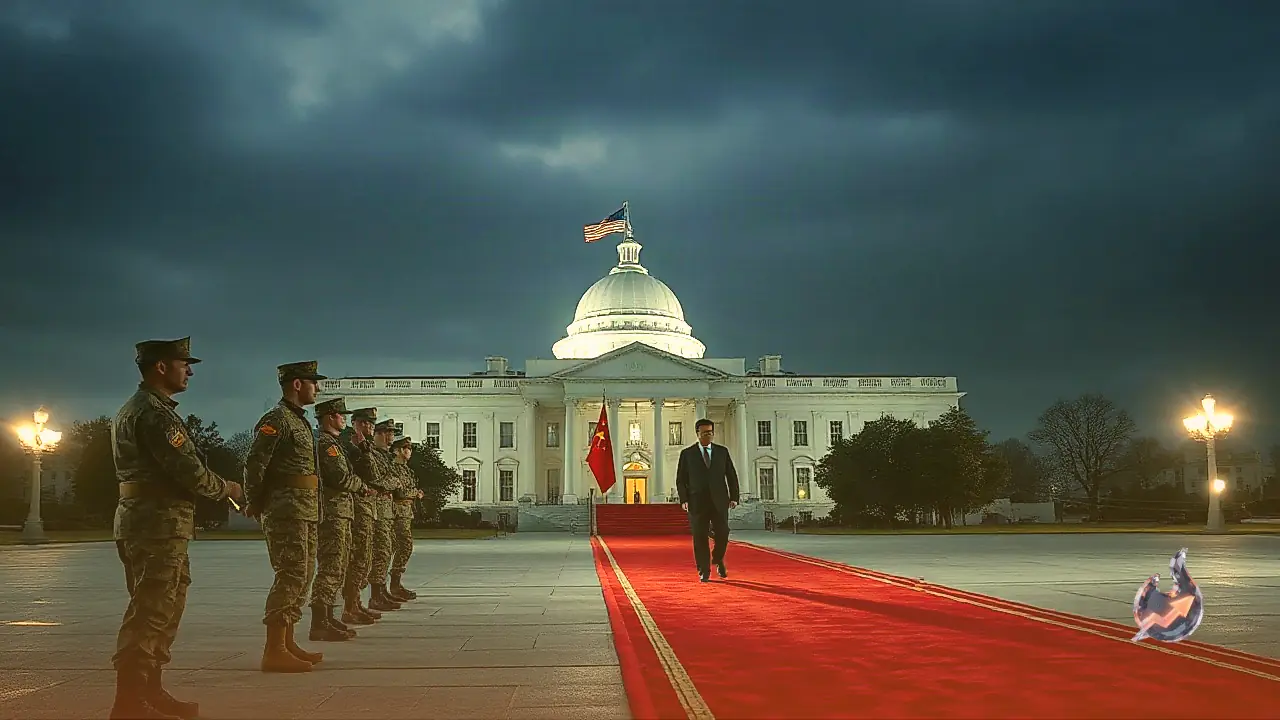
The ceremonial reception prepared for Chinese President Xi Jinping and his wife Peng Liyuan was markedly grander than conventional state arrivals. US President Donald Trump and First Lady Melania Trump traveled directly to Joint Base Andrews to stand alongside the runway as the aircraft halted. Extending outward from the base of the plane stairs was a pristine 30-meter red carpet, bordered on both flanks by an honor guard of 21 US military service personnel standing in rigid formation. Trump and Melania exchanged warm handshakes with Xi and Peng beside the steps, signaling an effort by both competing powers to project goodwill despite a backdrop of deep strategic friction.
First American Tour Since the 2025 Tariff Conflict
This state visit marks a milestone in bilateral diplomacy, serving as the Chinese president's first journey to the United States following the disruptive trade war of 2025. During that economic clash, Washington and Beijing levied sweeping tariffs against each other's industrial exports, unsettling international supply chains and dragging diplomatic relations down to historic lows.
The centerpiece of the current itinerary is an indispensable bilateral summit inside the White House Oval Office. The two heads of state are scheduled to confront core friction points, ranging from cross-border commercial arrangements and technological restrictions to lingering diplomatic disputes. Following the high-stakes policy discussions, the White House will host an elaborate state banquet honoring the Chinese delegation. Xi is scheduled to conclude his two-day diplomatic trip on Friday, September 25.
Escalating Middle East Warfare and the Energy Shock
These bilateral discussions are taking place during a severe international emergency stemming from armed conflict across the Middle East. The fighting ignited on February 28 when a combined military offensive by the United States and Israel struck targets inside Iran. That operation resulted in the death of Iranian Supreme Leader Ali Khamenei, triggering an immediate wave of regional devastation.
Tehran retaliated by launching strikes against US military installations across the Gulf along with regional petroleum infrastructure and energy processing facilities. Concurrently, Iranian forces imposed a naval blockade across the Strait of Hormuz, the world's most critical maritime transit choke point for petroleum. The shutdown severed a major fraction of global crude oil shipments, sending international energy prices surging and pushing numerous import-dependent economies into deep instability.
World Economy Watches for Bilateral Compromise
Against this backdrop of spiraling hostilities and commercial disruption, the Oval Office dialogue carries immense consequences. China relies heavily on Middle Eastern crude oil to fuel its domestic industrial engine, leaving its factories directly vulnerable to the shipping freeze through the Strait of Hormuz. Simultaneously, the United States faces severe economic and security fallout from the escalating crisis and the disruption of commercial sea lanes.
With both global leaders seated across from each other, finding an off-ramp for the Middle Eastern war and resolving bottlenecks in world commerce will dominate the agenda. Observers across international markets are watching closely to see if Trump and Xi can forge a collaborative strategy or negotiate an interim compromise to defuse the conflict. The forthcoming hours will determine whether this summit can steer the international community away from a deeper catastrophe.