



















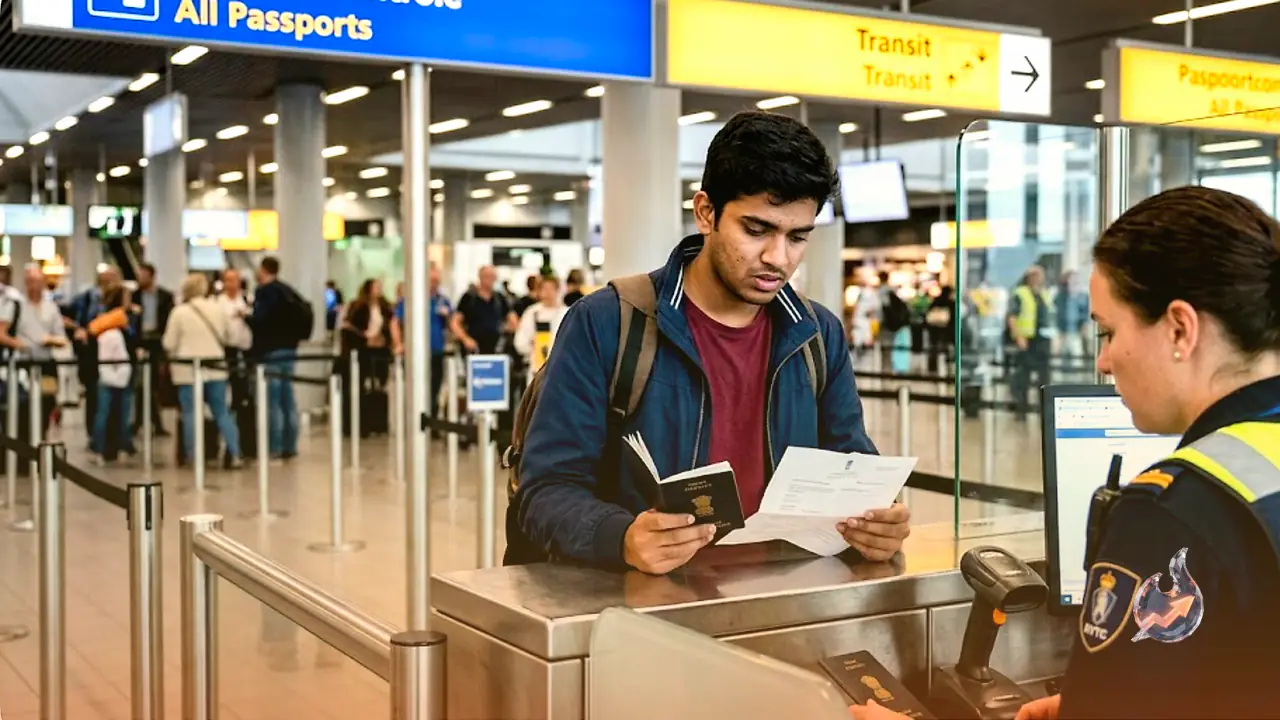

Returning to the United States turned into a nightmare for an Indian student when he was stopped from continuing his journey at the Amsterdam airport in the Netherlands. It was here that the Hyderabad student first received the shock of his life: his F-1 student visa had already been cancelled the previous year. What stunned him the most was that he had never been given any information or official notice about this decision.
The student said he had travelled to the U.S. in January 2025 on an F-1 student visa and was pursuing his studies there. During a holiday break he came to India, and then set off from Hyderabad, via Amsterdam, towards New York's John F. Kennedy (JFK) airport. But just before boarding the U.S.-bound flight in Amsterdam, officials from U.S. Customs and Border Protection (CBP) approached him and told him plainly that his visa was no longer valid, and that he could not be allowed to enter the United States.
Asked to Approach the Consulate
The officials advised the student to contact the nearest U.S. consulate for the next steps. He was also told to return to India immediately. According to the student, the news left him reeling, because he had not broken any rule or law during his time in the U.S. He said there was no drink-and-drive case against him, no traffic violation, and no legal action of any kind. Even so, his F-1 visa was cancelled in July 2025, and he was not informed at all.
University Said the Documents Were Fine
After the incident, the student got in touch with his university. The university told him that his Form I-20 and his Student and Exchange Visitor Information System (SEVIS) record were both fully active, and that his student status was in line with the rules. In other words, there was no problem at all with the official paperwork connected to his studies.
The Difference Between an F-1 Visa, I-20 and SEVIS
Experts point out that many people do not understand the difference between an F-1 visa, an I-20 and a SEVIS record. Form I-20 is the document that an accredited U.S. educational institution issues to an international student, and it is on the basis of this form that the student applies for an F-1 visa.
SEVIS, on the other hand, is an electronic record system run by the U.S. government that holds all the information about international students' studies and their status. As long as a student is in the U.S., their university keeps updating this record from time to time.
The key point is that even with an active SEVIS record and I-20, a student's F-1 visa can be revoked separately. This is because the visa is required to enter the U.S., while the SEVIS record and I-20 only show that the student's status within the country is valid.
What Students Should Do in Such a Situation
In such a situation, students should first find out exactly why their visa was cancelled. After that, they will need to apply for a fresh F-1 visa. During the visa interview, officials may ask questions about the earlier revocation. The advice is that students should not try to hide this fact, but should instead share accurate information with complete honesty.