




















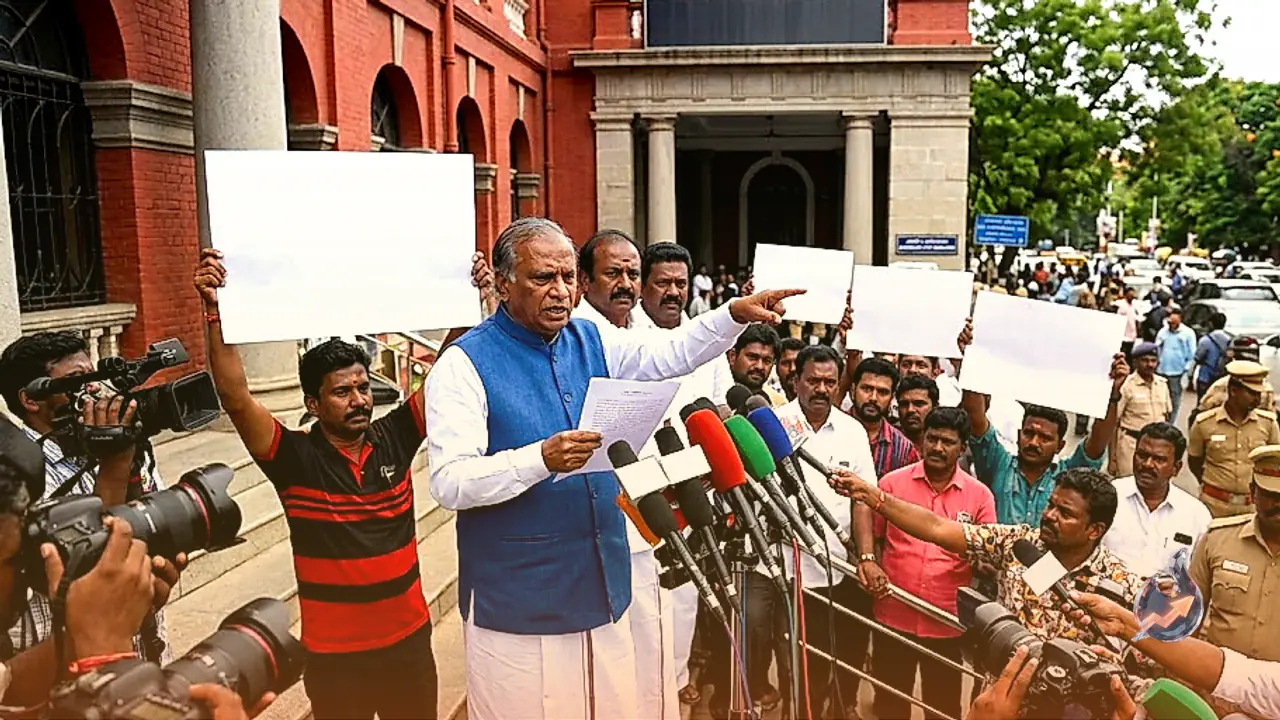

Political friction has dramatically intensified across Tamil Nadu following the federal government's proposal for a nationwide parliamentary delimitation bill. In a bid to assess the potential administrative and political impacts of this realignment on the state, Tamil Nadu Chief Minister C. Joseph Vijay convened a crucial consultation meeting with all members of parliament representing the state. The high-level convention was scheduled to take place at 3 PM on Saturday at the Kalaivanar Arangam auditorium in Chennai. However, shortly before the proceedings were set to commence, the ruling Dravida Munnetra Kazhagam decided to boycott the session entirely, delivering a significant setback to the state government's outreach efforts.
Official Invitations and DMK's Boycott Stance
According to official administrative records, Tamil Nadu Chief Secretary M. Sai Kumar dispatched individual invitations to the state's MPs on August 6 and August 7. The primary objective of the invitation was to formulate a unified legislative strategy regarding the proposed redistribution of parliamentary seats. Despite the formal outreach, the DMK leadership explicitly confirmed that none of its parliamentary members would attend the discussion convened under the leadership of Chief Minister C. Joseph Vijay.
The DMK has tied its participation to a strict precondition. The party publicly stated that it will refrain from engaging in any government-led deliberations on delimitation until the state administration convenes a comprehensive all-party meeting regarding the contentious Mekedatu dam project. The DMK maintains that the water rights issue concerning the Cauvery River directly impacts the livelihoods of farmers across the state, demanding immediate and exclusive executive attention ahead of federal electoral restructuring.
Procedural Objections and Party Hierarchy Concerns
Elaborating on the rationale behind the boycott, a DMK MP raised fundamental procedural objections during an interaction with the news agency PTI. The parliamentarian argued that the state government's decision to directly invite individual MPs bypassed established political protocols. According to the party, the administration should have formally engaged the top leadership of the respective political parties first rather than sending direct notices to individual lawmakers.
The MP emphasized that within a constitutional democracy, parliamentarians operate strictly under the policy directives of their respective party leaderships. Consequently, attending a consultation arranged without prior party-level consensus was deemed redundant. The lawmaker further asserted that the DMK remains unyielding in protecting Tamil Nadu's state rights, noting that DMK chief M.K. Stalin was among the first political leaders to voice strong opposition against the potential hazards of the proposed delimitation framework.
Delimitation Concerns Versus the Mekedatu Water Dispute
Delimitation remains a deeply sensitive political issue across southern India, particularly in Tamil Nadu. Political parties in the region harbor serious apprehensions that redistributing Lok Sabha seats solely based on population metrics could disproportionately penalize states that successfully executed national family planning and population control policies. Chief Minister Vijay's initiative to gather all state parliamentarians on a single platform was intended to present a consolidated front against any reduction in the state's federal legislative voice.
However, the escalating dispute over the Mekedatu balancing reservoir project in neighboring Karnataka has overshadowed the delimitation discourse. The proposed construction across the Cauvery River has raised severe concerns regarding Tamil Nadu's downstream water security. The DMK asserts that state rights concerning water allocation and electoral representation cannot be decoupled or negotiated selectively, demanding that the executive prioritize an all-party consensus on water security before addressing federal seat allocation.
Congress Criticism and Shifting Coalition Dynamics
The DMK's refusal to attend the session drew sharp criticism from senior Congress MP Manickam Tagore. Rebuking the boycott, Tagore remarked that political entities prioritizing party interests over the collective welfare of Tamil Nadu might choose to abstain from such critical state-level consultations. He contended that leaders who place the state's future above party lines ought to actively participate in the joint meeting convened by the Chief Minister.
Tagore emphasized that the delimitation exercise concerns the broader constitutional rights and federal standing of Tamil Nadu, transcending routine electoral rivalry. He added that the electorate is closely monitoring these developments and will remember which political parties stood firm during pivotal state consultations. Notably, the Congress party functions as a key coalition partner of the ruling Tamilaga Vettri Kazhagam led by Chief Minister C. Joseph Vijay in Tamil Nadu, giving Tagore's remarks added political significance.
Assembly Debates on Mekedatu and Future Outlook
The broader political stalemate also resonated within the state legislative assembly. On Friday, Leader of the Opposition Udhayanidhi Stalin raised the Mekedatu project on the floor of the house, prompting Chief Minister Vijay to clarify his government's position. The Chief Minister informed the assembly that he had personally proposed direct discussions with the Karnataka state government regarding the Cauvery dispute, optimistic that diplomatic dialogue could yield a constructive solution.
Chief Minister Vijay reiterated in the assembly that his administration rejects petty political maneuvering on issues affecting state sovereignty. Following his statements, political analysts view the DMK's absence from the delimitation conference as a sign of growing friction among key regional players. As Chief Minister Vijay attempts to present a united front to safeguard Tamil Nadu's parliamentary weight, the political divide over the Mekedatu project highlights the complex regional dynamics shaping the state's governance landscape.