























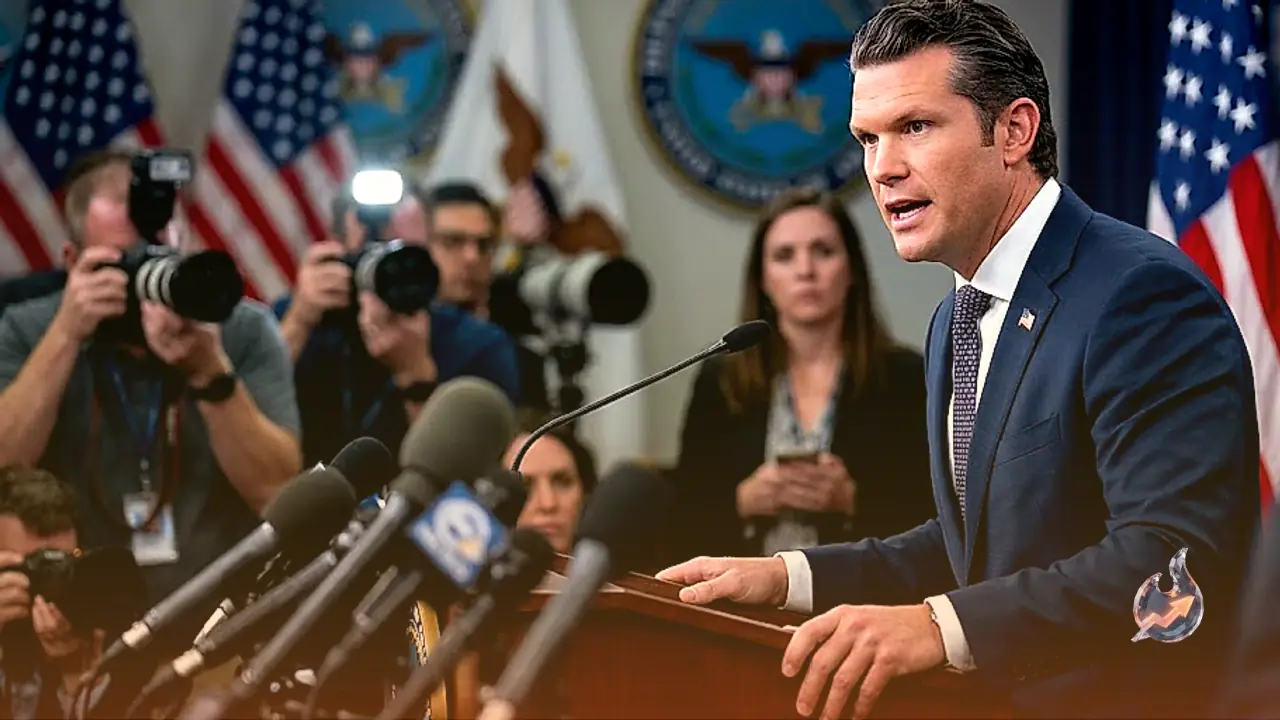

The Pentagon's newest fitness initiative has nothing to do with pushups. Defense Secretary Pete Hegseth wants troops screened for testosterone every year, and if the numbers come up short, he wants them offered hormone replacement therapy, a proposal that endocrinologists say collapses a genuinely complicated medical question into a marketing pitch.
A Warrior Ethos, Now With Blood Tests
Hegseth has spent much of his tenure arguing that the US Armed Forces watered down combat standards to accommodate women, and he has posed for photo ops lifting weights alongside service members. His speeches lean heavily on the phrase "warrior ethos" and refer to troops as "warfighters" tasked with restoring some lost martial toughness. The testosterone program fits neatly into that narrative, a screening regime meant to certify that the force is as physically dominant as possible.
What Hegseth Actually Announced
In a short video posted to his official X account on Wednesday, Hegseth said that "under the supervision of our world-class medical professionals, warfighters aged 30 and older are going to be tested annually as part of their periodic health assessment." Troops younger than 30 will be allowed to opt into the same testing, he added. Anyone flagged with low levels won't be forced into treatment, Hegseth said: "If treatment is recommended, it's entirely your choice to receive testosterone replacement therapy." He told service members directly, without citing any evidence, that the program would boost "your performance, your resilience, and your long-term health," describing it as an effort "not about artificial enhancement" but about "restoring and optimizing your natural capabilities, protecting your longevity, and ensuring you have the biological foundation required to sustain the fight."
Doctors Call the Science Shaky
Adrian Dobs, who researches endocrine gonadal function at Johns Hopkins University, says she was "quite surprised that this is what they're thinking about," adding that diagnosing male hypogonadism, the clinical term for testicles not producing enough testosterone, "is a very complicated issue." According to Dobs, Hegseth is radically oversimplifying a diagnostic process that depends on the type of assay used and even the time of day a sample is drawn. Because of circadian rhythms, testosterone tends to run higher in the morning and lower as the day goes on, she explains. There's also the problem of context: testing "a healthy person who sits at a desk" is nothing like testing someone returning "from basic training or overseas" who may have lost weight and endured heavy physical stress, since chronic stress itself can suppress testosterone production.
Not a Smarts Pill or a Fountain of Youth
Dobs calls Hegseth's underlying view of testosterone "misinformed." The hormone matters enormously for puberty and masculinization, she says, "but it is not something that's going to make you smarter. It's not something that's going to make you live longer, we simply don't have any data to suggest that." Proving any longevity benefit, she adds, would be extraordinarily difficult under any circumstances.
The Pentagon Isn't Saying Much
Beyond Hegseth's own description of the screening and treatment process, the Pentagon declined to comment, leaving open exactly what outcome the Defense Department expects from dosing an unknown number of active-duty troops with testosterone, and whether women in the Armed Forces will be subject to the same hormone assessments. The department also hasn't disclosed what research, if any, or which medical experts shaped the policy.
Treat the Cause, Not Just the Number
Dobs points out that beyond the challenge of even defining a "normal" testosterone level or standardizing how the tests are run, treating deficiency with replacement therapy as a quick fix skips over standard medical practice, which calls for identifying and treating any underlying condition first. Causes ranging from kidney disease to liver disease to diabetes need to be addressed "before you launch into any hormonal intervention," she says.
The Risks the "High T" Craze Ignores
The recent surge in demand for "high T" treatments tends to bury the hormone's real risks, Dobs says. "If a man is taking testosterone, his own testes are going to essentially shut off. They run the risk of having what they call atrophy of the testes, so that the testicles can get smaller." A second common effect is a drop in sperm count, which Dobs says should worry service members in their twenties and thirties who are "basically at the prime of their fertility," since lowered counts don't automatically recover once someone stops taking testosterone. The hormone can also thicken blood, forcing the heart to work harder.
A Movement Built Around a Wonder Drug
None of this appears to have registered with the MAHA movement or the Manosphere influencers who treat testosterone as a wonder drug any man can simply take. Podcast host Joe Rogan is open about his own testosterone replacement regimen and recommends it to every man over 40. Health Secretary Robert F. Kennedy Jr. is another booster of the treatment, and he's currently pushing the Food and Drug Administration to strip warning labels from TRT products, including language about potential cardiovascular risks.
"Not a Simple, Benign Thing"
"This is not a simple, benign thing," Dobs says of Hegseth's plan. "You just can't do that without really knowing what's fully going on with a patient." She notes that while Kennedy and Rogan credit TRT with transforming their lives, "when you look at the studies, it's not so clear really what it does." Testosterone treatment can genuinely help in specific cases, she says, such as clinically low levels caused by a genetic abnormality, trauma, infection, or a pituitary tumor, but that's a far cry from a prescription that fits every man in uniform.
Part of a Bigger Pattern
The testosterone push fits a broader campaign to remake the Armed Forces around a particular masculinist, anti-diversity vision. Under Hegseth, the Pentagon has moved to purge transgender service members and bar trans people from enlisting, imposed "male standard" fitness tests, and blocked scheduled promotions for women and people of color. Senior female officers and officers of color have been removed from their posts with no explanation given, in some cases over perceived ties to what Hegseth has dismissed as "DEI woke shit."
Even Shaving Rules Are Tightening
Most recently, the Navy announced it will stop granting permanent shaving medical waivers to sailors with shaving-related health conditions, offering instead a year of treatment aimed at getting them to meet a clean-shaven standard; those who still can't will be removed from service. Hegseth had already imposed a blanket ban on shaving waivers for nearly all troops the previous year. The most common reason for such waivers is pseudofolliculitis barbae, a painful inflammation triggered by shaving that affects about 45 percent of Black service members compared with just 3 percent of white service members.
A Clear Message, an Unclear Goal
While the discriminatory intent behind several of these measures is hard to miss, the actual purpose of the testosterone directive remains murky. Dobs says neither Hegseth nor the Defense Department has offered any concrete "measure of success" to back up the claim that testosterone functions as a natural performance enhancer. "What is the function that people are looking at that Hegseth wants?" she asks. "Is he looking for somebody who's going to be stronger on the field? Is he looking for someone who's going to be smarter when they fly in an airplane? That's a tough one to study." As with so many policies out of the Trump administration, it may ultimately come down to the vibes.