






















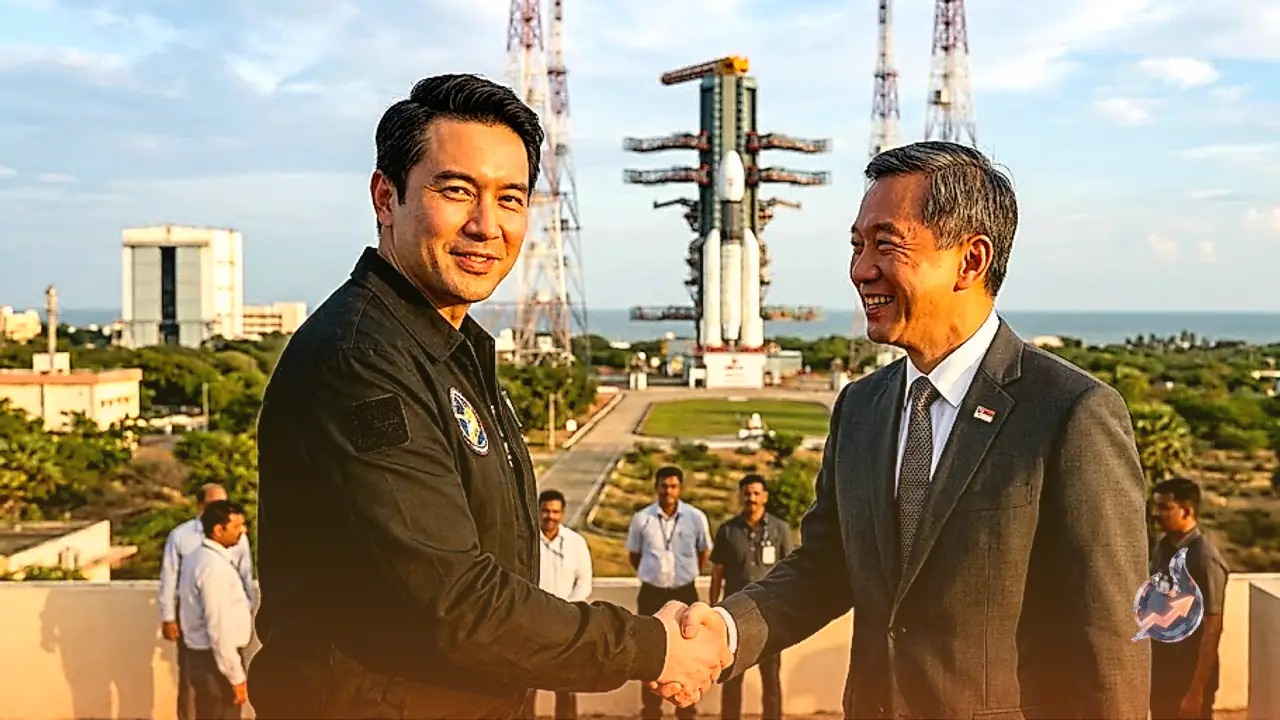

Two days before Skyroot Aerospace attempts India's first privately built orbital rocket launch, Singapore's High Commission in India has publicly thrown its weight behind the mission, calling the moment a milestone for the space partnership between the two countries.
Singapore's message on X
In a post on X on Friday, the High Commission wrote, "Singapore-India ties are reaching for the stars!" The post explained that Skyroot Aerospace, which counts Singapore's sovereign wealth funds GIC and Temasek among its backers, is set to carry out India's first private orbital launch. "Backed by GIC & @Temasek, @SkyrootA is set to make India's first private orbital launch," the High Commission said, adding that it was praying for #Vikram1's success. The message tagged the Indian Space Research Organisation, IN-SPACe, Union Minister Jitendra Singh and Skyroot's founders, and carried the hashtags #MissionAagaman and #SpaceTech. The post was signed off by HC Wong.
What Mission Aagaman involves
The goodwill message comes just ahead of the scheduled launch of Vikram-1, India's first privately developed orbital-class rocket, built by Hyderabad-based Skyroot Aerospace. The rocket's maiden test flight, named "Mission Aagaman," is scheduled to lift off from the Satish Dhawan Space Centre in Sriharikota on July 18 at 11:30 AM. Standing 24 metres tall, Vikram-1 will mark the first time an Indian private company attempts to place satellites into orbit using a launch vehicle it built itself, without relying on a government-developed rocket or launch programme. The rocket is constructed entirely with a lightweight carbon-composite structure and is powered by three solid-fuel stages along with a liquid orbital adjustment module. It is designed to carry payloads weighing up to 350 kg into a 450-km Low Earth Orbit at a 60-degree inclination. Among the payloads travelling on board is a lab-grown "Diamond Lotus," developed by Bengaluru-based Cosmos Diamonds.
IN-SPACe on the sector's rapid growth
Speaking to ANI, IN-SPACe Technical Director Rajesh Jothi said the launch reflects how quickly India's private space sector has expanded since the space sector reforms were announced in 2020. "We are seeing the growth of the private sector. We started with hardly five or six startup companies, and today we have more than 400 startups. This has happened because of the government space reforms in 2020, after which IN-SPACe was formed in 2022. The vision of our Prime Minister is now being implemented, and we are seeing the outcome of the space policy," he said. Jothi added that a successful launch could meaningfully lift India's standing in commercial launch services. "Skyroot is now going to launch its first maiden launch vehicle, which will be the first of its kind. Not only in India, but outside India as well, only one or two countries have such a small satellite launch vehicle. If this succeeds, it is going to give a boost to both the small satellite market and the small launch vehicle market," he said.
Eight years in the making for Skyroot
Skyroot Aerospace Co-founder and Chief Operating Officer Naga Bharath Daka said the company was set up around eight years ago with the specific goal of building affordable and reliable rockets from India for satellite operators across the world. "We started Skyroot around eight years ago with an aim to build affordable, reliable rockets from India to the world and provide affordable, reliable and on-demand launch access solutions for satellite operators around the world. All our effort and the team's effort are culminating today in this historic milestone," he said.